
The current educational system is undergoing rapid changes that exceed all previous development rates. The traditional role of universities as academic institutions has expanded to include their new function of preparing students for practical challenges and technological advancements and industrial shift requirements. The process of digital transformation through automation and artificial intelligence and immersive technologies has created a wider gap between theoretical academic knowledge and actual workplace capabilities.
To bridge this gap, universities around the world are focusing on building strong industry collaboration programs. The partnerships create three benefits which provide students with practical experience while industries obtain new talent and research capabilities and educational institutions maintain their market alignment. The university-industry collaboration program creates two major advantages which transform student learning and industrial innovation processes.
Industry collaboration is no longer limited to internships or guest lectures. The current state of industry collaboration extends to research partnerships and innovation labs and startup incubation centres skill development programs and immersive learning environments and AR VR training courses and digital laboratories and live projects and faculty development, and curriculum co-creation. Universities that invest in these collaborations position themselves as future-ready institutions capable of producing industry-ready graduates.
The first step of developing an effective collaboration program requires organisations to assess their current business requirements. Universities must establish ongoing partnerships with companies and organisations to determine existing skill deficiencies and emerging technological developments, and anticipated workforce requirements. Industries experience continuous transformation throughout various sectors which include artificial intelligence and virtual reality and healthcare technology and manufacturing automation and gaming and digital media and data science. The value of academic institutions increases when they adapt their educational methods to meet current academic standards.
Effective collaboration depends on curriculum alignment because it serves as a vital component for successful teamwork. Many industries state that graduates have theoretical knowledge, but they do not possess the ability to apply that knowledge in real work situations. The solution to this problem lies with universities, which need to use industry experts for their curriculum development and evaluation processes. Industry professionals can provide insights into real-time workflows, software tools, project management methods, and emerging technologies that students should learn before entering the workforce.
Engineering and technology universities now include AR VR courses, immersive simulations and real-time project-based learning as essential components of their educational programs. The new programs enable students to gain actual workplace experience by using industry-standard tools and technologies. Technology companies and universities can create certification programs and workshops, and specialised training modules that help students learn skills for better job prospects.
Another critical factor in successful collaboration is establishing dedicated industry partnership cells within universities. The departments serve as connecting paths that link academic institutions to corporate organisations. Their responsibilities may include identifying partnership opportunities, organising internships, coordinating campus recruitment, managing collaborative research projects, and facilitating innovation initiatives.
The ability to communicate effectively creates an essential requirement for sustaining partnerships that last over time. The strategic relationship between universities and their industrial partners should be treated as permanent partnerships instead of temporary sponsorships. The organisation uses several methods to maintain good relationships, which include holding regular meetings, creating progress reports and conducting joint planning sessions and feedback discussions. The companies will extend their partnerships when they observe specific achievements, which include skilled graduates, research outputs, product developments and successful educational programs.
Internships exist as the most effective method to connect educational institutions with their partner industries. The current internship programs of today need to provide more than just observation opportunities to their participants. Students need to work on significant projects which enable them to use their academic knowledge to address actual problems. Universities can establish structured internship programs through partnerships with companies which will include specific learning objectives and mentorship programs and performance assessment methods.
Live industry projects provide equivalent worth to their academic counterparts. Students who solve real business challenges learn to solve problems while developing teamwork abilities and communication skills and technical knowledge. Their professional experiences help build confidence while enabling them to function in work environments. Industry-led hackathons and innovation challenges together with collaborative competitions create environments that foster both innovative thinking and hands-on problem-solving skills.
The research collaboration between universities and industries serves as a primary method to establish shared advantages between these two sectors. Universities possess academic expertise, research infrastructure, and talented students, while industries provide practical challenges, funding opportunities, and market access. The two parties can work together to create new solutions that will advance fields such as healthcare, renewable energy, immersive technologies, robotics and smart manufacturing.
Many universities are now creating innovation and incubation centres to support entrepreneurship and startups. The centres exist to help students and researchers develop their ideas into actual products and businesses. The program benefits from industry partnerships which provide essential resources through mentorship and funding and networking opportunities, and market guidance. The university startup ecosystems promote innovation, which leads to economic development.
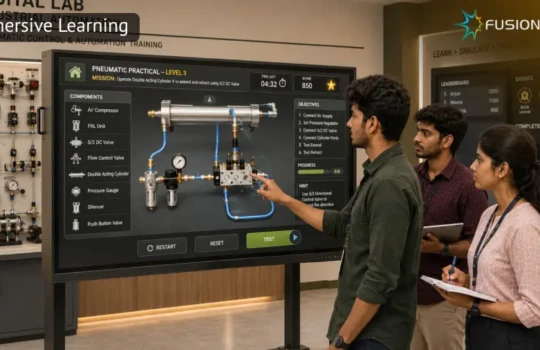
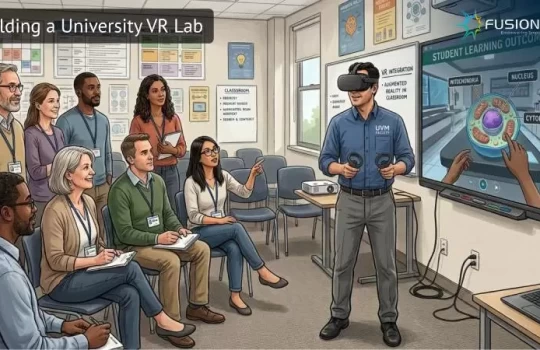
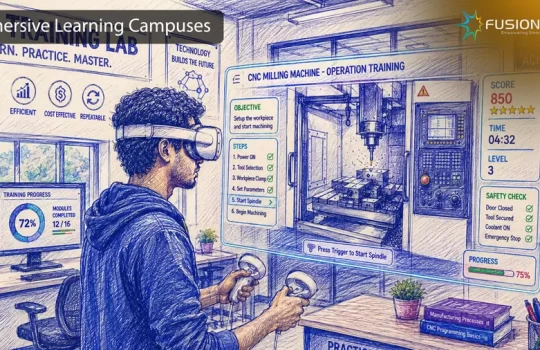
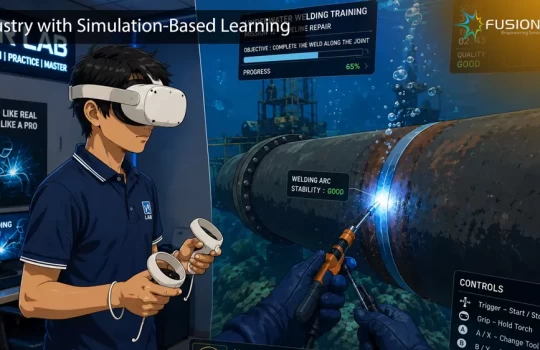
Modern collaboration programs need technology-driven learning environments because these systems help drive their operational processes. Educational institutions have rapidly adopted virtual labs together with simulation platforms and AR VR learning systems, and immersive classrooms because of digital transformation. Universities that work together with technology companies develop innovative learning spaces that provide students with hands-on educational experiences.
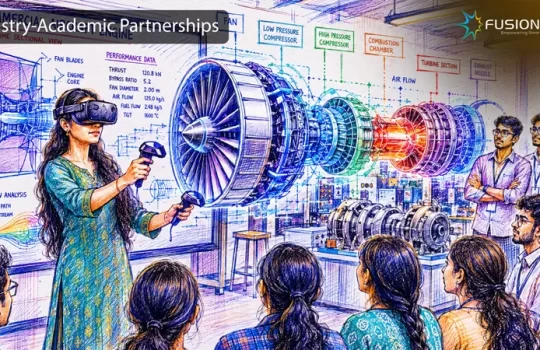
Virtual reality allows medical students to practice surgery through its simulated environments, while engineering students can use 3D models to examine machinery and architecture students can create visualisations of buildings before they are built. The use of immersive learning experiences leads to better understanding and knowledge retention and to more active student participation. The partnership between industry and educational institutions guarantees that students learn current technologies that meet industry standards.
Faculty development is an essential program element that people frequently overlook during collaborative projects. Professors and trainers must stay updated with current industry practices to effectively teach modern concepts. Universities can organise faculty training sessions through industrial visits, certification programs and collaborative workshops with industry experts. This exposure enables educators to bring practical insights into their classroom work, which enhances their teaching effectiveness.
Implementing guest lectures and expert sessions will deliver ongoing value when their implementation occurs through strategic planning. Industry professionals can share real-world experiences, emerging trends, career guidance, and case studies that enrich academic learning. The interactions enable students to learn about actual workplace requirements together with the professional environment of their respective fields. Universities should aim for continuous engagement rather than one-time events.
Successful collaborations require organisations to maintain flexible and adaptable capabilities. Industries operate in fast-changing environments where technologies and market demands evolve rapidly. Universities that maintain rigid structures may struggle to sustain partnerships. The institutions need to maintain flexibility for updating their academic systems, which includes creating new interdisciplinary programs and testing different teaching approaches.
Organisations can use data-based decision-making methods to enhance their collaborative work processes. Universities need to measure key indicators, which include internship success rates, placement statistics, research outputs, student satisfaction, employer feedback, and startup achievements. The insights enable institutions to identify their strengths while they work to fix their weaknesses through continuous enhancement of their partnership programs.
Another important strategy is integrating experiential learning into academic programs. Traditional lecture-based teaching methods alone are no longer sufficient for preparing students for dynamic careers.Students achieve practical knowledge through experiential learning methods which include simulations and case studies and collaborative projects and industry visits and immersive technologies.Industry partners can provide real scenarios and datasets and tools and mentorship to support projects.
Collaboration programs should establish their training programs for developing new skills. Industries increasingly seek graduates with expertise in artificial intelligence, machine learning, cybersecurity, data analytics, extended reality, cloud computing, and digital content creation. Universities that proactively introduce these domains through industry partnerships can significantly improve graduate employability.
Global collaboration opportunities are growing in significance. Through partnerships with international companies and research institutions, and technology organisations, universities create opportunities for students to gain international experience. International collaborations can include virtual exchange programs and cross-border research partnerships and online certification programs and international innovation development projects. The programs establish global industry standards and cultural diversity, which the students use to assess their progress.
The industry collaboration programs need to establish their first priority as creating inclusive access for all people. The universities need to provide equal internship access and training program access and collaborative project access to students from all backgrounds. The solution to financial barriers and geographical limitations and technological gaps requires the implementation of scholarships and remote learning platforms, and digital infrastructure support.
The existing government policies, together with educational systems, provide additional support for industry partnerships. Current government policies allow universities to establish direct partnerships with industries for the purpose of developing new research and workforce training programs. The institutions can use grants together with innovation programs and policy assistance to develop stronger research partnerships and advanced research facilities.
A successful collaboration program needs a long-term vision that needs to be clearly defined. Universities choose their partnership targets after establishing their institutional goals and the industries they want to pursue, the results they want to achieve and the strategic priorities they need to follow. Some institutions may choose to develop new technologies while others will concentrate on business creation, healthcare studies or manufacturing expertise, or digital change. A dedicated approach to partnership development enables organisations to establish effective long-term partnerships.
Strong industry partnerships contribute to the maintenance of brand reputation. Universities that provide education that meets industry needs attract more students and faculty members, investors and corporate partners. The achievements of student placements and innovative research projects,startup accomplishments and advanced training programs create institutional credibility and visibility.
Educational innovation now relies on immersive technologies, which include both augmented reality and virtual reality. Universities that team up with companies developing immersive technology can establish experiential learning environments that educate students for upcoming professional fields. The value of virtual labs, 3D simulations, interactive museums, corporate experience centres, and digital training environments continues to increase throughout different industries.
Industry collaboration programs must establish interdisciplinary learning requirements as their main objective. Modern challenges require professionals to possess knowledge about multiple fields of study. The development of a healthcare virtual reality application needs medical professionals, together with software developers, designers, and psychologists, to work on the project. Universities should develop interdisciplinary programs that simulate actual industry work environments to help students learn how to solve problems through teamwork.
Student feedback serves as a crucial resource that helps to enhance collaboration programs. Universities need to establish a system that allows them to collect student feedback about their internship programs, training modules, workshops and industry interactions. Understanding student experiences helps institutions refine programs and improve learning outcomes.
Digital communication platforms enable better management of collaborative work processes. The online systems allow universities and industries to conduct project coordination, track student progress, exchange research materials, and handle internship processes. Collaborative work that uses technology tools delivers better operational results and helps different parties communicate with each other in an effective way.
The successful university-industry collaboration programs require mutual trust between partners and shared objectives, ongoing innovation and commitment to their partnership. Universities provide talent, creativity, and research capabilities, while industries contribute practical knowledge, technology, and real-world opportunities. The two parties establish educational ecosystems that create advantages for students, instructors, businesses, and society.
The future of work will require academic institutions and business organisations to work together in their respective fields. The next generation of education will be advanced by universities that adopt innovative teaching methods, together with practical learning experiences, virtual learning environments and educational partnerships. Institutions can develop graduates who are prepared for future work environments by establishing industry partnerships that teach essential knowledge and skills and flexibility to adapt to new challenges.