Immersive Digital Museums Where the Visitor Steps Inside the Story
An immersive digital museum is a physical museum where the story reaches the visitor through stereoscopic 3D theatres, augmented reality and virtual reality (AR/VR), holographic experiences, projection mapping and interactive exhibits, rather than through glass cases and printed panels alone. Fusion VR has designed and delivered them across India for government departments, heritage bodies, religious institutions and corporates.
What a Digital Museum Actually Is
A digital museum is a building a visitor walks into, not a website. What changes is how the story reaches them. Instead of reading a label beside an object, they step inside the place that object came from. At Fusion VR we build these as complete visitor experiences, where technology carries the narrative and the artefacts keep their authority.
Start with what stays the same, because it is more than people expect. The scholarship stays. The curatorial authority stays. The artefacts stay, in their cases, conserved and lit as they always were. A digital museum does not replace the objects an institution holds. It changes what surrounds them, so that a visitor arrives at the object already understanding why it matters.
What goes is the assumption that a label can carry the weight. A printed panel asks a visitor to read two hundred words, hold them in mind, and imagine the rest. Most visitors do not. They glance, move on, and leave with the object seen but not understood. The technology exists to close that gap: to show the furnace working, the city standing, the ceremony taking place, so that when the visitor turns to the object in the case, they recognise it.
That is the practical definition. Everything else follows from it. Stereoscopic 3D theatres carry a long narrative to a seated audience. Virtual reality takes a visitor somewhere they cannot otherwise go. Holographic experiences place a figure in the room. Interactive exhibits let a visitor do the thing rather than read about it. Which of these a gallery uses is decided by what that gallery has to achieve, never by what is newest.
At the Porunai Museum in Tirunelveli, a visitor works a physical bellows with their foot and watches the iron furnace on screen respond to every stroke, following the five thousand year old smelting process step by step. A panel could have described that process in a paragraph. Almost nobody would have read it, and nobody would have remembered how much effort it took.
Museum 2.0 is the term for the standard we design to. A digital museum uses technology to present. That standard goes further and makes the visitor a participant rather than an audience: choosing what to explore, operating something, contributing, taking something away. The distinction matters because it changes the brief. A gallery designed for participation needs different space, different dwell time and different staffing from a gallery designed to be watched.
One honest caution. Not every gallery should be immersive, and a digital museum where every room competes for attention exhausts the visitor before the halfway point. The strongest projects Fusion VR has delivered vary the intensity deliberately: an intense theatre, then a quiet room with one lit object, then something a visitor operates with their hands. Deciding that rhythm is design work, and it happens long before any technology is chosen.
Digital Museum, Immersive Museum, Experience Centre: Which Is Which
Five terms are used interchangeably and do not mean the same thing. A digital museum is the category. Museum 2.0 adds participation. An immersive museum adds total sensory presence. An experience centre shifts the subject from a collection to an institution. A virtual museum is the only one that is online rather than a place a visitor travels to. Fusion VR's work is in the four physical formats.
Digital museum
Presenting heritage, culture or science through digital technology.
Museum 2.0
A two-way, participatory museum experience.
Immersive museum
Total sensory presence inside the story.
Experience centre
Interpreting an institution, its work and its mission.
Virtual museum
Remote access through a website, app or headset.
The distinction is not academic. It decides what an institution writes into a brief, what a sanctioning authority thinks it is approving, and what a visitor expects to find on arrival. A department that specifies a virtual museum and receives a building has a problem, and so does one that specifies the reverse.
Where the confusion usually starts is with the word virtual. In every other term on this list, the visitor travels to a place. A virtual museum is the exception: it lives on a website or in a headset at home, and there is no building to visit. Our work is physical, in rooms a visitor walks into, and virtual reality inside a gallery is a very different proposition from a museum that exists only online. Online-only projects sit outside what we normally take on, and we would want to talk through the scope properly before committing to one.
An experience centre is the same discipline pointed at a different subject. A museum interprets a collection, a period or a place. An experience centre interprets an organisation: what it does, what it stands for, what it has achieved. The technology, the visitor journey and the engineering are identical. Only the narrative changes. That is why the same team builds a memorial museum and a corporate experience centre without switching approach.
There is one more term worth addressing, because it is the one government departments use most. Tenders and sanction documents across India increasingly say AR VR museum, and they use it for any museum that is technology-led, including projects with no augmented or virtual reality in them at all. We answer to the term and we understand exactly what is being asked for. The accurate description is a digital museum, in which augmented reality and virtual reality are two formats among many. We say so plainly, because the name shapes what gets specified, what gets costed, and what a visitor expects to find when they arrive.
What Changes for the Person Who Walks In
The change a visitor notices is not the technology. It is that they stop reading about something and start being inside it. They stay longer, they remember more, and they bring people back. At the digital museums Fusion VR has delivered, the exhibits visitors spend longest with are almost always the ones they operate themselves rather than the ones they watch.
Consider what a conventional gallery asks of a visitor. Read this panel. Look at this object. Now imagine the rest. That is a considerable amount of work, and it is work most people decline. They walk the room in four minutes, photograph one thing, and leave with an impression rather than an understanding. Nobody is at fault. The format simply asks more of a casual visitor than a casual visitor is willing to give.
A digital museum moves that effort onto the institution. The furnace is already burning. The city is already standing. The figure is already speaking. The visitor is not asked to reconstruct anything, so the attention they do have goes into the story rather than into the reconstruction.
Three things follow, and institutions notice all of them.
Dwell time in a gallery with a seated theatre or a participatory exhibit is measured in minutes rather than seconds, and a longer visit is a better visit for almost every purpose an institution has, from learning outcomes to a cafe that becomes viable.
Anything a person does with their hands or feet is retained far better than anything they read, which is why a physical bellows, a pedal, a wheel or a touch surface earns its place. Aroma is the strongest of all and the most easily overdone, which is why we use it sparingly.
A static gallery is seen once. A digital museum with several distinct experiences gives a visitor a reason to return with a child, a parent or a visiting relative, and repeat visits are what turn an installation into a civic habit rather than an opening event.
The evidence for this sits with the institutions rather than with us. Most of the digital museums Fusion VR has built are owned by government departments and trusts, and they hold the footfall records. What is publicly visible is indicative. Vivekananda House in Chennai has accumulated more than ten thousand public reviews across travel and social platforms since its multimedia overhaul, and the majority of them talk about the experience rather than the building. Where an institution needs verified figures to build a funding case, we can point the enquiry to the authority that holds them.
Designing for a real audience matters more than any of this. An Indian public museum receives school groups in noisy waves, families with small children, elderly visitors, pilgrims, researchers and occasionally a dignitary with fifteen minutes. They do not want the same visit. Seated theatres run to a timetable and handle volume. Participatory exhibits absorb children and create queues, which have to be planned for rather than discovered. Quiet galleries give the elderly and the reflective somewhere to be. Getting that mix wrong is the most common failure we see in digital museums built elsewhere, and it is a planning problem rather than a technology one.
Why Institutions Are Building Them
Institutions build digital museums for reasons that have little to do with technology. A legacy needs protecting. A generation raised on screens has stopped visiting. A heritage site is too fragile to open. A state wants cultural tourism. Fusion VR has worked on all of these, and the reason behind a project shapes it more than any specification does.
Sites erode, structures become unsafe, crafts lose their last practitioners, and witnesses to recent history grow old. A digital museum records and reconstructs while the evidence still exists, using survey, scanning and photogrammetry so that what is captured is measured rather than imagined. The survey and scan files are valuable in themselves, whatever happens to the exhibit later. If the site is damaged or lost, that record is what remains of it.
This is the reason we hear most from government departments. A collection of national importance receives a fraction of the visitors it deserves, because a generation accustomed to screens finds a room of labelled cases unrewarding. The institution has not changed and the collection has not weakened. What changed is the audience, and meeting them where they are is not a compromise of scholarship.
Some places cannot take visitors: a cave with pigment sensitive to breath and light, a structure that is unsafe, a site that no longer stands, an interior too small for a queue. Recreating them lets an institution show what it cannot let people enter. This is the reason behind Ajanta VR, where a visitor can come close to the paintings in a bright, evenly lit setting and see detail that a physical visit to the caves may restrict.
Memorial digital museums carry a different weight. The subject is recent, the audience often knew them, and the institution is accountable to a public that holds strong feeling about how the story is told. Restraint matters more than spectacle, and the technology has to serve the memory rather than perform over it.
Government departments, research bodies and public sector organisations do work the public rarely sees and often misunderstands. An experience centre makes that work visible: what is being built, why the policy exists, what the research is for. The Tamil Nadu Planning Commission experience centre exists for exactly this reason.
States across India are investing in heritage as an economic asset, not only a cultural one. A digital museum draws visitors who stay in the district, eat there and return, and it gives a town a reason to be on an itinerary. That case is usually what carries a proposal through sanction, and it deserves to be made properly rather than assumed.
Two cautions Fusion VR states plainly to every institution. A digital museum will not rescue a collection with no story to tell; the story has to be there before the technology can carry it, which is what a feasibility study exists to establish. And a digital museum built to be impressive rather than to be understood dates quickly, while one built around a story that matters is still working twenty years later. In our experience, a clear reason for building is what separates the digital museums that last from the ones that do not.
What a Digital Museum Is Made Of
A digital museum is made of galleries built around concepts, not a distribution of technologies across rooms, and each gallery does a different job. One sets expectations. One carries the main story to a seated audience. One asks the visitor to do something. One holds an object in silence. A Fusion VR digital museum is planned as a sequence of these, so a visit builds rather than repeats.
The first gallery sets what kind of place this is and how long a visit will take. It answers the questions a visitor arrives with, silently: where do I go, is this for me, how long will this take, is there something here for my child. Institutions plan the exhibits carefully and often leave the entrance to the architect, which is a gap the concept team can close if it is involved early enough. A visitor who is unsure what to do in the first ninety seconds carries that uncertainty into every room after it.
These carry the story in order: the period, the life, the discovery, the movement. They are where projection, holographic experiences and wall-scale imagery do most of their work, and where the writing matters more than the equipment. If a visitor leaves a narrative gallery without carrying away the story it was built to tell, the gallery has not done its job, no matter how good it looked.
Almost every digital museum has one or two galleries, sometimes more, that carry the weight of the visit. These are usually a 7D theatre combining motion simulation with a stereoscopic 3D film, a large-scale interior 3D projection mapped environment, a multi-layered holographic space, or a multisensory virtual reality experience. These are the galleries a visitor describes afterwards. They also govern the building, because they need height, structural capacity, acoustic separation, power and queuing space that does not block the gallery beside them. These are the galleries that have to be settled earliest.
Here a visitor operates something: a bellows, a pedal, a wheel, a touch surface, a gesture-controlled exhibit. These absorb school groups, hold children longest, and generate the queues an institution has to plan for rather than discover. They are also where the learning sticks, because doing is retained better than watching.
The quiet rooms. A single lit artefact, room to stand, and nothing competing for attention. These are not a concession to tradition. They are what makes the immersive galleries work, and the reason is physiological as well as psychological. Stereoscopic 3D projections, virtual reality experiences, bright multi-wall and multi-sided projection, and screens viewed close up all ask a great deal of the eyes, and long hours of continuous digital viewing produce real eye fatigue, so the visitor gets less from the next experience than they would have done. A gallery lit for objects rather than for screens gives the eyes time to recover. It also gives the visitor a moment to absorb what they have just seen, so they arrive at the next gallery ready for it.
Memorial and devotional projects need a space that is calmer than the ones around it: a place to pause, to offer something, to remember. There is as much technology here as anywhere else. A digital floral tribute uses displays, sensors, a petal effect and an aroma diffuser, and a life-sized holographic projection needs its own optics, lighting and physical set. What changes is how much of it announces itself. The visitor should be aware of the moment, not the equipment, and the gallery works because everything around it was louder.
The last thing a visitor meets shapes what they tell other people. A photograph with a revered figure sent to their phone, a certificate earned from a quiz, or simply a well-planned exit that does not dump them into a car park. Arrival and departure are galleries too, and they are the two most often left out of a brief.
Not every digital museum needs all seven, and across the projects Fusion VR has delivered the mix has depended on the story, the floor area and the audience. What matters is the order and the rhythm: intense, then quiet, then hands-on, then still. Deciding that sequence is the work of master planning, and it happens long before any equipment is chosen.
What It Costs to Run, and What It Returns
A digital museum has a running cost, and it is the part institutions plan for least. Power, spares, lamp replacement, software support, trained operators and an annual maintenance contract all continue for as long as the doors are open. Fusion VR sets these out at feasibility stage, because a project that cannot be sustained is not a project worth sanctioning.
Start with the honest position. The capital cost is approved once and the running cost arrives every year, which is why the second is the one that quietly decides whether a digital museum is still working in a decade. In digital museums Fusion VR has been called in to assess, we have seen galleries dark because a lamp was not replaced, and exhibits switched off because nobody was trained to restart them. Neither failure was technical.
What an institution actually has to budget for.
- An annual maintenance contract. The industry-standard range is 12 to 18 per cent of the installed technology value per year, and it can run higher for complex installations with motion platforms, large projector counts or bespoke engineering. That figure covers preventive visits, fault response, spares holding and software support. An institution should have it in the sanction from the start, not find it later out of an operating budget that was never sized for it.
- Consumables, power and subscriptions. Projector lamps and filters have finite lives that are published by the manufacturer and can be planned to the month. Power is the larger and less obvious cost: a multi-projector theatre with motion platforms and its cooling load draws meaningfully more than a conventional gallery, and the electricity bill is annual and permanent. Where an exhibit depends on a cloud service, an AI model, a hosted photo or certificate delivery system, or a content management platform, those subscriptions renew annually too, and an institution should know at sanction stage which exhibits carry them and which do not.
- Trained operators. A digital museum needs someone who can open it, run the daily start-up sequence, restart a show that has stopped and know when to call for help. That is a trained role, not an additional duty for an existing attendant. Staff move on, so the training has to be repeatable and the documentation has to survive the person who was trained.
- Keeping content compatible. Over ten or fifteen years, hardware reaches end of support and is replaced by models with different capabilities, and the software driving a show needs upgrading alongside it. The content itself is not remade. It is reformatted to suit the new environment, with adjustments such as a change of codec, resolution or output format. This matters because content is where the largest share of the original budget went, and it is an asset worth maintaining rather than replacing.
Against that, what does an institution get back. A digital museum earns its return in ways that mostly sit outside a revenue line: visitors who stay longer and come back, a collection that reaches an audience it was losing, a heritage record that outlives the exhibit, a spiritual or philosophical teaching carried to far more people than a printed volume ever reaches, a leader's life and work presented to a generation that did not know them, a district that gains a reason to be visited, and an institution whose standing rises because the public can finally see what it does. There is a direct commercial effect too. A visitor who stays two hours instead of twenty minutes is far more likely to buy a ticket for the full experience, stop at the cafe, and take something home from the souvenir shop.
The number an institution most wants, footfall, is the one we are careful about. Most of these digital museums are owned by government departments and trusts, and they hold the records. We can point an enquiry to the authority that holds them, and we will not quote industry averages that cannot be traced to a source.
The practical conclusion is simple. Ask for the running cost in writing before sanction, not after commissioning. Any competent consultant should be able to give you an annual figure, the assumptions behind it, and what it excludes. If nobody has offered you that, it is worth asking why.
Five Things Institutions Get Wrong
Five beliefs about digital museums come up in almost every first meeting, and all five are wrong. That the technology replaces the artefacts. That it is a website. That it dates within a few years. That it means screens on every wall. That it is only for large budgets. Fusion VR answers each of them the same way, with what actually happens on a project.
It replaces the artefacts. It does not. The objects stay in their cases, conserved and lit as they always were, and the curatorial authority stays with the institution. What changes is the context a visitor arrives with. A visitor who has watched the furnace burning understands the iron object in the case in a way a label could not achieve. The technology is there to make the artefact mean more to the visitor, not to take its place.
It is a website. A digital museum is a building. A virtual museum is the online one, and the two are separate things with separate purposes. This confusion matters because it changes what an institution thinks it is sanctioning. Virtual reality inside a physical gallery is not the same as a museum that exists only virtually, on a digital screen at home.
It will be obsolete in five years. Some of it dates and some of it does not, and the distinction is worth knowing before sanction. Hardware ages on a known schedule, and lamps, projectors and computers are replaced through the maintenance contract as a matter of routine. The content, which is where most of the budget goes, does not date in the same way. When the hardware around it changes, the content is reformatted to suit the new environment rather than remade. Our earliest installations went in during 2010 and still run daily.
It means screens on every wall. This is the failure we are most often asked to fix, and it is a design failure rather than a technology one. A digital museum where every room competes for attention exhausts a visitor before the halfway point. The strongest projects Fusion VR has delivered vary the intensity deliberately: an immersive theatre, then a quiet gallery with one lit object, then something a visitor operates with their hands. Some of the best galleries we have built contain no screen at all.
It is only for large budgets. The cost follows the scope, and the scope is a choice. A single gallery, one immersive experience, or a phased plan where the first phase proves the concept before the rest is sanctioned are all legitimate ways to begin, and we design and build at that scale as readily as at full museum scale. What does not vary with budget is whether the story is worth telling. That question is answered by a feasibility study, and it costs a fraction of what a misjudged project costs.
Questions Institutions Ask Us
From the date the execution work order is issued, with the concept and documentation approved and frozen, execution typically runs eight to eighteen months, and it can be shorter or longer depending on scale and site readiness. The stages before that have their own durations: a feasibility study takes four to eight weeks, master planning six to twelve, and a detailed project report two to four months, with sanction time between them that is outside anyone's control. Where a programme demands it, Fusion VR has worked to compressed timelines: eleven experiences delivered for the Amma Memorial in seven weeks, and thirteen experiences delivered across the Porunai Museum and the Tamil Nadu Planning Commission experience centre developed in parallel over four months. Those were exceptional, driven by fixed opening dates, and we would not present them as normal. A single gallery or one immersive experience is a much shorter project than any of this.
An existing museum can absolutely be upgraded, and a large share of Fusion VR's work is exactly that. The building, the galleries and the collection stay, and we work within the architecture and the visitor flow already there rather than against them. The practical constraints are usually ceiling height, power capacity and where equipment can be housed, all of which are established before anything is designed. Upgrades can also be phased gallery by gallery, so the digital museum stays open and keeps earning while the work proceeds.
The honest answer is that it depends on the number of galleries, the experiences chosen and the state of the building, and any figure quoted before those are known is guesswork. What Fusion VR can tell you is how the cost divides. Content production usually takes the largest share, technology and hardware the next, then interiors and scenography, then engineering and integration. A feasibility study establishes a realistic cost band early, and the detailed project report fixes it precisely enough for sanction. If it would help sooner than that, talk to us: we can walk you through comparable installations we have delivered and what budgets they involved, which is usually more useful than a range taken out of context.
Ownership is agreed in writing before a project begins, so there is never ambiguity. Any material an institution owns the copyright to, or otherwise holds the rights to, and supplies to us for the project remains entirely theirs, and we use it only for their project. What Fusion VR creates is delivered on a clear basis. The final compiled executable software applications and the final rendered multimedia content are handed over as the client's copyright on delivery. The institution is free to run, display and use them without any time limit and without further permission from us. Source project files, editable code, and 2D, 3D and other multimedia source assets remain our intellectual property and are not part of the delivery. Those deliverables are built on top of proprietary pipelines, platforms, tools and techniques developed over decades of our own research and development, and every project extends them further. The exact terms are set out in each project contract, and the contract is what governs.
Usually not, and at Fusion VR it is something we plan for from the start. Where a museum is already open to the public, we sequence the work gallery by gallery so most of the building keeps operating, with only the active zone closed and hoarded. Full closure is sometimes unavoidable, for structural work or a large theatre installation, and where that is the case we say so early so the institution can plan around the loss of footfall rather than discover it mid-project. This is a normal part of any brownfield upgrade.
Fusion VR has been building digital museums since 2010, and the installations from that first year still run daily. What follows is a sample of the range, across government, heritage, memorial, devotional and corporate institutions.
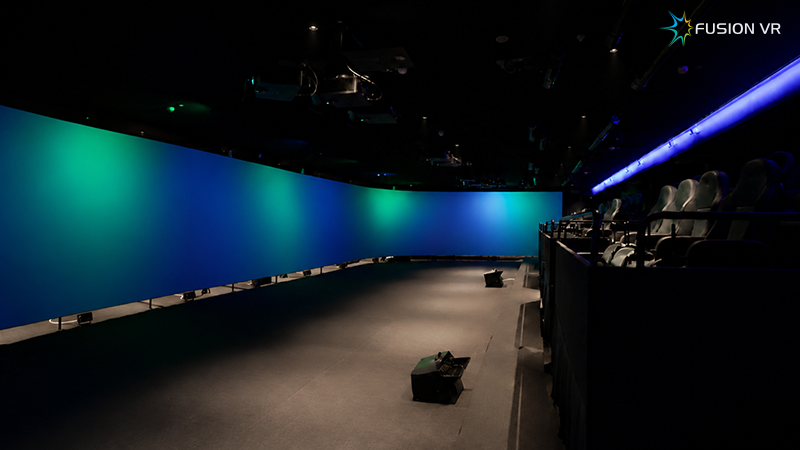
A 100-foot curved screen at 28K horizontal resolution in stereoscopic 3D (14K per eye), with motion simulation and 64-channel spatial audio. Developed for IITM Pravartak and the Department of Science and Technology, installed for Shri Ram Janmabhoomi Teerth Kshetra.
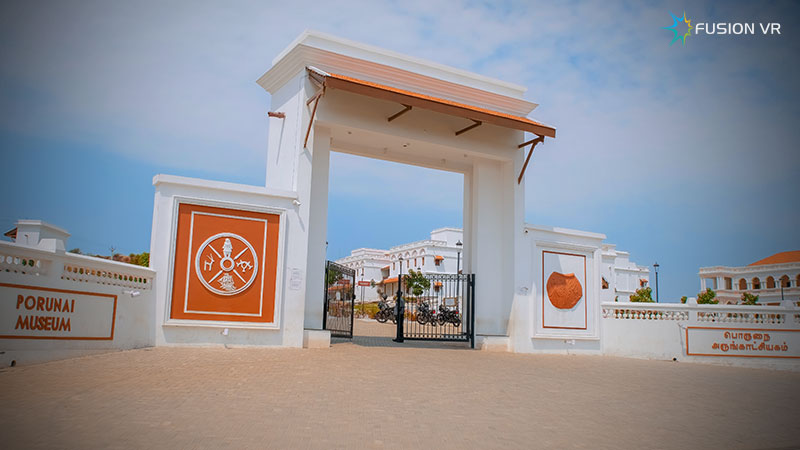
A five thousand year story of the Tamil civilisation for the Tamil Nadu Department of Archaeology, with India's first indigenously developed stereoscopic 3D VR 7DX multisensory boat experience, a stereoscopic 3D film and the full audio-visual installation for the 5D theatre, and a hands-on iron smelting exhibit.
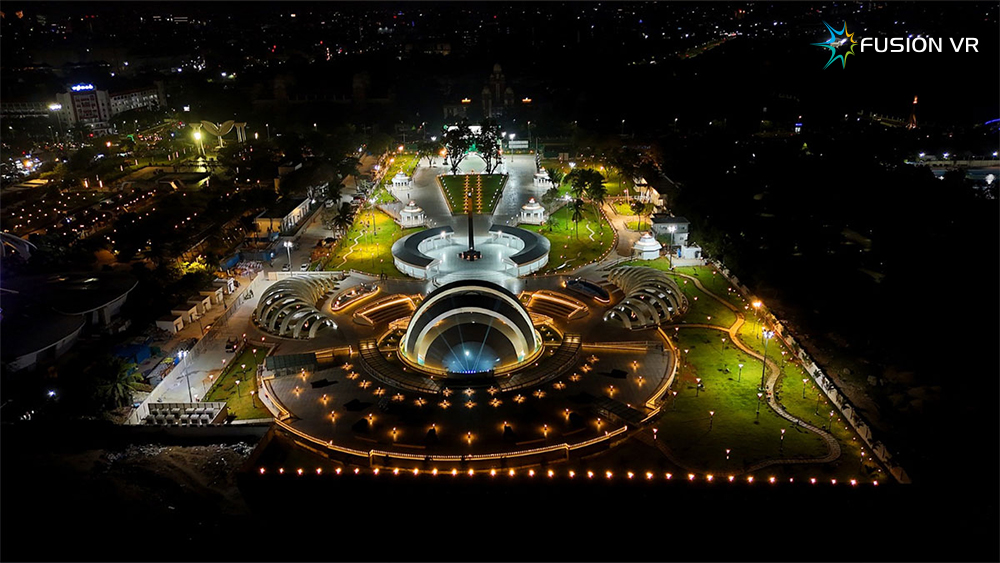
A memorial digital museum including India's first indigenously developed 7DX train simulator and a life-sized Pepper's Ghost holographic projection set against a lit physical set.
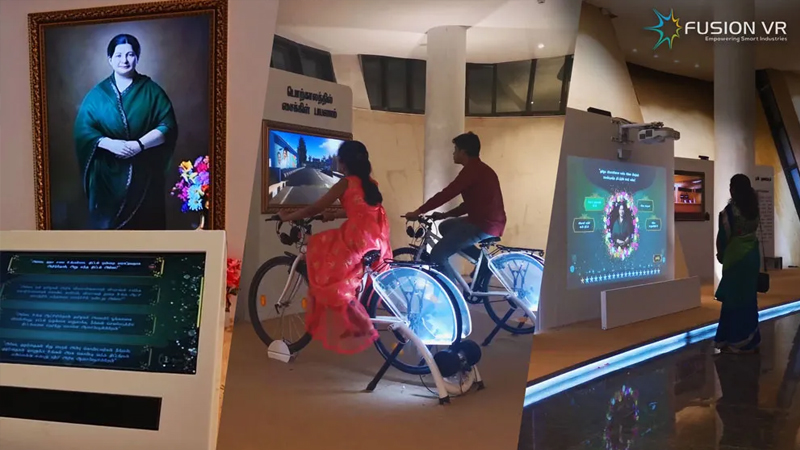
Eleven experiences delivered in seven weeks against a fixed opening date, including sensor-integrated interactive cycling and a gesture-controlled selfie station.
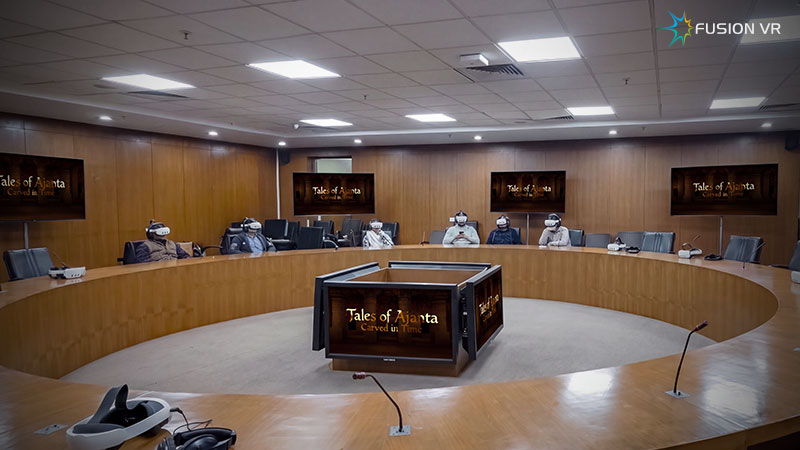
India's first stereoscopic 3D virtual reality recreation of a UNESCO World Heritage site with an Ambisonics soundscape, launched nationally in December 2024.
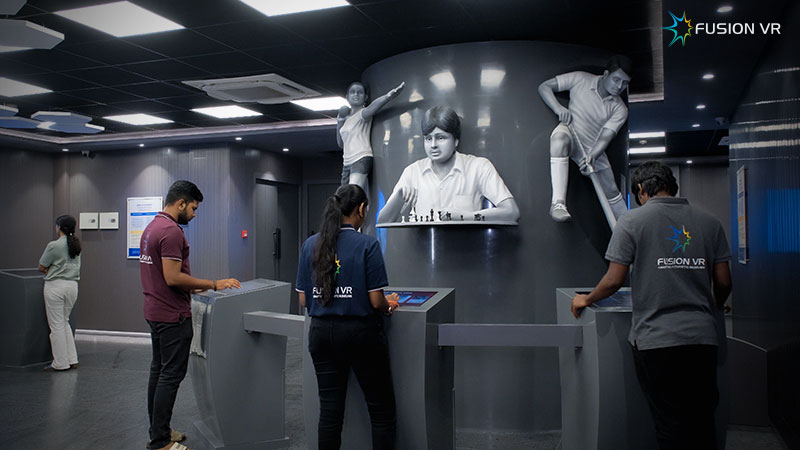
A 7D theatre, tabletop miniature projection mapping, and the Vaigai AI holographic avatar holding real-time spoken conversations with visitors, alongside five further interactive digital experiences.
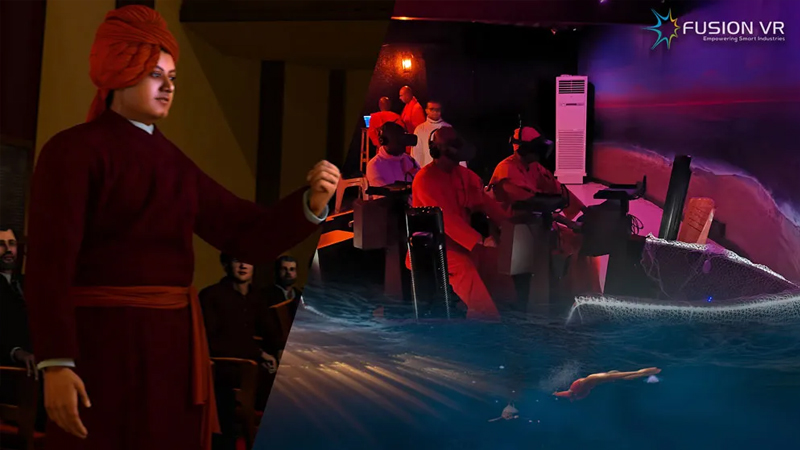
An engagement that began in 2010 and is still running, now past its fifteenth year, spanning multiple centres and nearly the full range of formats.
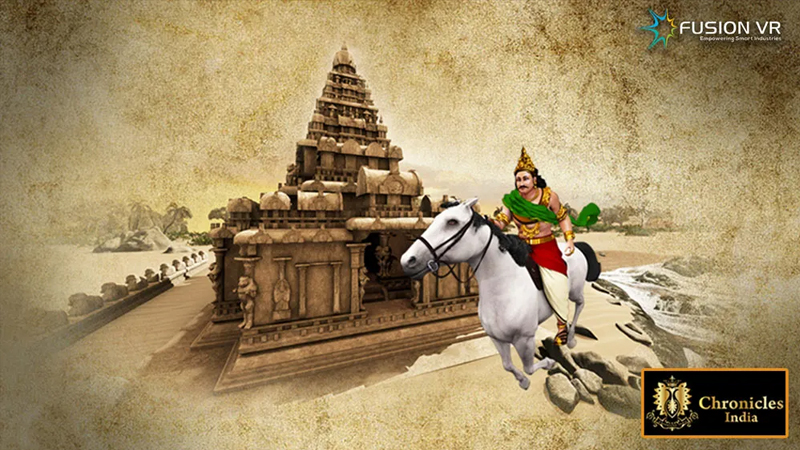
Part of Chronicles India, and the country's first archaeological 7DX experience.
Three multisensory virtual reality experiences launched in early 2014 across three countries, with virtual reality headsets and an indigenous dynamic haptics simulation platform, a commercial virtual reality concept equally new to all three markets at the time.
Four digital experiences delivered for the Auroville Foundation, ahead of the centre's opening to the public.