Augmented & Virtual Reality in Industry 4.0.
Fusion VR helps manufacturing enterprises harness Industrial IoT, AI and immersive technology to become smart factories — as a leading Industry 4.0 immersive solutions provider across India, the Middle East and South-East Asia.
What is Industry 4.0?
The Fourth Industrial Revolution is also widely referred to as Industry 4.0. This is an industrial revolution that is already happening and is making spectacular changes to the manufacturing landscape. It’s a set of technologies that enable today’s manufacturing enterprises become smart factories. The term Industry 4.0 originated in Germany in 2011.
To get a better understanding of Industry 4.0 it is useful to learn about the earlier industrial revolutions. The first industrial revolution began with the invention of steam engines which revolutionized transportation and powered large machines. The invention of electricity which led to mass production heralded the second revolution while the third was ushered by the advent of microprocessors and computers which transformed manufacturing. The fourth industrial revolution promises to deliver “smart manufacturing” by capturing data and deploying a suite of technologies such as Industrial Internet of Things, Artificial Intelligence, Cyber Physical Systems, Virtual Reality, Augmented Reality etc. to harness data and intelligence to deliver manufacturing excellence. This is also a widely accepted Industry 4.0 meaning or definition across various industries and academia.
Several companies worldwide have understood the power of these technologies and have invested considerable efforts and resources towards embracing Industry 4.0 technologies and enable the digital transformation in their organization. Fusion VR is proud to be contributing as a leading Industry 4.0 Immersive solutions provider in India, Middle East and SE Asia.
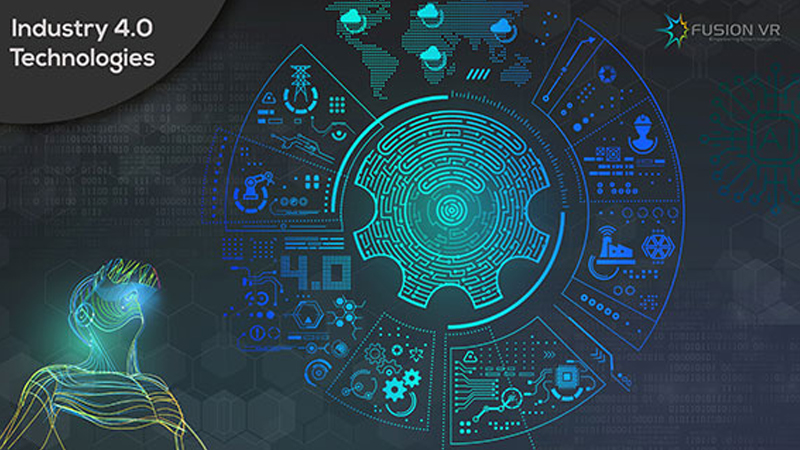
Industry 4.0 Technologies
Industry 4.0 comprises a set of latest technologies which are deployed to deliver the complete transformation of modern factories into smart manufacturing factories. They are delivered to manufacturing organizations and supported by Industry 4.0 solution providers in India and elsewhere.
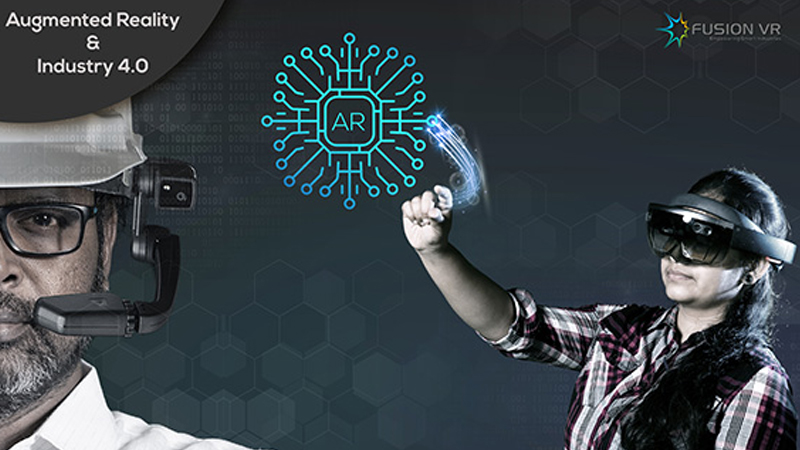
Augmented Reality & Industry 4.0
Augmented Reality (AR) is one of the most widely used of Industry 4.0 technologies. The ease and simplicity of use is one of the key factors behind the extensive adoption of AR in Industry 4.0 implementation. This technology is transformative in the manner by which data and critical information is obtained, displayed, utilized, transmitted and retrieved. It has proven itself to be immensely useful as it effectively augments the user’s reality, experience and delivers enhanced performance.
Augmented Reality in Industry 4.0 opens up a completely new dimension for smart manufacturing in the way that information is interactively used. AR delivers increased efficiency and quality in execution, reduction of errors, guided assistance and superior training.
Virtual Reality & Industry 4.0
Virtual Reality (VR) is one of the most exciting technologies with immense benefits due to its immersive nature. VR in Industry 4.0 creates life like and highly realistic simulations of products and processes that delivers experiential learning and insights. Delivering improvements in human skills is one of the crucial applications of Virtual Reality in Industry 4.0 implementation across the world. VR is used in the design and construction of manufacturing facilities, visualization of complex data, training and competency enhancement of operations and maintenance personnel, improved assembly line & plant operations performance and emergency responses. The scope and benefits of VR in Industry 4.0 is breathtakingly extensive. VR is widely used in training with operator and maintenance training simulators such as VR-OTS and VR-MTS. VR training is not only highly immersive but gamified, experiential and four times more effective than conventional classroom training.
Explore our Virtual Reality solutions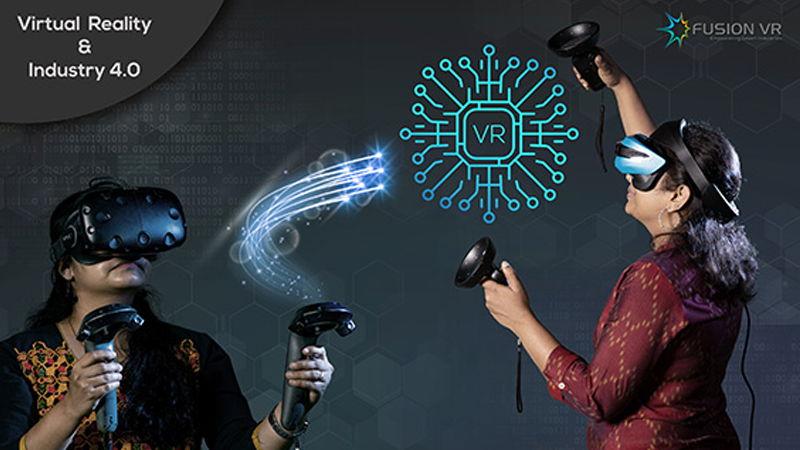
What are some concerns companies have about Industry 4.0 implementation?
Companies are often hesitant to invest in Industry 4.0 technologies due to a few concerns that need clarifying with better information and data.
Lacking expertise to quantify the overall project benefits and RoI
Unavailability of an internal champion who regularly monitors and communicates to leadership on project implementation
Making accurate budget allocations and obtaining senior leadership approvals for investment
Effectively communicating the vision and purpose of Industry 4.0 initiatives with all stakeholders
Clear details on the infrastructure and human capital needed for success
Engaging with unions and addressing their apprehensions
Ensuring they have domain knowledge expertise within the organization
Managing cybersecurity vulnerabilities when new systems are implemented or integrated
Creating an organizational culture that accepts change and disruptive technologies
How to Successfully Implement Industry 4.0?
When it companies wish to implement Industry 4.0 or digitalization initiatives, they need to carefully consider the following in their roadmap
Develop a written charter with a clear scope, goals, resources, requirements and execution plan
Ensure Stakeholder engagement in all phases of the project
Focused and decisive leadership and execution teams
Identify clear deliverables, KPIs, milestones and Return on Investment targets
A phased approach de-risks the investment and builds internal confidence.
Engage experienced Industry 4.0 solution providers with the requisite industry background
Conduct Project Assessments and identify lessons learned
What mistakes companies make while implementing Industry 4.0?
It's not unusual to make mistakes — most companies learn and eventually succeed. It's always better to start correctly and save on time, effort and cost.
Not understanding the full extent of the capabilities of Industry 4.0 technologies
Failing to select the proper use cases that deliver the maximum advantages and understand the cost and benefits
Not engaging the correct and experienced Industry 4.0 partners affects conceptualization, scope development and execution
Trying to develop in-house expertise and force them through a steep learning curve
Not investing in data analytics for gaining insight on their existing data
Poor stakeholder engagement at all stages of project development, execution and operation
Less attention to knowledge transfer and training for all end users and other stakeholders
Expecting fast implementation and immediate returns. Typically, Industry 4.0 projects require detailed preparation, planning and establishing the necessary infrastructure that most companies may not have in place
Inadequate capital and resource allocation at the beginning and budgetary flexibility to support or accommodate technological changes and upgrades
 Watch · 15 min
Industry 4.0 Essentials
This video tells us about Industry 4.0 and why it will play a pivotal role in shaping our future. In a simple, yet engaging style, Dr. Bharathy encourages us to pay heed to warnings as he delves into the earlier industrial revolutions, case studies in Industry 4.0 by leading organizations and the applications of these technologies in manufacturing, pharmaceutical and healthcare industries. The video explains the advantages to you and also provides answers to your most difficult questions on adoption. Please share with the leaders and change-enablers in your organization and deliver smart manufacturing for a brighter future.
Workshops & Seminars
We believe in sharing advances in technology and its applications in industry for the benefit of everyone. We deliver business seminars, workshops and educational presentations to help understand, explore and begin or refine your immersive Industry 4.0 journeys. Allow us to help you navigate into the exciting new world of smart manufacturing. Our experienced team of professionals can custom design Workshops and Seminars at your chosen venue for any target audience.
Our workshops not only educate top-managements and employees, but also ignite their interest and actively engage them in the range of Industry 4.0 technologies. Being industry pioneers, we have a range of XR hardware and software right from the early days to demonstrate and help participants to understand and experience them at these events. Plus your team has the opportunity to interact with leading industry professionals and gain invaluable perspectives.
 Watch · 34 min
Industry 4.0 & Immersive Solutions Roadmap
A comprehensive one day Workshops at Client-Site by Experienced Industry 4.0 Professionals
Who should attend?
CIOs, CTOs, CEOs, CFOs, Managers, Engineers, Product Designers and just about anyone else driving Industry 4.0 change in organizations
What will you gain?
In-depth familiarization of the Industry 4.0 / Smart-Factory landscape and disruptive technologies from a pioneering organization
Deep insight on latest Interactive VR/AR/MR-Technologies with hands on Demos
Develop the ability to design your own customized Use-Cases through the solid "Bow-Tie-Analysis" methodology to increase production and HSE efficiencies up to 70%
Case-Studies from the early-adopters of Industry 4.0
Visionary Decision making capability towards Intangible asset investments during the DigitalTransformation journey
Understand the advantages of Industry 4.0 strategic adoption in your own business and the negative impacts the non-adoption will create in near future
Ability to derive the ROI for the XR-Training investments through a systematic approach
Meet industry experts and gain exciting perspectives
Certificate of Participation











Questions we hear often.
A Cyber-Physical System (CPS) is the integration of computers and robots with physical and human systems to deliver capabilities that improve function and efficiency. A self-driving car is a good example of a CPS — it enables safer driving, better traffic management, and frees up humans to perform productive activities during travel. Other examples include robots deployed alongside humans in manufacturing and drones used in combat.
A PDP, or Physical-Digital-Physical loop, is an interactive process that captures data from various sources in the physical world, digitizes it for analysis, visualization, and decision-making, and then feeds it back into the physical systems to deliver improved operations, outputs, and results. This can be summarized in three phases: Physical-Digital, where information is digitized; Digital-Digital, where the digitized information is analyzed; and Digital-Physical, where the analysis is actioned back in the physical system. This last phase is crucial — it completes the cycle and delivers true Industry 4.0 transformation.
Industry 4.0 adoption grew significantly during the COVID-19 pandemic, with industry experts identifying many applications that made a real difference. These are just the beginning, with aggressive efforts underway to maximize the use of Industry 4.0 technologies for better healthcare:
- IoT enabled real-time data collection on patients, available medical support, and critical medical logistics, with AI-powered analytics and live dashboards supporting speedy, efficient, life-saving decisions
- Blockchain technology enabled critical data collection platforms to ensure the integrity of information on pandemic status, infection rates, supply availability, vaccine distribution, and the complete medical and pharma supply chain
- 3D printing effectively managed the dramatic increase in demand for ventilators, valves, adapters, PPE, quarantine booths, fittings, and accessories
- Drones supported distribution of medical supplies, quarantine and lockdown surveillance, disinfection, and crowd control with aerial mapping
- VR simulator training improved learning outcomes for managing COVID-affected patients, understanding viral impact on the body, and applying diagnostic and treatment methods
- Geographical Information Systems (GIS) were deployed for spatial mapping of COVID spread, medical supplies, and infrastructure support data to assist effective decision-making
- Remote collaboration platforms and AR wearables supported ongoing manufacturing and troubleshooting efforts
- Digital twins of critical assets and processes enabled close monitoring and management with minimal physical intervention from engineers and technicians
The most widely known Industry 4.0 technologies include immersive technologies such as Virtual Reality (VR), Augmented Reality (AR), and Mixed Reality (MR), along with Industrial IoT (IIoT), Big Data & Analytics, Simulation and Digital Twins, Artificial Intelligence (AI), autonomous robots, additive manufacturing, drones, cybersecurity technology, and the cloud.
VR/AR/MR — collectively known as Extended Reality (XR) — are widely adopted to enhance design, operations, maintenance, reliability, and safety across factories, refineries, and manufacturing units by improving human performance and productivity. XR stands out within the Industry 4.0 landscape because, while most other technologies make machines and processes smarter, XR is the one technology focused on making humans smarter — dramatically improving the workforce's knowledge, skill, and judgment through experiential learning.
Alongside XR, the Industrial Internet of Things (IIoT) enables sensor data collection and communication between equipment, devices, and instrumentation for better operational integration. The resulting data is often voluminous, and analyzing it to extract insight and drive data-driven decisions is known as Big Data and Analytics — another key Industry 4.0 technology.
This analyzed data often leads to better decisions, predictions, and automation through Artificial Intelligence, including machine learning, deep learning, and computer vision — technologies that are frequently sequential or integrated with one another.
Together, these technologies lead enterprises toward Simulation and Digital Twins, which deliver long-term equipment reliability, efficiency, and cost savings. Real-world examples include digital twins of industrial compressors and wind turbines, VR operator training simulators, drone-based equipment inspections, AI-based decision-making to minimize manufacturing errors, and even 3D-printed bridges. These are not science fiction — they're real, available today, and supported by highly competent Industry 4.0 solution providers across India.
Virtual Reality is a key technology leading the transformation of the industrial landscape, helping build a smart workforce by improving employees' knowledge, skill, and judgment through experiential learning.
VR's immersive experience can catalyze design processes and train employees quickly and effectively on operations, maintenance, and emergency response procedures — all key functions that enhance production, reduce maintenance costs, and improve ROI.
For example, VR in the oil & gas industry helps with exploration through better visualization of sub-surface deposits and enables safer drilling operations. VR also supports training through the Virtual Reality Operator Training Simulator (VR-OTS) — a highly realistic virtual recreation of the plant or shop floor, integrated with content and controls that simulate the actions needed to build competency in a company's SOPs and SMPs. Operators, technicians, and engineers can familiarize themselves with the plant environment and train on required actions without ever entering the actual plant.
The learning is gamified, letting users make mistakes and learn from them without any real-world consequences. This kind of training has widespread applications across oil & gas, chemicals, nuclear, power generation, mining, aviation, automotive, and pharma — particularly valuable during the COVID pandemic.
Augmented Reality in Industry 4.0 overlays digital information onto a user's physical environment in a smart factory, using a smartphone, tablet, or wearable headset.
As users perform tasks on the factory floor, AR applications provide relevant, contextual information or simulation to support the task, helping them complete it safely, correctly, and efficiently — saving companies time, cost, and effort.
AR also helps teams in different locations collaborate effectively on product design reviews, checking applicability and compatibility under various conditions, and improving prototype designs before construction even begins.
AR provides automated or remote assistance from specialist engineers to guide equipment overhauls, reducing plant downtime and boosting production without requiring the expert's physical presence — especially valuable when travel is restricted.
AR operator and maintenance training simulators (AR-OTS and AR-MTS) enable faster training on critical tasks at plants, offshore oil rigs, or car assembly lines, and can be deployed across nuclear, mining, power, utilities, pharma, and automotive industries.
Mixed Reality is being widely adopted by manufacturing companies to boost their competitiveness. MR can be thought of as an enhanced version of AR that adds true immersion, integrating digital assets and experiences with the physical world. Like AR and VR, MR plays a key role on the plant and shop floor, but also in design, customer service, and marketing.
Design teams use MR to collaborate, review, and finalize designs faster, accelerating time to market. The COVID-19 pandemic accelerated remote support from specialists using MR devices — guidance and instructions are delivered digitally, in real time, from experts to on-site work crews, overlaying live process values, alarm status, design data, or SAP data to resolve challenges. This saves time and expense by reducing downtime, minimizing supply-chain issues, and maximizing customer satisfaction.
MR applications are unique in their ability to map the user's environment, making it interactive and enabling simulations that provide new insight, data, or intelligence. MR uses devices such as Microsoft HoloLens, including intrinsically safe versions for hazardous environments like refineries and chemical plants.
Mixed reality has an exciting future, with applications across oil & gas, chemicals, nuclear, mining, power, utilities, healthcare, and pharma — backed by some of the biggest names in the industry, making it increasingly cost-effective to adopt.
While Industry 4.0, or the Fourth Industrial Revolution, is new, the challenges in implementing it are not unique or different from those found in any strategic organizational project. Still, it's worth identifying a few common challenges and how to overcome them.
The first challenge is selecting the right technologies that generate the most value or ROI for smart manufacturing. Organizations can overcome this by building a solid understanding of these technologies and the use cases that align with their long-term strategic objectives.
Engaging an experienced, reputed consultant or solutions provider to study the plant or process, perform a gap analysis, and recommend suitable use cases with cost-benefit analysis is essential.
Organizations also need the right in-house technical champion to coordinate with consultants, navigate implementation challenges, and establish systems for sustained success — with KPIs in place to evaluate performance and gather feedback.
Another challenge is securing leadership support and funding. Companies can address this by allocating capital for digital transformation projects during annual budgeting, with board and senior management support for these initiatives.
At this stage, it's important to engage the right technology partner with domain experience and subject-matter expertise. Many Industry 4.0 solution providers in India specialize in different areas — no single vendor covers the entire smart manufacturing landscape. At Fusion VR, for instance, our core expertise is developing customized AR/VR/MR solutions, just one part of the broader Industry 4.0 spectrum — so selecting the right partner for your specific initiative matters.
Leaders should start small and scale up gradually. Overly ambitious projects can stall without adequate technological, logistical, and financial support, and expecting quick results isn't always realistic — teams need time to fully leverage new solutions.
Strong leadership and competent project management are indispensable for Industry 4.0 success. As experts often say, every challenge presents opportunities for those who look for them.
Safe and efficient plant operations require reliable performance without unplanned downtime, which in turn requires highly trained operations and maintenance personnel with a strong understanding of the process and machinery involved.
Industry 4.0 technologies deliver smart manufacturing that helps plants operate assets efficiently, safely, and reliably — achieving operational, safety, and environmental excellence. Since building and operating process plants is capital- and labor-intensive, Industry 4.0 creates opportunities for smart, intelligent digital ecosystems that deliver sustainable growth and better ROI.
Chemical plants, for example, use hundreds of sensors and controllers generating vast amounts of data. Processes are controlled through distributed control systems (DCS) and protected by safety instrumented systems (SIS) to ensure incident-free operations, with the generated data enabling systems to interconnect, communicate, and analyze for continuous improvement.
While newer plants have embraced digital advancements, older plants often struggle due to the capital investment digital transformation requires. Plant data typically needs to move to a cloud service using 4.0-standard OPC UA communications to enable analysis and AI-based operational improvements, which can be further integrated with SAP data for better supply chain management and customer satisfaction.
VR and AR help enhance employee performance through training simulators for operators, technicians, and engineers — reported to be up to four times more effective than conventional classroom training for retention and confidence.
VR training immerses personnel in a highly realistic 3D model of the plant, letting them perform every step as they would in the real plant, following SOPs. Trainees can make mistakes and learn from them at no real cost, repeating as many times as needed until skills are deeply ingrained — extending beyond operations and maintenance into safety and emergency response training.
Traditional plant maintenance has focused on fixing machinery and equipment after breakdowns or failures, requiring urgent repairs to reduce downtime and restore production quickly. Industry 4.0 technologies are geared toward delivering superior maintenance and reliability through increased digitalization.
Sensor costs have dropped roughly 70% over the last decade, driving wider use in monitoring machinery. Sensors track performance parameters and generate large volumes of data, which — when analyzed — provide insight into machinery performance and support predictive and prescriptive maintenance strategies. This data-driven approach, using IIoT and Big Data & Analytics, helps prevent unplanned downtime, reduce costs, improve plant availability, and maximize production.
Sensor data also enables the creation of a Digital Twin of critical machinery such as compressors, turbines, and pumps — ranging from operational digital twins to more advanced intelligent or immersive twins — supporting better performance monitoring, scenario simulation, faster troubleshooting, and improved reliability.
VR/AR/MR are extensively used to build training simulators for operators, technicians, and engineers. PwC has reported that VR training is up to four times more effective than conventional classroom training for retention and confidence, developing skills quickly and reducing training duration and cost. Fusion VR has core expertise in developing and implementing VR/AR/MR training solutions across manufacturing domains.
VR training, for example, uses highly realistic 3D models to instruct trainees on the construction and maintenance of critical plant machinery — a very different experience from learning through 2D section drawings and manuals. Since the model is virtual, learning is reinforced through a gamified approach, and errors during training carry no real-world consequences. AR applications also deliver effective training, without the fully immersive experience of VR.
Industrial drones are increasingly used to monitor and inspect equipment in remote, hazardous, or inaccessible locations, avoiding extensive preparation and travel while keeping inspection personnel safe. Drones also perform internal inspections to measure corrosion and mechanical damage — critical non-destructive testing that supports mechanical integrity, process safety, and faster repair planning.
Maintenance teams often rely on large inventories of spare components kept on hand, at significant cost. 3D printing offers the ability to fabricate urgent components locally, without air-freighting them, enabling accurate reproduction with the right materials and dimensions at a fraction of the cost and time.
Taken together, Industry 4.0 technologies play a crucial role in elevating maintenance performance to be more intelligent, efficient, and cost-effective for manufacturing organizations.
Almost every industry that delivers products and services can benefit from Industry 4.0 technologies, which are geared to make the manufacturing ecosystem "smart" and deliver insight that drives continuous improvement, cost savings, and better ROI.
Industries such as oil & gas, chemicals, nuclear, mining, power, automotive, manufacturing, pharma and health sciences, and design, engineering & construction are among the primary beneficiaries. Big Data & Analytics, IIoT, AI, additive manufacturing, drones, and immersive technologies like AR/VR/MR all find exciting applications across these sectors, which tend to gain the most given the significant capital and human resources they employ.
Automobile companies have already engaged robots on assembly lines and equipped employees with AR wearables to boost productivity. Chemical and refining companies are deploying AR and VR training to prepare employees for hazardous operational tasks and emergency response. Manufacturing companies are integrating 3D printing into existing operations for better customer engagement and support.
To identify and maximize these advantages, it's important to engage Industry 4.0 experts early — such as Fusion VR, a leading Industry 4.0 solution provider in India — bringing deep domain knowledge to help identify the right use cases in collaboration with a company's own engineers and technicians. This understanding and collaboration is essential for the digital transformation of any industry, sector, or organization.