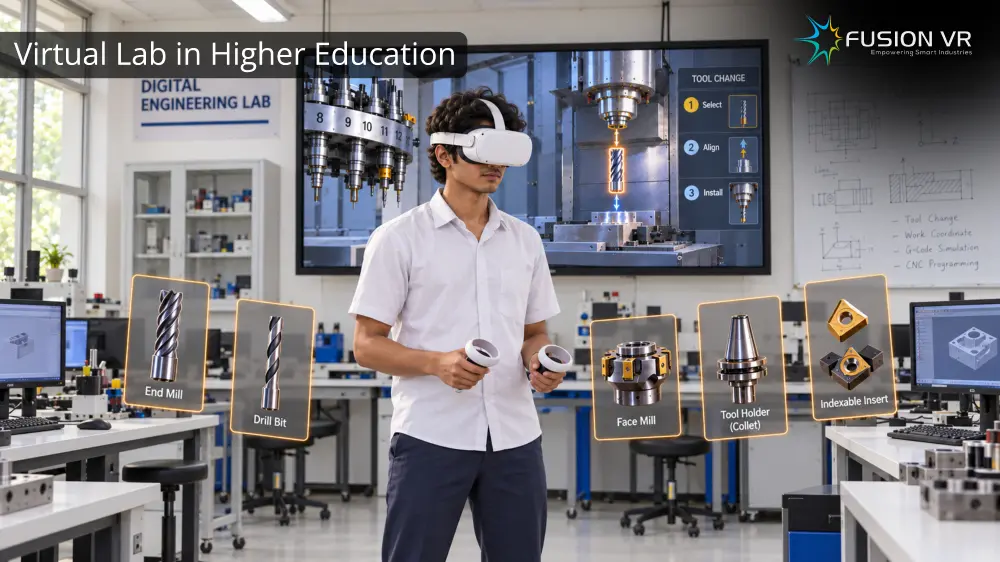
The following is an illustrative conversation written by Fusion VR to explain the topic.
Arun: Can you imagine yourself doing a chemistry experiment away from a lab or even using large industrial machinery without a factory?
Priya: Yes, with virtual reality, you can do this. Virtual labs allow students to work, learn, and explore, by using simulation. It’s an innovative tool for teaching, in a controlled environment.
Arun: Practical training has always required some physical setup with equipment, special facilities, and in-person demonstrations. How does virtual reality change this training experience?
Priya: Students can use digital simulations to change inputs and variables, and view how that impacts the process and outcomes. Instead of simply studying, students can gain first-hand understanding by virtually interacting and performing.
For instance, a chemistry student could perform an experiment to simulate a reaction, an engineering student could build a virtual machine, and a medical student could investigate the different parts of the human body in 3D. These experiences link concepts to real life.
Arun: In your view, what are the factors that make virtual laboratories increasingly useful for universities?
Priya: Virtual labs offer a means to provide students access to laboratory based practicals in situations where there are limited resources and expensive equipment or high-risk laboratory environments. Digitalization of learning in the recent years has increased the requirement to offer learning opportunities to students that are beyond the normal teaching classroom environment.
Virtual labs provide the learners the possibility to perform an experiment, repeatedly if needed, and to develop interactive visualization models to support their learning of difficult concepts and topics.
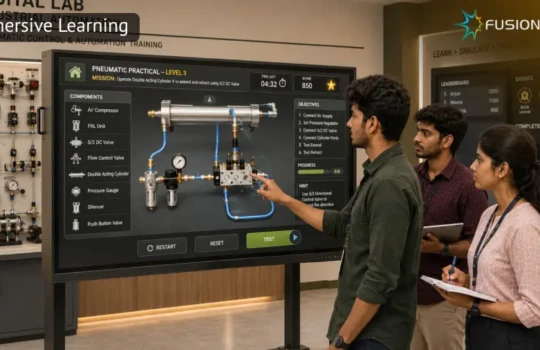
Arun: Virtual laboratories enable engineering students to explore mechanical and electrical systems, simulation of manufacturing, and the understanding of industrial automation.
Priya: Let’s consider a scenario in which an engineering student is studying hydraulic systems.
Using a virtual laboratory, the student can adjust system pressure and examine how that impacts individual components within the hydraulic system.
For example, electrical engineering students have the opportunity to make adjustments to various circuit parameters and watch the values of current and voltage change. These tasks provide students with an understanding of the concepts behind real life technical systems and problem-solving, without having to use real world equipment.
Arun: Additionally, they would be useful for practising techniques that would be dangerous or cost too much to do in real life.
Priya: Simulations are great. Virtual labs let students practice the dangerous and expensive stuff like hazardous reactions, electrical engineering and operating heavy equipment, or even emergencies, but in a safe environment.
While practicing in a safe environment helps develop a lot of the skills that students will need in real life, simulations are meant to complement hands-on training with an instructor, especially in cases where developing real-life hands-on skills is absolutely necessary.
Arun: Take healthcare, for example. Complex anatomy is hard to master and it is especially hard to combine it with practicing real life scenarios.
Priya: VR allows students to examine three-dimensional anatomy. It makes learning more engaging, and students can examine tissues, organs and body systems from different angles. Instead of viewing anatomy through illustrations in a textbook, students can learn by observing spatial relationships between body structures.
Another learning technology is simulated clinical scenarios. They provide opportunities to interpret, evaluate, and learn the potential outcomes of the decisions learners may make. This technology complements learning by placing digital anatomy in real clinical settings.
Although these technologies can support student preparation for clinical rotations, supervised clinical procedures, and real patient experience, they are not replacements.
Arun: What do you think of core disciplines such as physics, biology and chemistry?
Priya: Virtual labs provide flexibility in learning especially with complex topics. For example, physics students are able to manipulate and observe the change of the properties of projectile motion (angle, speed), observe the changes in electromagnetic field properties and change of molecular structures for chemistry students and look into cells, ecosystem and even different tissues for biology.
There is a huge advantage with the opportunity to repeat simulations. For example, students studying the movement of a projectile, are able to experiment by changing the launch angle and velocity and observe how this changes the path.
This turns learning into an active process where students are investigating cause and effect, instead of just memorizing equations.
Arun: Can immersive technology really support educational experiences?
Priya: With VR, students feel as if they are in the actual simulation, giving them the freedom to explore objects in their virtual environment. In contrast, AR puts digital elements into the real world. Computer simulations, on the other hand, provide an educational opportunity without requiring additional gear.
For example, VR could allow a student to experience a solar system, examine the mechanics of a machine, or explore the impact an altered environment might have on a particular ecosystem.
All the learning potential rests on a particular technology’s utility. Does it truly clarify a difficult concept? Does it provide a unique opportunity for skill building, or is it simply an attractive element?
Arun: One of the challenges is cost. Building and running specialized laboratories at universities can be costly..
Priya: That is true. Physical facilities often require expensive equipment, consumables, maintenance, dedicated space, and safety systems. Virtual laboratories can reduce some of these recurring costs and allow multiple students to access simulated equipment without waiting for a physical workstation.
However, developing realistic simulations, purchasing hardware, maintaining software, and VR training faculty also require investment. The financial benefits depend on the subject, student numbers, and how the technology is integrated into the curriculum.
Arun: One of the challenges is cost. Building and running specialized laboratories at universities can be costly.
Priya: Yes, building a lab is costly because you have to build or buy and run an area, including the purchase, maintenance and operation of various types of safety systems, space, equipment and consumables. Virtual labs also offer reduced costs and provide simultaneous student access to simulations of lab equipment, instead of the need for students to take turns at a single physical lab workstation.
It does require funding to make, purchase, maintain and train faculty to use the technology. This is dependent on the level of adoption, the type of technology, the subject area, and the volume of students in a course.
Arun: Will traditional laboratories become redundant in the face of such advancement?
Priya: Of course not. Hybrid combinations of virtual and physical labs is an ideal solution for their complementary uses.
Simulations allow students to familiarize themselves with tools, workflows, and protocols prior to their scheduled in person sessions. After mastering this portion, students are able to execute tasks in person more effectively, all while feeling comfortable and confident. That being said, manual tactile manipulation, measurements, material management, and calibration are best acquired through direct participation and action.
Arun: Do universities know if digital learning experiences are working?
Priya: Yes, they can test the effectiveness of these digital tools by assessing learning outcomes. Take virtual lab tools for instance. They can track the virtual lab steps, and assess if students chose the right tools, followed the right steps, interpreted results correctly and were able to spot and correct errors.
The lab outcomes, feedback and performance from physical lab sessions help to determine if students can take their learnings from the virtual labs and become proficient in the lab.
Arun: What problems do universities need to anticipate before buying this kind of tech?
Priya: First, does it teach the course? A good tool reflects the lessons of the course. It’s got to support curriculum development and learning outcomes. You’ll need support from faculty, some technical support, cyber security, software updates, and ongoing support for years to come.
Tools for teaching need the teachers. Without support from faculty, the most expensive and sophisticated tools are just more classroom equipment.
Arun: What is the potential future development of virtual laboratories?
Priya: With the emergence of artificial intelligence, digital twins, and the progress of computing technologies designed for immersion, these environments are bound to be more realistic and intelligent. With AI-assisted systems, virtual laboratories can detect common errors, provide more personalized guidance, and even offer more practices for students depending on the student’s performance.
Digital twins will help bridge the gap between classroom and professional life for students by allowing them to work with models of machines, systems and industries in virtual spaces.
There are opportunities for universities to create specialized experiences for their students that address their individual disciplines and budgets.
Arun: The development of virtual labs isn’t just digitizing experiments. It means broadening how students apply what they’ve learned and providing a means for that to occur.
Priya: You’re right. Virtual labs let students practice procedures and explore concepts in new, accessible, and potentially limitless ways. In my view, the real innovation is in integrating them with quality teaching and actual physical experiences.
Future practices in higher education will be both in person and remote. Educational institutions will be able to utilize virtual lab software to provide students with more opportunities to experiment and gain a better grasp of the real world of technology and automation.