Digital Museums › Services › Turnkey Execution
Turnkey Execution for Digital Museums
You have a sanctioned project and a date. Turnkey execution is the step that turns the Detailed Project Report into an operating digital museum: content, software, mechatronics, audio-visual and IT systems, installation, calibration and commissioning, delivered by Fusion VR under one contract. One accountable party from work order to opening day.
Why Single-Point Delivery Matters
A digital museum fails at the joins. Content, software, motion systems, projection, audio, show control and the building itself all have to meet as a single solution, and when each is bought under a separate contract, the gaps between them belong to nobody. Under a turnkey contract those joins are ours. Fusion VR carries one obligation: a seamlessly performing digital museum solution, never a set of delivered parts.
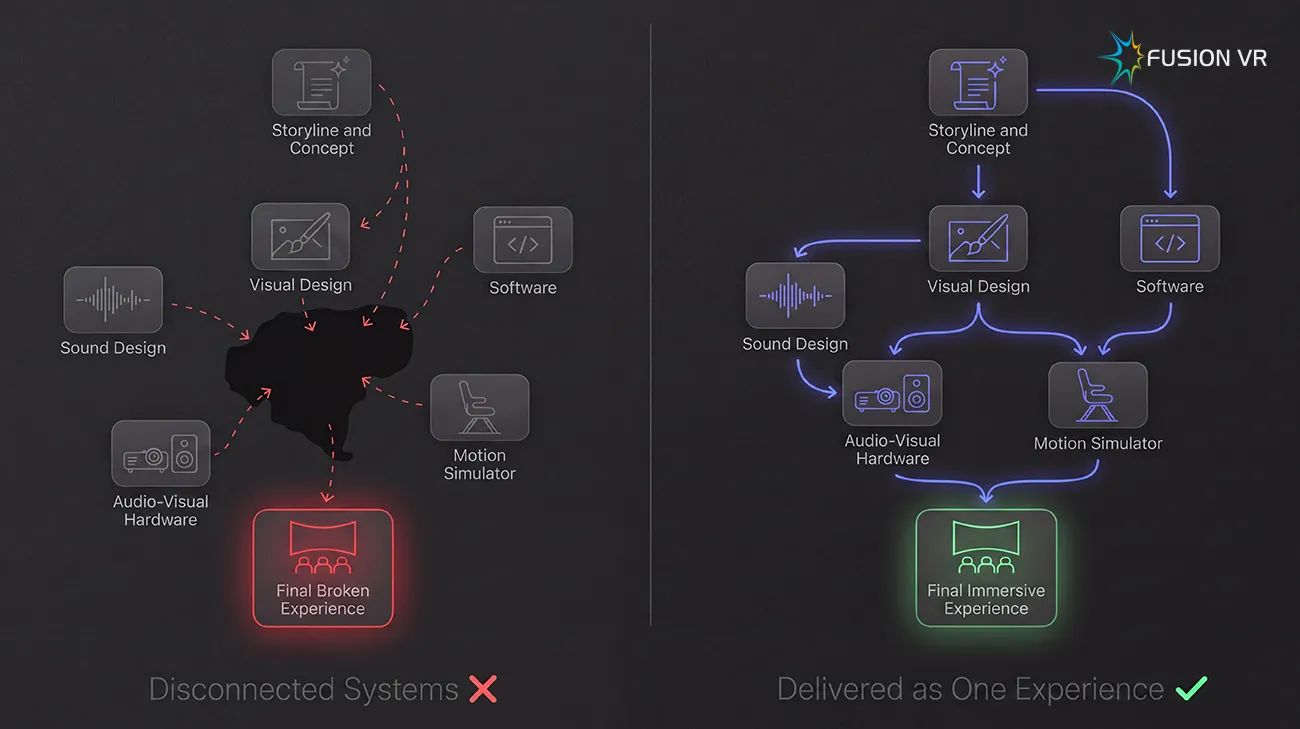
What is delivered is the experience, not the equipment. A digital museum is not a supply of components followed by their installation. It is one solution, and that solution is the visitor's experience taken as a whole. Behind a single gallery sit hundreds of individual elements, each fully capable of performing on its own, in isolation, to its own specification. None of that is the deliverable. The deliverable is those hundreds of elements handshaking with one another, frame by frame, so that a visitor walking in meets one cohesive, seamless environment and never the seams between the parts producing it. This is a materially harder standard to contract to than a bill of materials supplied and installed, because an installation can be complete, free of defects and compliant with every line of its specification, and still not perform as an experience. The experience is the delivery. Everything else is a means to it.
The interface is where a digital museum is lost, and no one is in breach. Content arrives at a resolution and frame rate the projection chain cannot carry cleanly. A motion profile is authored for a platform whose real envelope turns out to be narrower. A screen is fabricated before the projector throw distance is finally settled. An audio design is tuned for wall finishes that changed during interiors. In every one of these cases each supplier has delivered exactly what its own contract asked of it, and not one of them is contractually wrong. The failure lives in the space between the contracts, where no obligation was ever written. That space is not a small residual category. On an immersive project it is most of what the visitor actually experiences.
Split delivery quietly appoints the institution as its own systems integrator. An institution that awards content to one agency, hardware to another and interiors to a third has taken on the reconciliation work by default, usually without realising it and almost always without the technical staff for it. Museum officers end up sequencing vendors against one another, deciding whose schedule yields, and adjudicating technical disputes on which they have no independent basis to judge. The decisions still get made, because they must, but they get made by the party with the least information. This is precisely the situation our project management consultancy service exists to protect, and where an institution has already split delivery, independent oversight is the right answer rather than a second-best one.
What single-point responsibility actually commits us to. One contract, one programme, one party answerable for the solution performing as one experience. Not components individually free of defect, which is a much lower standard and the one an institution is left with when responsibility is distributed. If the image is not seamless across projectors, if sound does not follow picture, if motion does not match what is on screen, there is no supplier for us to point at, because the design, the content, the engineering and the integration are ours. We should be equally precise about the limits. This commitment covers what is inside the contracted scope, which the next section sets out plainly, and it does not silently absorb civil works, interiors or building services unless they were contracted. Nor does it mean every task is performed by our own hands: voiceover, music and final mixing are executed by specialist studios under our direction, and where a project's scale or eligibility criteria call for it we work in consortium. What does not move is the answerability. Direction, integration and the obligation to deliver a working digital museum stay with us in every one of those arrangements.
The hardest project we have delivered is the clearest illustration. The Odyssey of Hanuman 7DX - Sankat Mochan Gallery required 28K stereoscopic 3D (14K per eye) projection across fourteen projectors onto a 100-foot curved screen, a 64-channel Holophonix spatial audio system from France, and 6DoF proportional hydraulic motion across four platforms carrying thirty visitors, with every one of those systems handshaking frame by frame. No equipment manufacturer is responsible for making fourteen projectors behave as one continuous stereoscopic image, because no manufacturer sells that. The mapping, the edge blending, the convergence across a curve, the synchronisation of motion to picture and of sound to both: all of it is the seam, and the seam is the entire visitor experience. A project of that difficulty is only deliverable when one party owns the whole of it.
Years of working inside the public works process, not just alongside it. As a PWD licensed contractor, Fusion VR has worked with the Public Works Department over several years on digital museum projects, delivering the digital museum scope at the Amma Memorial and the Kalaignar Memorial, including its operation and maintenance, and at the Porunai Museum and the TNPAGE experience centre. What those years have given us matters more than the licence itself. We know how a government project actually moves: how sanctions are released, how measurement and billing are recorded, how approvals are routed and stages certified, what a file must carry, and how work is coordinated across departments, consultants and site agencies without the programme stalling between them. A turnkey contractor has to operate inside that system for the whole life of the project, and technical capability on its own does not carry a project through it.
Both routes are legitimate, and we will tell you which suits your project. Some institutions split the work between several agencies and manage it well, and on government projects the rules sometimes require the advisory role and the execution role to sit with different parties. Where they do, we follow them. Turnkey suits an institution that wants one accountable party and a single point of responsibility for audit. It suits you less if you already have your own technical team and would rather manage the agencies yourself. Tell us your situation and we will say plainly which of the two we think it is, even when the honest answer is not the one that wins us the work.
What Is In Our Scope, and What Stays With You
A turnkey contract has to state its edges as plainly as its contents. The visitor journey is ours, and so is everything experienced inside each gallery: experience design, content, software, mechatronics, audio-visual and IT systems, and the thematic interiors, lighting and scenography. The base building, its general services and statutory clearances stay with the institution. Fusion VR states this split in the Detailed Project Report, before the contract is signed.
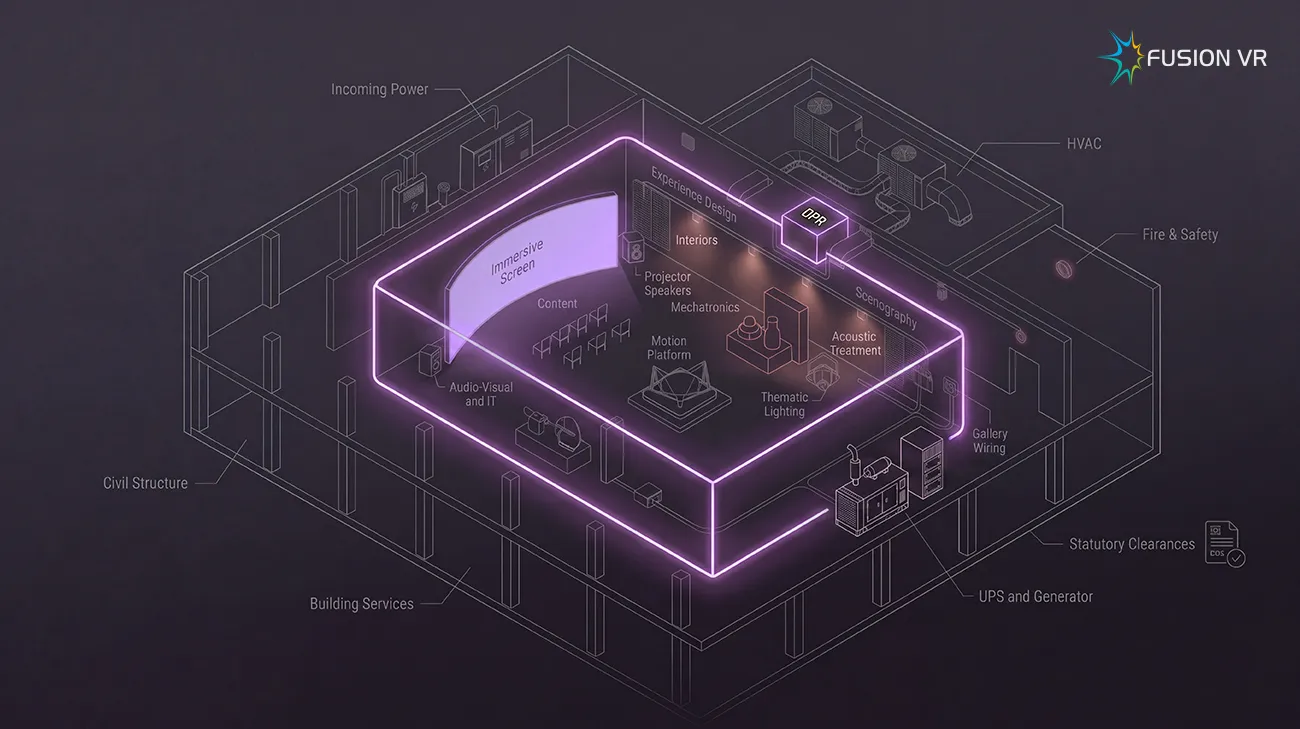
Gallery interiors are experience design, not building work. This is the distinction institutions most often expect us to draw the other way, so we state it first. Thematic interiors, scenography, physical set works and thematic lighting inside a gallery are not finishes applied to a room after the technology arrives. They are part of the experience itself, and they have to be designed in the same room, at the same time, by the same people who are designing the projection, the sound, the motion and the story. A set piece decides where a visitor stands, which decides the sightline, which decides the screen geometry. A lighting scheme that is beautiful on its own terms will wash out a projection surface or break a dark adaptation the gallery depends on. A scenographic wall built without the acoustic treatment designed into it turns a soundscape into an echo. These cannot be split into separate contracts and then reconciled, because by the time they meet on site, all of them are built. Our own teams and our long-empanelled specialist design consultants handle this work as one discipline with the digital experience, which is why it sits inside our scope and not in the building contract.
What stays with the institution, and why it should. The base building and its general services are a different kind of work. They are tendered under different rules, built by contractors licensed for construction rather than for immersive systems, and on most projects the building is already being built, or is finished, by the time a digital museum contractor is appointed at all. General civil and structural works, the general interiors and finishes of the building outside the gallery experience, the incoming electrical supply and its main distribution, UPS and generator backup, and statutory clearances all remain with the institution and its licensed consultants. Two disciplines sit in between and are worth naming exactly. Air conditioning and fire detection are designed by the institution's own appointed consultants, but they design to requirements we issue, gallery heat loads, temperature and humidity bands, clearances, and the constraints the experience places on where a duct, a diffuser, a detector or a sprinkler can sit without spoiling a projection surface or a scenographic set. We then check their layouts against the gallery design and confirm the two agree. Inside the gallery, the electrical wiring and data cabling are ours, designed and installed by us, with the power load stated equipment by equipment so the institution's electrical contractor can size the supply up to our point without interpretation.
The Usual Split, Stated Before Signing
Typically in Our Scope
Digital solutions for the galleries and the visitor journey across the museum
Concept, storytelling and experience design
Multimedia content production, films and animation
Software, AR/VR and interactive development
Mechatronics design, fabrication and simulation platforms
Gallery interiors, scenography, physical set works and thematic lighting
Acoustic design and treatment within the galleries
Internal electrical wiring and data cabling within the galleries
Audio-visual and IT hardware, installation, calibration and commissioning
Operator training, documentation and handover
Typically in Institution's Scope
General civil construction and structural works
General building interiors and finishes outside the galleries
Incoming power supply and main electrical distribution
UPS and generator backup
Air conditioning and fire detection, designed to requirements we issue
Statutory clearances and approvals
Building maintenance, housekeeping and site security
Anything not explicitly stated in the Fusion VR scope column, as set out head by head in the Detailed Project Report
Heritage buildings are held to a stricter discipline. A protected structure cannot simply be drilled, partitioned and cabled to suit an experience, and the constraints are legal as much as physical. Where a digital museum is going into a heritage building, heritage conservation architects work within our team from the design stage, not as a review at the end, because the questions they answer, what may be fixed to a surface and what may not, how services are routed reversibly, what can be returned to its original state, decide the scenography and the technology layout rather than following them.
Where the boundary is documented. The Detailed Project Report carries the split head by head against measured quantities, which is what allows a finance department or a technical committee to see exactly what it is sanctioning and what it must budget separately. The master plan settles the visitor journey before any gallery is designed in detail, which gallery sits where, how a visitor moves between them, and where the sequence should rise and where it should go quiet, and it states what the building has to provide to support it: loads, heights, spans, service routes and clearances. That work is step 03 of the sequence and is described in full on the master planning page, so this page does not repeat it. Both exist before execution begins, and both are written so the institution can hold us to them.
The line can move, and on some projects it should. This is the usual arrangement rather than a fixed one. Where a project's scale or eligibility criteria call for it, we deliver in consortium with civil and services partners and the boundary shifts accordingly. What matters is that it is settled in writing before award rather than discovered on site. Every dispute we have seen on this subject began with a scope line that two parties each read in their own favour, and none of them began with a line that was explicit.
A sensible project carries a contingency, and we say so at estimate stage. A room that turns out to need more sound treatment than expected once its walls are up. A site change that only becomes visible when a wall is opened. A better specification an institution decides it wants after seeing a review sample. None of these are planning failures. All of them are normal on a project of this kind. A modest contingency sanctioned at the outset is the difference between deciding these on their merits and deciding them by whatever is left in the budget.
What creates extra cost during execution, and who carries it. Under a fixed-price turnkey contract the answer is not the same in every case, and it should be stated in advance rather than argued later. Where the institution asks for something outside the contracted scope, a new experience, an extended run time, a changed specification, that is a variation: priced, approved and only then built, never absorbed silently and never begun on a verbal instruction. Delay in approvals is the fifth category, and on content it is the most costly of all. Multimedia and software production runs to a schedule in which artists, engineers, motion capture time, render capacity and studio slots are all reserved in advance against specific milestone dates. When a milestone sits waiting for review, production does not slow down, it stops, and the reserved teams and infrastructure either sit idle or are committed elsewhere and are no longer available when approval finally arrives. Restarting a halted production is not the same as resuming it. This is why the review and approval turnaround, how many working days each milestone is allowed for review, and what happens if it overruns, is documented and mutually agreed in the contract before work begins rather than left to goodwill. Agreed in advance it protects both sides: the institution knows exactly what it must return and by when, and neither party is arguing about a schedule after it has already slipped. Where the cost arises from something we should have foreseen and did not, an underestimate, an omission in our own bill of material, an integration we misjudged, it is ours, and the fixed price is exactly where that risk is meant to sit. Where a genuine site condition appears that neither party could have known, we bring it with the evidence and the options rather than as a bill. And where a statutory requirement or a regulatory change lands mid-project, it belongs to the institution, because it attaches to the building and outlives the contract. We would rather set out these five categories at the outset than have every extra cost become an argument about which one it is.
A quote has a life, and a delayed start has a cost that has to be handled openly. Sanction cycles are long, and it is common for a project to be awarded many months, sometimes years, after the proposal that priced it. Over that period equipment prices move, exchange rates move, and material and labour rates move, almost never downward. We do not carry that silently and absorb it into quality, and we do not quietly inflate the original figure either. We revalidate: re-price against current rates and show the institution precisely what changed and why, line against line. Revalidation protects the institution as much as us, because a specification frozen three years ago will often name equipment no longer manufactured or no longer supported, and buying it because the sanction says so is how a museum opens with hardware already at the end of its life.
The Work Order That Should Go Out First
On most projects the digital museum contract is awarded last, after civil, interiors and services are nearly done, leaving three or four months for the work that needs the longest runway. Content and software are the slowest part of a digital museum to make well, and the hardest to rush. Fusion VR advises institutions to issue this order first, as soon as the concept is approved.
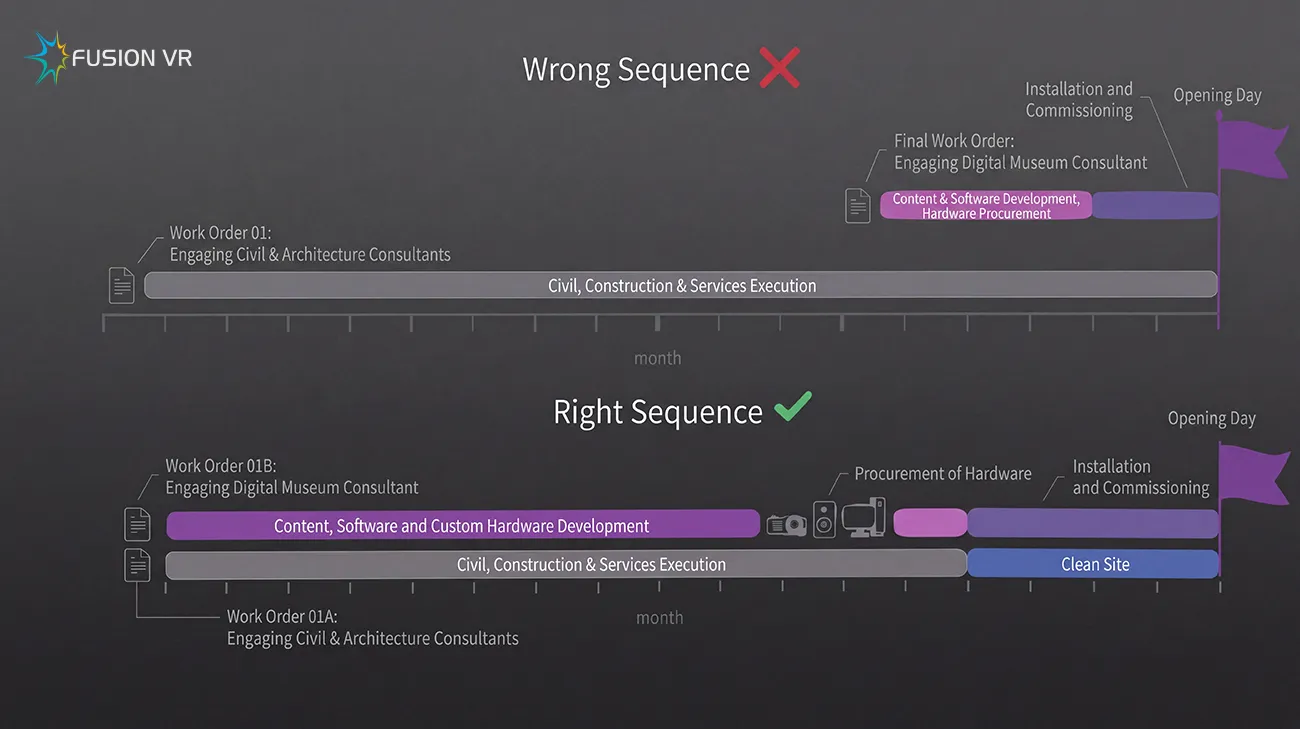
Why this order goes out last, and why that is the wrong way round. The sequence is understandable. A building has to be built, and a digital museum contractor cannot install into an empty site, so the digital work is treated as the finishing trade and tendered accordingly. But the analogy fails on one point. A finishing trade begins when the site is ready and its duration is set by how fast the work can be done. Content and software do not work that way. Their duration is set by how long it takes to research, write, design, build, animate, render, test and refine an original creative work, and none of it needs the building. Every day of that work could have been done while the walls were still going up. The result is upside down. Content and software, which need the most time and could have started on day one, are left until the end and given a few months. The civil and interior work, which genuinely does have to come first, is given the full programme it needs. Only one of the two was ever given a fair chance.
What actually takes the time. A digital museum's content is not selected from a catalogue. Historical and scientific material has to be researched and validated, often with scholars, before a single scene is written. Then scripting, storyboarding, character and environment design, modelling and texturing, motion capture, animation, lighting, simulation, rendering at delivery resolution, sound design, original music, mixing, and the software that has to run all of it reliably in front of the public thirty times a day. Where an institution wants something not attempted before, there is genuine research and development inside that path. This work can be planned, resourced and accelerated to a point, but it cannot be compressed indefinitely without the result showing it, and the visitor will see the difference in the one thing they came for.
The flagship is the measure. The Odyssey of Hanuman 7DX - Sankat Mochan Gallery took sixteen months of content development. That figure is not a symptom of a slow process. It is what a 17-minute, 28K stereoscopic 3D film running at a high frame rate of 60 frames per second per eye, 120 frames per second across the stereoscopic pair, with a 64-channel spatial soundtrack, built to hold an audience on a 100-foot curved screen, actually costs in time. An institution that sees that experience and wants something of the same standard is asking, whether it realises it or not, for a programme that allows the content to be made.
Hardware should be bought late, and we will say so against our own interest. This is the part of the argument that costs us something, so we would rather state it plainly than leave it out. Most audio-visual and IT hardware is bought, not made. It is specified, ordered and delivered. A small number of items do need to be ordered early, and we identify them at planning stage: anything with a long manufacturing or import lead time, anything custom built, and anything the civil or interior work has to be built around, such as equipment that must be positioned before a ceiling or a wall closes over it. That short list aside, the bulk of the hardware should be bought close to installation. Ordering it early only starts the manufacturer's warranty running while the equipment sits unused in a store room, so months of cover are spent before a visitor has seen anything, and it locks the institution into a specification that will already have been overtaken by the time the museum opens. Bought closer to installation, the same budget usually buys a better specification, and the maximum possible warranty period is still available to the museum on the day it opens to the public. A large share of our contract value sits in that hardware, so recommending it be ordered later delays our own billing. We recommend it anyway, because it is what protects the institution.
What we recommend, in plain terms. Once the concept is approved, issue the content and software work order first, and allow it the majority of the project programme. On an eighteen-month project that means issuing the content and software work order within the first month or two, so that content development has around sixteen months to run. Hardware procurement, installation and commissioning then follow in the later part of the programme, alongside the building work. Fusion VR is not asking for more months on the calendar. We are asking for a fair share of the months the project already has. Content and software need the greater part of the programme, not the last three months of it. Institutions that have given content that time do not talk about the schedule afterwards. They talk about how the finished gallery feels to walk into.
Where the constraint is real, and what to do instead. We are not pretending the sequence is always a choice. Fund sanction cycles release money in a fixed order. Civil tenders often have to be concluded before dependent contracts can be raised. Administrative approval chains have their own sequence and their own timing, and a project officer cannot simply reorder them. Where the full award genuinely cannot be issued early, the answer is to phase it: sanction the content and software as the first work order, on its own, and release the hardware, installation and commissioning as a later one. This is administratively straightforward, it fits how phased sanctions already work, and it buys the content the runway it needs without waiting for the whole budget to clear. Raise it with us at feasibility or master planning stage, before the procurement route is fixed, and we will help structure it so it survives the approval process rather than complicating it.
What an institution gains by getting this right. Content built to a proper programme is content that can be reviewed properly, revised where a trustee or a scholar has a legitimate objection, and refined rather than merely finished. It is also the version of the project where our best people stay on it long enough to do their best work. On a compressed schedule a capable team can still deliver something that works properly. What it cannot do is go further and make it beautiful. That last stretch, the refining, the reworking of a scene until it moves someone, is the part that needs time, and on a rushed schedule there is none left for it. A digital museum is judged for decades on the strength of what plays in its galleries. The single most effective decision an institution can take to protect that is one taken before anything is built, in what order the work is put out.
What Begins the Day the Order Is Issued
By the time a work order is issued, the deciding is done. The scope split, the approval schedule, the site readiness dates and the programme were all settled in the contract before award. So nothing waits. Fusion VR moves straight into production on two parallel tracks, content and software, months before the building is ready, and usually while its walls are still going up.
Nothing is being negotiated in week one, and that is deliberate. On a well-prepared project the first weeks are not spent agreeing how to work together. Who approves what, how many working days each review is allowed, when the site must reach readiness, and what sits in whose scope were all fixed in the contract, as the earlier sections of this page set out. What the work order does is release the work. The difference shows immediately: a project that begins by producing is a different project from one that begins by meeting.
One project manager holds the whole of it. From the day of award we assign a project manager who remains the institution's single point of contact through to handover, across every track described below. We ask the institution for the counterpart it agreed to nominate: one person with the authority to consolidate the institution's views and give a decision. The museum's subject experts, trustees, architects and officers all have their proper part, and the structure exists so their input arrives at the stages where it shapes the work rather than after production has moved past it.
The content track goes first, into pre-production. This is the work Section 3 argued must be given the longest runway, and it begins at once because none of it needs the building. Subject research opens immediately: the institution's archives, records and nominated experts, and where a specialist is needed and the institution does not have one, historians, archaeologists, scientists or scholars from our long-associated network, validating every fact, date and depiction before a scene is written. On that foundation, pre-production runs its full sequence: a finalised single-page definition of every experience, then script, screenplay, dialogues and narration, storyboards, character designs, environment designs, and the initiation of sound design. For stereoscopic work there is one more document most institutions have never heard of: the stereoscopic 3D depth script, which plans how deep or near each scene should feel, shot by shot, so that depth is designed for comfort and effect rather than discovered in rendering. Pre-production is where an institution's involvement matters most, because a correction to a script costs a conversation, and the same correction after animation costs a schedule.
The software track starts beside it. While the content team is in research and script, the software team is gathering requirements and defining every interaction the museum will carry: what a visitor touches, triggers, plays and controls. From that come the user interface and user experience designs, screen by screen and gesture by gesture, and the software architecture, the technical design that decides how the applications, media servers, show control and management systems will be structured and how they will talk to one another. Architecture settled early is what makes the later integration of content into software an assembly rather than an improvisation.
The engineering tracks begin on paper, and stay there for now. Networking, audio-visual and IT engineering start with detailed design: drawings, layouts, cable routes, rack positions and equipment schedules, frozen against the gallery designs. What deliberately does not happen yet is buying. As Section 3 set out, beyond the small list of long-lead and custom-built items identified at planning, hardware waits until installation is in sight, so the specification stays current and the warranty is not spent in a store room. Design now, procure later is not a delay. It is the sequence working as intended.
The institution sees all of it, on a schedule it already agreed to. Review points arrive as the contract set them: concept, script, storyboard and staged production reviews, each with a named reviewer and an agreed turnaround. Between those points the tracks run without needing the institution's daily attention, and Fusion VR reports progress against the programme rather than against impressions. The review points are where an institution's attention genuinely shapes the work, and an institution that engages them fully is giving the project everything it needs. The best digital museums we have delivered came where the client placed their trust in us and gave the teams creative freedom between reviews, without interruptions, and the schedule is built exactly for that.
How We Produce the Content, Software and Motion Systems
Once pre-production is approved, the project enters its longest and least visible phase. For months the work exists on screens, workbenches and test rigs rather than on site, and Fusion VR runs it as three converging tracks: content in production, software in development, mechatronics in fabrication. One rule governs all three: nothing is trusted on paper, and everything is prototyped and physically proven before it ships.
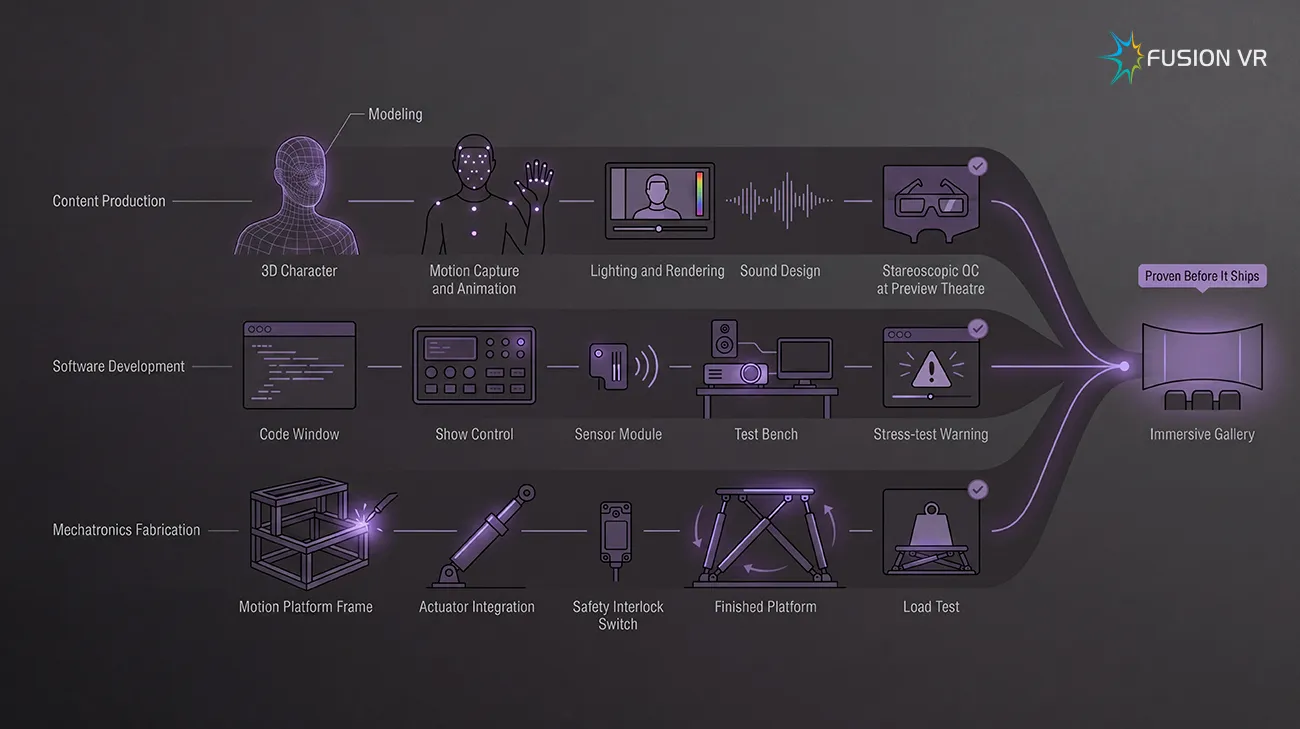
Content production builds the world before it performs in it. Production runs in two deliberate levels. First, environments and characters are modelled to their base geometry, rigged ready for animation, while the sound design begun in pre-production develops alongside. The second level adds what makes them believable: fine detail and surfacing, hair and cloth simulation so robes and banners move as fabric rather than as cardboard, fluid simulation for water, fire and smoke, crowd simulations, and the full animation pass. Where human performance drives a character, our motion capture pipeline records face, body and fingers together, so a gesture and the expression that belongs with it arrive as one performance. Post-production then finishes it: final cameras, final lighting, rendering at delivery resolution, compositing, colour correction, editing, and music and sound design finalised against the locked picture.
Software moves from architecture to a running system. Core development builds what the architecture designed: the applications a visitor will use, the show control that runs each experience, the management layer the museum's operators will live with daily, and the integration of sensor modules that let the experiences respond to visitors. As finished content arrives, media and content integration marries the two, every film, interactive and audio asset placed, triggered and tested inside the software that must run it thirty times a day. Integration testing runs on the bench with real projection, audio and control hardware, and failure modes are stress-tested deliberately at extreme conditions and extreme user behaviours, restarts, power cuts, a show stopped mid-run, a visitor doing what no visitor was expected to do, so behaviour under fault is a design decision rather than a discovery.
Nothing is believed because it worked last time. Every project is different: a different hall, a different audience position, different distances, heights and sightlines. So every subsystem, not the mechatronics alone, is prototyped and physically tested at our studio and fabrication facility before it goes anywhere near the site, because a design that is correct on paper, or proven in a previous project's geometry, has proven nothing about this one. Take something as small as an aroma effect. A dispenser that performed perfectly in a hall where visitors sat close to it faces a different task where the distance is longer and the mounting height has changed: the air movement that carries the scent has to be engineered again, and the only way to know it reaches the visitor at the right moment, without lag, is to reproduce the same distances in the studio and test it until it does. The same discipline applies to every multisensory effect in the experience, and to custom-built pieces: a purpose-designed 3D hologram is assembled and run at our facility playing samples of the actual show content, not a test pattern, before it ships. Prediction models and engineering calculations tell us where to start. The prototype tells us the truth.
Sound is proven in simulation before it is proven in the hall. A spatial audio design with dozens of channels and moving sound objects cannot wait for the finished gallery to find out whether it works. So the soundscape is translated into an ambisonic monitoring environment by our sound designers, and the mix is auditioned inside it: whether each sound sits where the designer placed it, whether movement tracks the picture, whether the scene holds together as a space. This is not a substitute for calibration in the real hall, and we do not pretend otherwise. It is a verified starting point, a minimum guarantee carried to site, so the work there is refinement rather than rescue.
Picture is proven the same way, even when no screen on earth matches the site's. No studio holds a duplicate of every giant curved screen or dome, so we build workarounds that test what actually matters. For The Odyssey of Hanuman 7DX - Sankat Mochan Gallery, there was no second 28K stereoscopic screen to preview on. The content was cut into segments and reviewed in our studio's stereoscopic 3D theatre, a 4K passive system with 2K per eye, section by section, to verify the depth: that the parallax behaves, that the stereoscopy reads correctly, and that nothing in the grade strains the eyes. Then the complete 180-degree film was mounted inside a VR headset, stitched end to end, to judge the whole sweep of the image as a single view, the thing no flat monitor can show. Between the two, the content arrived at site already proven in depth and in coverage, with the site's own calibration left to do what only the site can.
Mechatronics is built by our own hands, and cycled before it leaves. Motion platforms and simulation systems are mechatronics engineered and fabricated by our own team: structure, hydraulic or electric actuation as the experience demands, control systems and safety interlocks, assembled in-house. Fabrication runs in parallel with content so that motion profiles are authored against the real platform's measured behaviour, not a datasheet's promise. Factor of safety is calculated for every load-bearing element, and every platform runs extended cycling under load on our floor, hours of repeated motion, before it is dismantled for transport.
The tracks converge on purpose, and the institution sees it happen. Content is rendered to the exact geometry, resolution and frame rate the projection design specifies. Software is built against the content's real files and trigger points. Motion is profiled frame-accurate against the finished film, and the mix is made for the hall's actual speaker layout. The convergence points sit in the programme from day one, so nothing downstream is built on anything upstream that has not been approved. Through all of it the contracted reviews continue: work-in-progress screenings of key scenes, software demonstrations, and where a client wishes, a visit to watch their platform run on our floor. Fusion VR shows real work in progress rather than polished previews of the easy parts, because a review that only sees what is safe to show protects nobody.
MOTION PLATFORMS · 3DOF vs 6DOF
Scroll or pinch to zoom · select a movement to see its direction
3DOF MOTION PLATFORM
Three movements · Heave · Pitch · Roll6DOF MOTION PLATFORM
Six movements · Heave · Pitch · Roll · Surge · Sway · YawMOTION PLATFORMS · 3DOF vs 6DOF
Scroll or pinch inside a stage to zoom · select a movement to see its direction
3DOF MOTION PLATFORM
Three movements · Heave · Pitch · Roll6DOF MOTION PLATFORM
Six movements · Heave · Pitch · Roll · Surge · Sway · YawTested at Our Facility Before Shipping to Site
Turnkey should never mean the client finds out on site. Standard equipment ships under its manufacturer's factory acceptance tests. Every custom-engineered system, and every standard item whose replacement would take months, is additionally tested at our own facility against its specification before anything goes to site. Fusion VR is equally plain about the limit: integrating everything into one performing experience can only happen at the site itself.
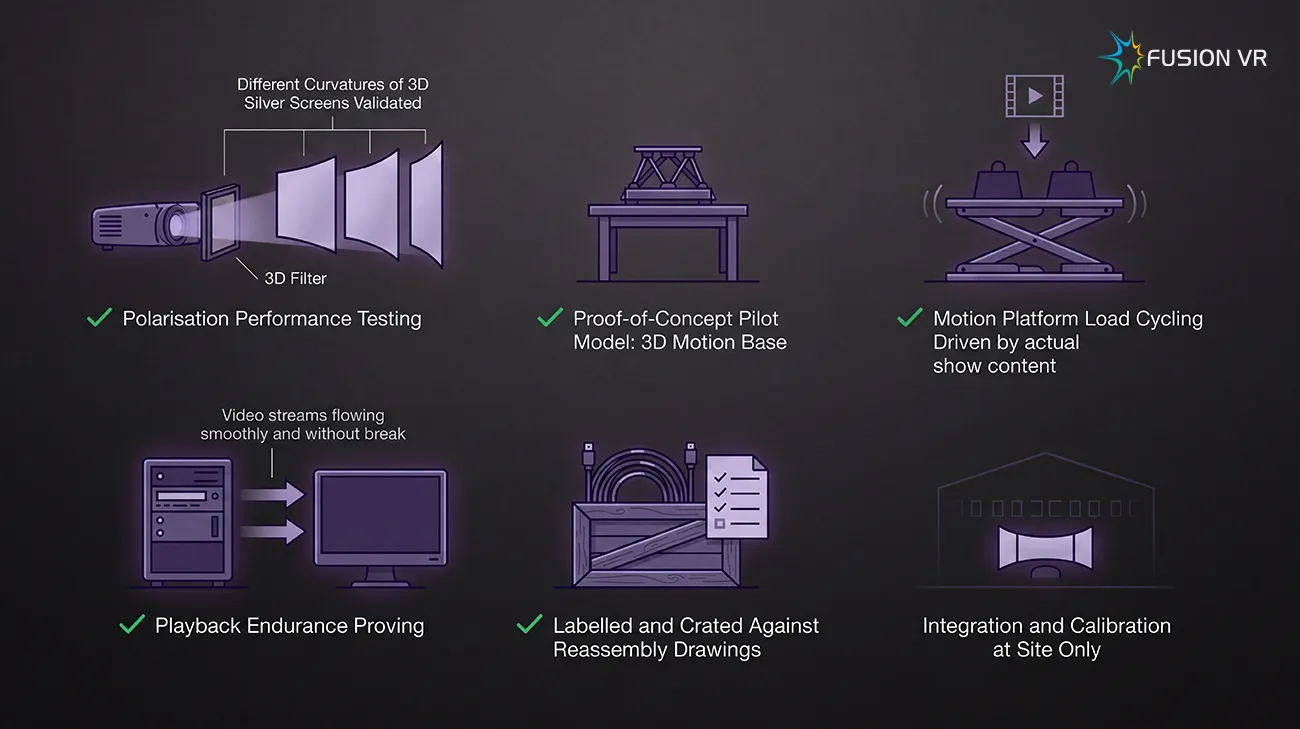
Testing happens at two levels, and criticality decides which level applies. Manufactured equipment, projectors, speakers, playback hardware and the like, passes its maker's factory acceptance testing before dispatch; that is how professional-grade equipment is sold, and it is one reason we specify it. But an OEM's test certificate is not the end of the question. The question that decides everything is: if this item arrived faulty and we only discovered it at the site, how long would a replacement take? Anything custom-engineered has no factory but ours, so it is tested here by definition. And any standard item that is made to order, with a lead time running to months, is treated as critical and tested at our facility the moment it arrives, regardless of the OEM certificate it shipped with. A surprise at unboxing on site, with a three-month replacement clock, is precisely the kind of schedule wound a turnkey contractor exists to prevent.
A worked example of criticality: fourteen filters that could not be risked. The Odyssey of Hanuman 7DX - Sankat Mochan Gallery runs fourteen custom-engineered polarised 3D glass filters, one per projector, and the full set takes around three months to manufacture and ship. A filter can arrive physically perfect, unmarked, uncracked, and still be optically wrong, because polarisation performance cannot be judged by looking at a piece of glass. It shows itself only in projection. So every one of the fourteen was tested for its polarisation performance at our facility on arrival, individually, and spare filters were ordered alongside as a matter of precaution, because on a component this critical, with a lead time this long, a spare on the shelf is cheaper than a season lost. If a filter fails the test, the replacement order goes out months before installation instead of months after opening day was missed. The cost of the test is an afternoon. The cost of skipping it can be a season.
What our facility proves, system by system. The motion platform runs its full profiles under passenger load, driven by the actual show content, cycled for hours before dismantling. Every multisensory effect is engineered and tested for the real hall's distances and mounting positions, as Section 5 describes. Content is reviewed in our stereoscopic preview theatre and, for wide-format work, whole inside VR headsets. The sound design is auditioned in the ambisonic monitoring environment. Software is exercised against its sensor modules and control hardware on the bench, stress-tested at extreme conditions and extreme user behaviours. Where joining subsystems is feasible, Fusion VR joins them: software driving the real platform, effects firing on live cues from the show control. What is possible to test is tested. Where a result falls short of its mark, the design goes back to engineering and is redesigned, rebuilt and retested until it performs, because here is where problems are cheap. A fault found at our facility is a task; the same fault found on site is a crisis.
A worked example of proving performance: playback for a 28K stereoscopic film. For The Odyssey of Hanuman 7DX - Sankat Mochan Gallery, the video playback system had to sustain a 14K left-eye stream and a 14K right-eye stream simultaneously, each at 60 frames per second, for the full running time, show after show. Whether a hardware and software environment can genuinely do that, without a single stutter, must never wait for the site to be answered. So it was proven at our testing facility: the playback chain running the real content at full resolution and frame rate, measured for sustained, smooth delivery. Where performance falls short, we work the problem from both ends. The content side is optimised, selecting the video encoding and compression techniques that let it play flawlessly without visible loss, and the hardware side is tuned or upgraded, a component swapped for a stronger one where the chain needs it, until sustained smooth playback is proven. That proven pairing, the optimised master on the upgraded chain, is what ships. What we hold back from claiming is just as deliberate: once fourteen projectors are mapped to the real screen's geometry and edge-blended into one image, the demands on the chain shift, and final performance can only be confirmed there. What leaves our facility is a minimum guarantee, the certainty that the system can play the show, so the work at site is confirmation and refinement, never rescue.
Why the full experience cannot be assembled at any factory, ours or anyone's. The finished hall is far larger than any test floor, with its own power capacity, cooling, rigging and acoustic environment, and no replica of it exists anywhere. Fourteen projectors can each be tested individually, but making them one continuous image is the work of calibration, and calibration exists only in the real geometry: the actual screen, the actual throw distances, the actual hall. Sound is the same: a 64-channel spatial system is only judgeable with every speaker in position inside the acoustics it was designed for. Until that calibration, nobody can even say whether a visible fault belongs to the content, the projection setup, the screen, the filters or the playback chain. A vendor who implies the whole experience was run at the factory is describing something that cannot be done, and an institution evaluating claims deserves to know that.
So what cannot be built twice is proven by method. Where a system is too large to assemble at the factory, we isolate the questions that decide its success and answer each one at a scale that can be tested. The flagship's screen could never come to our floor, so the critical unknown, whether a polarised surface would hold stereoscopic separation on a deep curve, was answered before fabrication: three test screens at three different curvatures, each measured for 3D polarisation retention, and the curvature that held is the one standing in the hall today. The projection geometry was validated on proof-of-concept pilot models. Nothing about the finished gallery was left to hope; the questions were answered where they could be, and every answer travelled to site with the equipment. And we will tell you honestly what method cannot catch, because one case taught us its exact edge. When the 100-foot silver screen arrived at Ayodhya and was stretched and fixed across its 180-degree frame, it looked right. Weeks later, with the projectors installed and the actual content running, a variation appeared in the coating across the middle of the screen: the polarisation and shading there behaved differently from the rest, something no inspection of the delivered material could have revealed, and only the full projection running on the installed screen could. In fairness, not even the manufacturer can stretch a 100-foot screen across a 180-degree frame at their own factory and install fourteen projectors to test it. So neither their factory nor ours could have found this fault before installation. It could only appear at the site. What it proved instead was the value of the partnership: understanding the stakes, the manufacturer prioritised production and delivered a correctly performing replacement screen within weeks, without any charges. That is not luck. Over two decades we have built long-standing relationships with our OEM and partner ecosystem, and when a last-minute manufacturing fault surfaces at the worst possible moment, those relationships are what convert it into a footnote instead of a failure. We state this in advance, system by system: which will be tested assembled, which in feasible combinations, and which by method, so the assurance an institution receives is exact rather than implied.
The institution is invited to witness, and packing protects the proof. We invite the client's officers and engineers to attend the factory stage, and for the flagship that is exactly what happened: officials from Delhi from the Department of Science and Technology, Government of India, and the committee members of IITM Pravartak visited our fabrication facility, watched the motion platforms run, sat on them and experienced the ride themselves, and confirmed the performance before the platforms were dismantled and shipped to Ayodhya. For a government project those signed records are audit evidence that what was paid for existed, worked and met specification before dispatch. Then dismantling follows a planned sequence, every cable and connection labelled against the reassembly drawings, components protected, crated and manifested so what arrives is checked against what left. On site, reassembly follows the same drawings, done by the same team that built and tested the systems, and the site work becomes what only the site can do: integration and calibration, the subject of the sections that follow.
The Site Has to Be Ready Twice, and for Different Work
A site becomes ready twice, for two different kinds of work. The first readiness lets our containment, wiring, mountings, racks, acoustic treatment and fabrication run alongside the interior and scenography trades. The second, far stricter, lets sensitive audio-visual and IT equipment come in. Fusion VR sets both dates in the contract programme, long before either arrives.
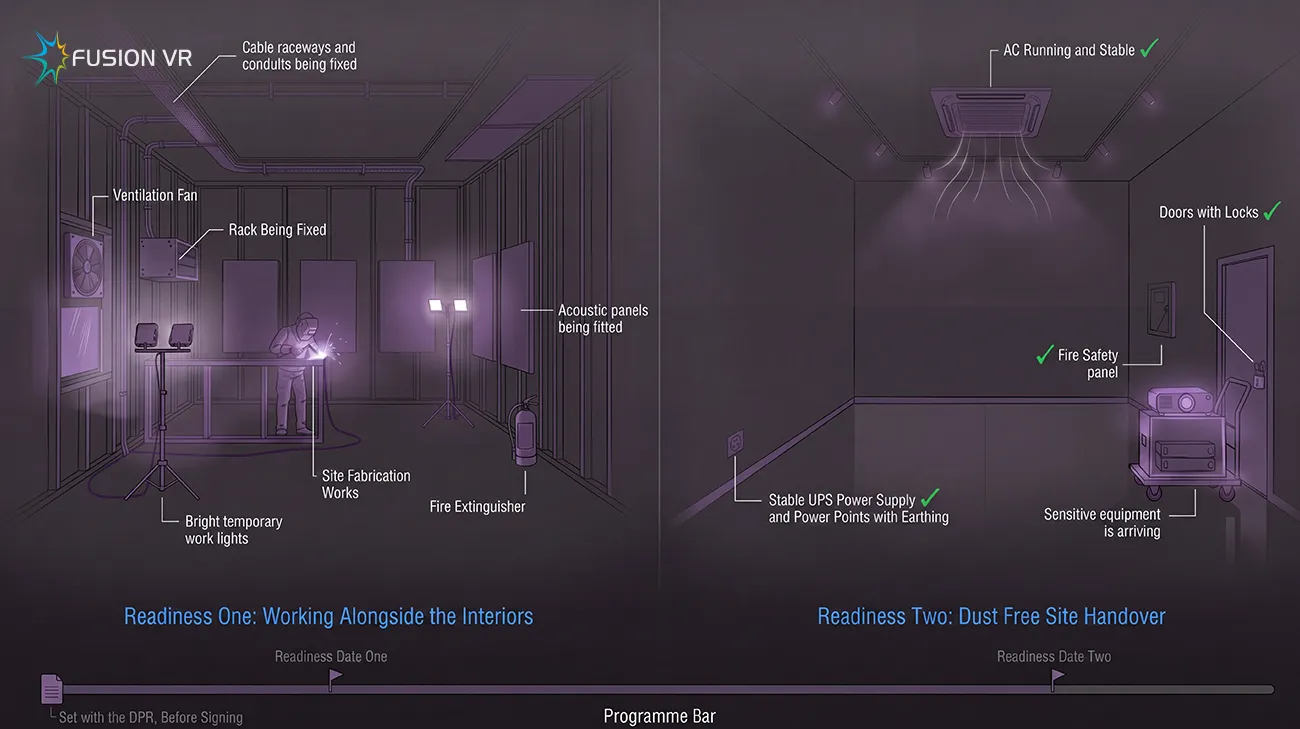
Both dates are agreed at the start, not asked for at the end. The two readiness dates go to the institution with the Detailed Project Report, before the contract is signed, and both are written into the programme with the works that depend on them. Nothing on either list is a late demand. By the time the site is needed, both sides have been working to the same dates for months.
Our first stage of site work runs beside the interiors, not after them. This surprises institutions who expect us to arrive at the end. Raceways and cable containment, conduiting, internal electrical and data wiring, low voltage runs, structural mountings and fixings for audio-visual equipment, rack positions, cable pulling and termination, acoustic treatment, and metal and wood fabrication all belong in the programme alongside the set works and scenography. They are planned that way from the start. Done afterwards, every one of them means opening a finished wall or ceiling that somebody has just closed.
That stage has its own conditions, and a clean site is not one of them. Dust is expected at this point, including ours. What we do need is different. Adequate power at the working points, so tools and test equipment run. Bright interior working lighting, not the thematic lighting, which comes much later: this work cannot be done well in a dark gallery. Ventilation, because the space is being cut, welded, drilled and finished. Safe building access for moving equipment and people: ramps, staircases, lifts whether temporary or permanent, and handrails in usable condition. Ladders and scaffolding for our own working at height are ours to bring. Basic site safety and portable fire extinguishers in place, because cutting and welding are going on. And basic amenities including temporary toilets, so a team works through the day instead of losing hours to walking off site.
Lockable storage, from the first delivery onward. We need a room with a door that locks, and we ask for it early. A live site has several contractors working at once, and material moves constantly. When something goes missing from an open gallery, nobody can account for it and everybody is under suspicion, which is bad for the project and unfair to people doing honest work. A locked store removes the question entirely.
The second readiness is the strict one, and it is a formal handover. Before any sensitive equipment comes in, civil, interior, scenography and thematic lighting work must be complete, not nearly complete. Painting and finishing done. The site cleaned and the dust-generating trades finished. Air conditioning running and stable. Power stable, properly earthed and available at every equipment point, with all electrical safety work complete. Fire safety systems installed and statutory approvals in hand. Security in place. We take this over as a documented handover of a dust free site, not as an informal nod, and the full checklist sits on our FAQ page.
Dust is the item people take least seriously and pay for the longest. Projectors, servers and motion systems breathe. Whatever is in the air on the day they are switched on goes inside them and stays there. Fine dust from cutting and drilling settles on optics, filters and moving parts of equipment that will run for hours every day for decades. It does not fail that week. It fails in the second or third year, long after anyone connects the two.
Pests and water do the quietest damage, and both are preventable. Rodents chew cable, and a gallery full of new cable routes is exactly what attracts them. Bats and birds get into high roof spaces and foul equipment mounted below them. Insects nest inside warm enclosures. Pest proofing and pest control must be done before we install, and kept up afterwards. Water is the other one. Roof and wall seepage, and condensate dripping from air conditioning indoor units and uninsulated ducts, will find electronics eventually. We ask for both to be checked and closed, because neither announces itself until something has already failed.
High-speed internet is a working requirement, not an office convenience. Software installation and activation, cloud services that have to be enabled and configured, remote support from our engineers who are not on site, and the monitoring of systems as they come up all depend on it. It also lets the project management team watch installation progress through site cameras rather than waiting for a report, and those recordings are what any incident on site is investigated from afterwards. A slow or intermittent connection turns a day of work into a week of it.
We survey the site before we ship, and an unready site costs the institution as well as the calendar. A joint survey happens well before dispatch and produces a written record: what is ready, what is not, and what must happen before the first crate leaves. Fusion VR would rather tell an institution months out that a date is at risk than mobilise into a site that cannot receive us. Teams booked against dates either wait or are released elsewhere. Equipment already delivered has to be stored and insured while its warranty runs down. Early bad news can be acted on. Late bad news can only be absorbed.
Readiness is the biggest single lever the institution holds on the opening date. Everything else on this page is ours to manage. This one is not. What genuinely cannot be brought forward is the finishing work: alignment, colour matching, stereoscopic setting, sound balancing and the final show runs all need the finished room, as Section 9 explains. Institutions that treat the two readiness dates as firm dates open on time. Where they slip, the squeeze always lands on that last stretch, the weeks where our team should be peacefully refining the experience and finishing it beautifully rather than rushing with compromise.
Installation, Commissioning and Integration
Installation is where a digital museum that existed in drawings and files becomes a physical thing. Our own teams do it, not a subcontracted crew, and they are largely the same people who built and tested the systems at our facility. Fusion VR works to a fixed sequence, because the order things go in decides how much can go wrong.
The order is fixed before we mobilise, and it follows the two site readiness stages. Overhead work comes first: mounts, brackets, rigging and the fixings for everything that will hang. Racks, containment, cabling and terminations follow, while there is still open floor to work across. Screen frames and motion bases go in after that, near the end of the dusty stage, because once a motion base is standing in a hall it fills it and nobody else can work around it. None of that work needs a clean site. Only when the dust free handover in Section 7 is complete do projectors, servers, sensors, speakers and interactive hardware come in.
Anything above a visitor's head is a different class of work. Projectors, speakers, screen structures and rigging hang over the exact spots where people will stand for decades. Every one of them is fixed to a structural provision that was designed to carry it, and every one carries a second, independent retention, so no single fixing is ever the only thing holding a load. Safety chains, secured brackets, anti-vibration mounting where it is needed, and a recorded check on each. Fusion VR does not treat any overhead item as too small to be worth this, because it is the one category on a project where a mistake is not recoverable.
Custom systems arrive as engineered sub-assemblies and are built up on site. A motion base or a screen frame is a large structure once it stands, and it was never going to travel that way. They are designed from the outset to break down into transportable sub-assemblies, each one engineered as a part rather than cut apart for shipping, labelled against the same drawings they were assembled and tested from at our facility. The same people who built them put them back together. Nobody on site is working out how it fits, which is what the factory stage in Section 6 buys: the team is repeating something already proved rather than attempting it for the first time in front of a deadline.
The work nobody will ever see decides how long the digital museum runs well. Power and signal cables kept apart. Runs secured and supported properly rather than pulled tight and left. Terminations made carefully, not at speed. Containment left with spare capacity, because a gallery always adds something later. Every cable labelled at both ends. Proper earthing and safe power connections throughout. None of this is visible once the panels close. All of it is what decides whether a fault in year eight takes an hour to find or a week.
From the dust free handover onward, we are working inside a finished gallery. By this stage the walls, the thematic interiors, the scenography, the lighting and the flooring are all complete. Some of that work is ours and some is the institution's, and none of it can be damaged and quietly repaired later. A scratch on a finished surface is visible on opening day. So we cover surfaces before work starts, agree the access routes in advance, plan any cutting or drilling instead of deciding it on the spot, and keep the gallery clean.
Commissioning brings each piece of equipment to life, one at a time. Before anything is joined to anything else, every individual item is powered up and proved on its own: each projector switched on and showing a test image, each speaker producing sound, each server booting, each sensor reading, each motion actuator responding. A fault found here belongs to one machine and is fixed in minutes. This is the checkpoint between installing the equipment and integrating it.
Integration is where the separate systems stop being separate. This is the stage where a room full of individually commissioned equipment becomes one experience a visitor can walk into. Subsystems are joined in a planned order, one link at a time: network, servers, projection, audio, motion, effects, show control and interactive stations. Done this way, a fault has one obvious cause. Done all at once, a fault has many possible causes and the search for it eats the schedule. This is the work that could not be finished at our facility, because it needs the real room, the real cable runs and the real distances.
At the end of installation, everything is in place and nothing is tuned. Every system is mounted, wired, powered and talking to the systems around it. Progress through this stage is reported against the programme at the review points the contract sets, and the site cameras let the project management team follow it without travelling. What is still missing is the part that decides how the experience actually looks, sounds and feels. That is calibration, and it is the next section.
Calibration and Fine Tuning
Calibration is the difference between equipment that works and an experience that feels right. It cannot be done at a factory, because it tunes the integrated systems to the actual room: its surfaces, its distances, its darkness and its silence. Fusion VR does this with its own specialists, in finished site conditions, and keeps tuning until the experience matches what was designed.
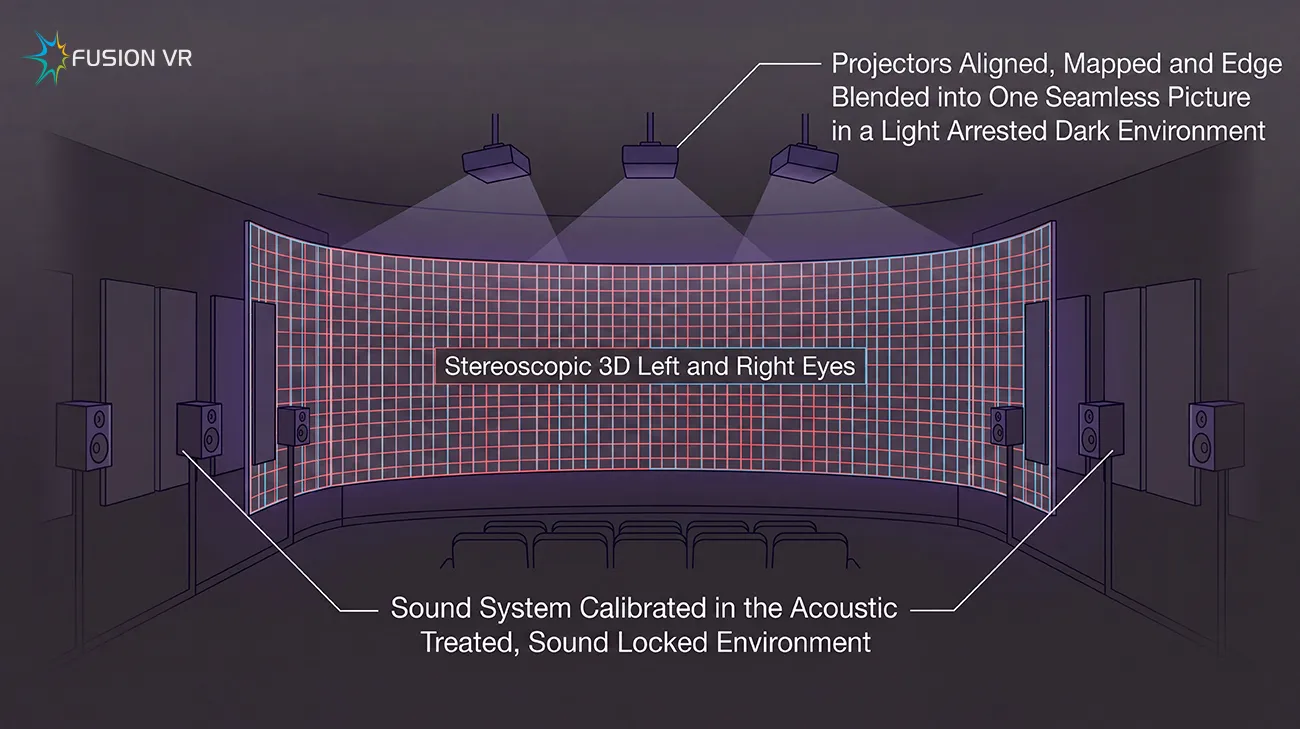
Calibration needs the finished room, because the room is part of the instrument. A projected image depends on the surface it lands on. Sound depends on what the walls, ceiling and seats do to it. Darkness depends on the blackout actually being complete. This is why calibration sits after the finishing work, never alongside it. Calibrating early to show progress means calibrating twice, and the first pass was never real.
Every projector is aligned into one seamless picture. Where several projectors build a single image, each one is geometrically aligned to the screen, the overlaps are blended until no seam shows, and colour and brightness are matched so the whole picture reads as one canvas rather than a patchwork. This is patient, specialist work, done in the dark, and it is the single biggest difference between a gallery that looks professional and one that looks assembled.
Stereoscopic 3D calibration is a discipline of its own. In stereoscopic work the left eye and right eye images must align precisely with each other across every projector, on a surface that is often curved, or the depth collapses and the audience feels eye fatigue instead of wonder. Fusion VR's team developed this capability through years of in-house work, and it is one of the hardest skills in the field. How we built it is a story our FAQ tells in full.
Sound is tuned to the hall, not to the specification sheet. Speaker by speaker, the system is measured and balanced for the actual space: coverage, level, timing and clarity at the seats where visitors will actually be, not at an ideal point in the middle of the room. In spatial audio work, sounds must appear to come from where the picture says they come from, and that placement is made here.
Motion and effects are synchronised to the frame. A motion base must move exactly with the picture, because even a small mismatch between what the eyes see and what the body feels is something a visitor senses immediately, without knowing why. Wind, water, scent and lighting effects are timed to their exact cues. Interactive stations are exercised with real hands: touched, triggered, played and deliberately misused, until they respond correctly every time.
Then comes the tuning no instrument can do. Instruments can confirm a system is set correctly. They cannot judge whether the show feels right. So after calibration, our senior creative and engineering team sits in the visitor seats and watches the complete show, start to finish. Wherever something does not feel right, they adjust it and watch again. They repeat this, show after show, until the whole experience plays the way it was designed to be felt.
Fine tuning ends when it matches the design, not when the calendar says so. The reference is the work the institution already approved at the review stages: the finished film, the finished sound mix, the approved motion design. The gallery is tuned until what plays in it is that same approved work, now at full scale, in its real room. Proving this formally to the institution, show after show, with witnesses and records, is the subject of the next section.
Tested and Delivered as a Complete Experience, Ready for Opening Day
A show that runs perfectly once has proven very little. The public will run it many times a day, every day, in a full hall. So before opening, the complete digital museum is tested the way it will actually be used, and Fusion VR does not present it for acceptance until it has already passed our own testing first.
We test it before we ask you to test it. Site testing has two rounds, and the first one is ours. Our own team runs every experience through its full test plan and fixes what it finds, before the institution is ever asked to witness anything. Presenting a half-proven gallery for acceptance wastes the institution's time and spends its confidence. When we invite your officers in, it is because we have already tried to make it fail and could not.
The whole system is stress tested by running real shows, continuously. This is not testing at component level. The complete integrated system, content, projection, sound, motion, effects and control together, is run show after show, exactly the way it will run for the audience once the digital museum is open. Every show is watched, any glitch found is recorded and fixed immediately, and the running continues. The air conditioning carries a real heat load with everything on at once, because faults that only appear with heat and hours must appear now, in front of our engineers, and not in the third week in front of the public.
The flagship shows what this means in practice. Before The Odyssey of Hanuman 7DX - Sankat Mochan Gallery was handed over, our team split into two shifts of eight hours each and ran the complete show continuously for sixteen hours a day, at three shows an hour, for two consecutive days, with only the overnight break between them. Within each day, the moment a show ended, the next was started immediately. That is nearly 100 complete shows, each run exactly as a public show, to prove the performance and stability of the entire system under sustained load. What was handed over was not a system that had worked once. It was a system that had already survived two days of its future life.
Interactive experiences are tested for how visitors actually behave. Where an experience is one the visitor operates, touchscreens, triggers, games and hands-on stations, correct use is only half the test. Visitors press two buttons at once, walk away mid-interaction, and lean on things. Operators will one day start systems in the wrong order, and power will one day fail mid-show. So these experiences are deliberately misused and interrupted until they recover correctly every time, because a digital museum has to practically survive its public, not only perform in ideal lab testing conditions.
The institution witnesses the testing, and the record is signed. Acceptance testing is run in front of the institution's own officers and engineers, experience by experience, against what the contract promised. Each result goes on record and is signed by both sides, and a witness video is recorded throughout the process, so the officers hold both a signed record and visual evidence for future audits. For a government institution this matters beyond reassurance. It is also simply how confidence should be built, by showing rather than assuring.
Delivery means the experience, not the equipment. In Fusion VR's grammar, delivery has one meaning. We design the solution. The outcome of that solution is the experience the visitor will finally immerse in and enjoy. That experience, running reliably, proven show after show, is the only thing we call delivered. Supplying the components on a bill of material and integrating them into something merely functional is not delivery. It is the difference between a hall full of working equipment and a story that moves the person sitting in it, and we are accountable for the second.
What testing finds goes on one list, and the list is closed. Testing exists to find things, and it usually finds something. Every finding goes onto a single list, each item with an owner and a date, and the list is worked down until it is closed or the institution has knowingly agreed how a remaining item will be handled. Nothing is left as a verbal assurance. An opening day should arrive with a closed list, not a hopeful one. Many of our digital museums have then been inaugurated and experienced by Hon'ble Chief Ministers and Union Ministers, and once by the Hon'ble Prime Minister of India, and for a day of that kind we rehearse the inauguration sequence itself and stand by on site through the event, as our FAQ sets out.
Delivering to a Fixed Opening Date
Government projects often carry an inauguration date that cannot move, fixed by an official event or a dignitary's calendar. Fusion VR plans backwards from that date, says honestly at the start whether it is comfortable or demands an accelerated effort, and then delivers to it. We have done this on some of the tightest timelines attempted in this field, and the proof follows.
The date is planned backwards, and the truth is told at the start. Once the opening date is known, we build the schedule back from it: what must be finished by when, which work sits on the critical path, and where the risk lives. Then we say plainly which kind of date it is. Comfortable, achievable with an accelerated effort, or not honestly achievable as scoped. An institution can act on any of those answers at the start. It can act on none of them in the final month.
Eight galleries in seven weeks. The Amma Memorial Museum and Knowledge Park was delivered for the Government of Tamil Nadu with eight galleries of interactive digital experiences completed in a seven-week timeline. Seven weeks is not a schedule anyone would choose. It was the schedule the project had, and it was met.
Around eleven galleries, two cities, two to three months, in parallel. The Porunai Museum in Tirunelveli and the TNPAGE Experience Centre in Chennai, both for the Government of Tamil Nadu, together carried around eleven galleries, inaugurated within a very tight two to three month window, and built in parallel with each other alongside our other running projects. Parallel delivery at that pace is only possible when one organisation controls all of its own capacity.
The in-house pipeline is what makes such timelines possible. On a compressed programme, every handover between separate vendors is a delay waiting to happen, and no vendor can be surged on another vendor's behalf. Fusion VR's content, software, mechatronics, audio-visual and IT teams work under one roof, so the schedule is compressed by running tracks in parallel and surging our own people, not by hoping several companies stay coordinated at speed.
What acceleration honestly costs, because it is not free. An accelerated delivery costs more than the same project on a fair programme, because it demands round-the-clock shifts and surged resources. And as Section 3 explained, what a compressed schedule takes away is the refining time at the end, the difference between content that is finished and content that is beautiful. Both of these are said to the institution before the commitment is made, not discovered after it. A tight date can be met, and it should be chosen knowingly.
What never changes, whatever the schedule. Acceleration compresses the calendar, not the method. The testing described in the previous section is not shortened, safety work is not hurried, and nothing skips the discipline that lets a digital museum run for decades. With all the practical challenges a compressed timeline naturally brings, we still managed to deliver all three of these beautiful digital museums, exceeding the expectations of the government clients without a trace of compromise, and all three are highly appreciated by the institutions and their visitors. A tight date is met by working harder and in parallel, never by cutting corners.
Handover, and What You Actually Receive
We treat every project as our child, and it always deserves our care. But handover is the day the digital museum officially stops being our project and becomes your institution. What changes hands is not a set of equipment but a proven, running experience, together with everything needed to operate it with confidence: documentation, training, and Fusion VR's continued support. This section states exactly what you receive.
Handover happens after acceptance, not instead of it. The sequence matters. The testing of the previous sections is complete, the witnessed record is signed, and the list is closed. Only then is handover conducted, formally, as the completion of the contract. An institution should never feel that handover arrived before the proving did.
You receive the experience, as final delivered work. The final compiled executable software applications and the final rendered multimedia content, the film and sound as they play in your galleries, are delivered as the institution's copyright, perpetually. This is the delivery itself: the finished creative and technical work your project sanctioned, running on your systems, in your building, for your visitors.
You receive a complete documentation set, built the way we actually hand over. For every major system, a final handing over report: the bill of material with serial numbers, the installation verification, and the signed checklist confirming what was supplied and installed. A technical document set: system architecture drawings, projection and signal flow diagrams, equipment layouts, and the guarantee terms in writing. And an operation and maintenance manual written for the people who will use it: the daily startup procedure step by step, the daily shutdown procedure, operational safety guidelines, do's and don'ts, a daily inspection checklist, and ready-to-use daily reporting formats for startup, preventive maintenance and shutdown. Because this documentation is maintained through the build rather than written at the end, it describes what was actually installed.
Your operating team is trained hands on, and we advise you to build it early. The team that runs a digital museum daily is a mix of technical and non-technical staff, and before we leave, all of them are trained directly on the systems: starting, running, shutting down, daily checks, and knowing when to report rather than touch. For a complicated custom-designed gallery, we go one step further and recommend it strongly: recruit the technical people who will later form your operation and maintenance team during the final stage of the project, when the major equipment is being installed. Working alongside our site engineering team, they learn the system under the hood, on the job. That team can then comfortably handle day-to-day operations, and with remote guidance from us they can also handle basic maintenance activities, which is what saves downtime when something small needs attention on a busy morning.
What stays with us, stated as plainly as what you receive. The source project files, editable code, raw assets, and the frameworks, engines, pipelines and platforms we developed over years of our own R&D remain Fusion VR's intellectual property, and the delivered software must not be reverse-engineered. The reason is simple. Your project funds the creation and integration of your unique content on top of our existing engineering, which we bring ready to your project. It does not fund that engineering itself. The distinctive content is yours; the engine that runs it is ours. The full position is set out in our FAQ, and the exact terms are written into the contract before work begins.
A one-year performance guarantee begins the day you take over, and it is not the same as an OEM warranty. Each piece of equipment already carries its manufacturer's warranty, but that covers the component alone: one item, working correctly on its own, to its own specification. Our guarantee covers what no component warranty can: the performance of the entire integrated system as a single solution, delivering the experience as a whole, the way it was experienced at the time of handover. For the first year from handover this covers the hardware, the software and the content together, at no additional cost. What it covers in detail, and how support continues after the first year, the next page explains in full.
Handover is a beginning, not a goodbye. Step 06 of the project sequence is operation, maintenance and lifetime support, and our earliest installations, running daily since 2010, are the proof of what that means in practice. The institution that takes over its digital museum on handover day is at the start of a relationship measured in decades, which is exactly how we build for it.
Questions Institutions Ask About Turnkey Execution
These are the questions institutions ask us most often once execution is being discussed seriously. Each answer here is the short, honest version, and where a fuller treatment exists on this page or in our FAQ, the answer points to it rather than repeating it.
At Fusion VR, payments are tied to milestones, and every milestone is tied to proof. The stages, their sequence and what must be demonstrated at each are written into the proposal and captured in the agreement and purchase order before work begins, so both sides always know where things stand. An initial mobilisation payment is commonly invoiced along with the purchase order, so the work starts funded from day one. From there, money moves when work is shown, through the proof-of-progress demonstrations and staged reviews this page has described, never against the calendar alone. The exact structure, including the mobilisation component, is tailored to each project's scale, nature and sanctioning rules, and is settled in writing before the work order is issued.
The content, software, mechatronics, audio-visual and IT work is done by Fusion VR's own in-house teams, which is what makes single-point responsibility real rather than contractual language. Where a project's scale or a directed specialisation genuinely calls for a partner, we say so openly and remain the single accountable party for their work. The full position, including how consortium arrangements work on large projects, is set out in the first section of this page. What we never do is win the work as one company and deliver it as another.
Less than institutions usually fear, and at predictable moments. Fusion VR asks for one nominated counterpart with the authority to consolidate the institution's views and give decisions, and for reviews to happen at the contracted milestones within the agreed turnaround. Between those points, the tracks run without needing your daily attention. The two responsibilities that genuinely sit with the institution are the review turnarounds and the site readiness dates, and both are fixed in the contract before award. Our FAQ covers the client-side involvement question in full, stage by stage.
Yes, through a defined variation process. At Fusion VR, a change outside the contracted scope is priced, approved and only then built, never absorbed silently and never begun on a verbal instruction, which protects both sides equally. The one change that costs more than institutions expect is delay in approvals, because a halted production line does not resume the way it stopped. What creates extra cost during execution, and who carries each category, is set out plainly in the scope section of this page, and stating it before signature is deliberate.
It depends on the milestone development has reached, and the honest answer is written down before you ever need it. At Fusion VR, hardware you have already paid for is handed over, site work completed till that stage is handed over, and your own archival materials are returned. Content and software still in production may not yet exist in deliverable form, because the agreed deliverables are the finished outputs, not the working files and assets behind them, as our FAQ explains in full. Stage-wise payments tied to demonstrated progress mean every payment made is justified by work shown, whatever point the stop comes at.
Execution Proven on Real Sites, Not Claimed on Paper
Everything this page describes has been done, on live sites, against real dates. Fusion VR delivered The Odyssey of Hanuman 7DX - Sankat Mochan Gallery, the most technically demanding immersive theatre attempted in India. We delivered the Amma Memorial's eight galleries in seven weeks, and around eleven galleries across Porunai and TNPAGE in two to three months, in parallel. And we hold a PWD government contractor licence.
The difficulty proof and the speed proofs answer different doubts. The flagship at Ayodhya answers whether we can execute at the outer edge of what is technically possible: 28K stereoscopic 3D on a 100-foot curved screen, four 6DoF motion platforms, 64-channel spatial audio, tested with nearly 100 complete shows before handover. The Amma Memorial, Porunai and TNPAGE answer whether Fusion VR can execute at speed, under government procedures, on dates that could not move. Both answers matter, because a turnkey institution needs its contractor capable of each. And while these projects were on site, the next generation of large-scale digital museums was already taking shape on our design desks, in concurrent design engagements for government clients.
Related Services
Execution is step 05 of the six-step sequence. It builds what the Detailed Project Report defined, and hands over into lifetime support at step 06.
One Accountable Party, From Work Order to Opening Day
Tell us where your project stands: sanctioned and ready for award, mid-procurement, or still being defined. We will tell you honestly what your execution should cost in time, what order the work should go out in, and what we would need from your side. The first conversation costs nothing.