Digital Museums › Services › AMC & Lifetime Support
AMC and Lifetime Support for Digital Museums
Your digital museum has to work every day, for years, in front of the public. Step 06 is how that is arranged. A one-year performance guarantee from Fusion VR covers the entire integrated solution from handover, not merely each component on its own. An annual maintenance contract then carries it for the life of the museum, with remote health monitoring and full operation support.
A Digital Museum Is a Living Asset
On opening day a digital museum stops being a project and becomes a public institution. Projectors, servers, motion platforms, audio and interactive software now run for hours every day, in front of visitors, with the institution's name on the door. Fusion VR plans for that life from the start, because reliability is not a feature of the equipment. It is a service that someone has to provide.
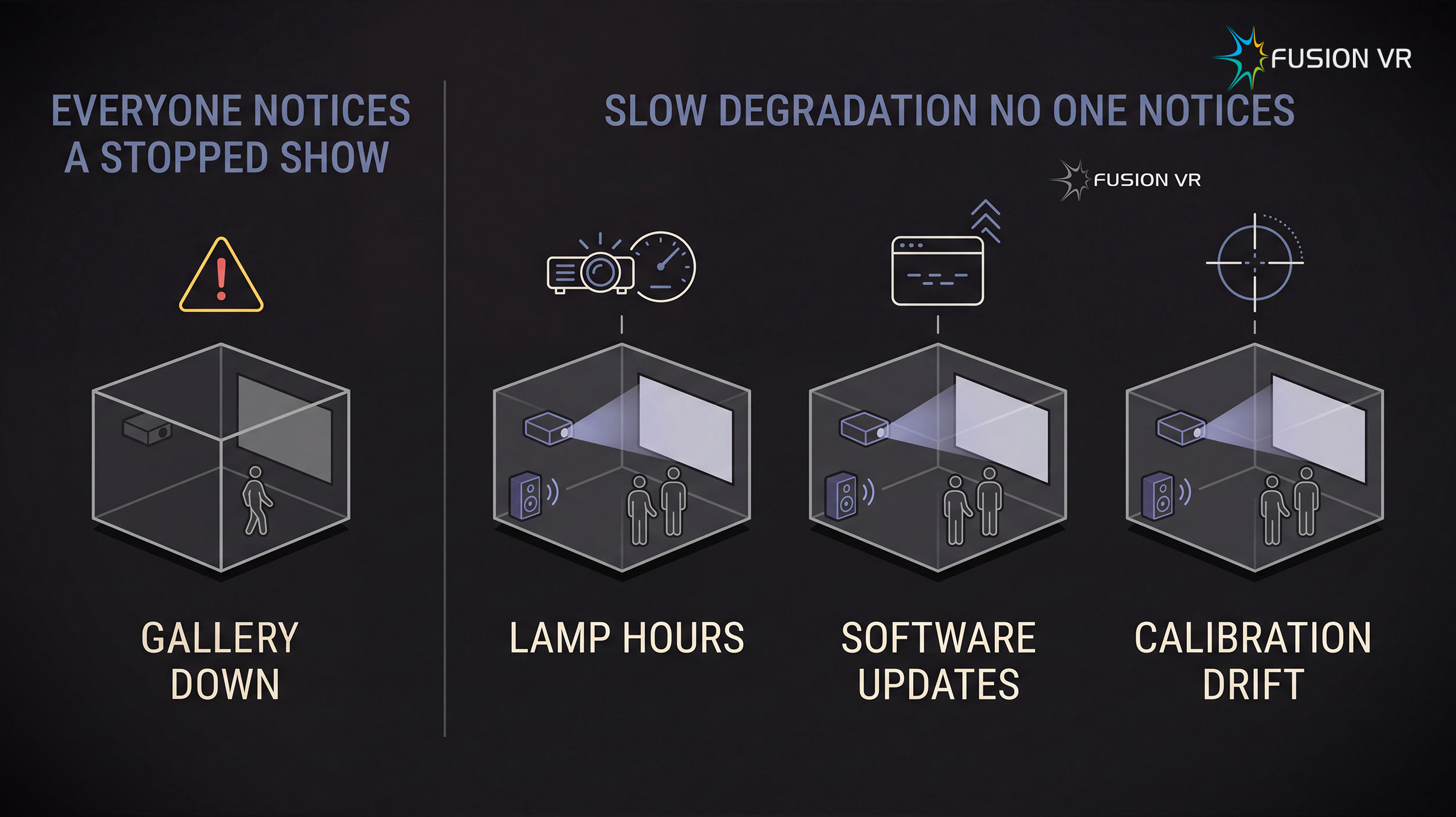
A dark gallery is never a private event. A conventional museum can lose a display case for a week and absorb it quietly. A digital museum cannot. When an experience is dark, visitors see it, staff apologise for it, and word travels. For a government museum inaugurated at the highest level, a dark gallery is not a technical event. It is a reputational one.
Daily operation ages technology in predictable ways. The machinery itself also ages in a particular way. Lamps and filters wear on running hours, not on calendar months. Software accumulates updates. Sensors drift out of calibration slowly enough that nobody notices until the experience feels wrong. None of this is a defect. It is what daily public operation does to any high-technology installation, and it is entirely manageable when someone is watching for it.
Multi-projector alignment is the clearest example. Vibration and ordinary mechanical settling nudge projectors out of position by fractions, and in a multi-projector environment those fractions break the seamless image on the screen. We recalibrate the stereoscopic 3D projection on the Kalaignar Express curved screen at regular intervals. And because projectors in any installation age unevenly, the edge blending in the Immersive Cinema Hall is corrected on the same routine.
Augmented reality drifts for the same reason. In the Kalaignar Memorial's AR photo booth, a virtual Kalaignar sits on a physical chair. A small movement of the camera or the chair misplaces the character, and the whole experience is spoiled. Periodic checks keep that anchoring true, so the character stays exactly where a visitor expects him.
Sensors wear fastest where visitors use them hardest. The touch walls at the Amma Memorial and Kalaignar Memorial are recalibrated regularly so every press lands where it should. The interactive cycling experiences at the Amma Memorial take continuous rough use: without recalibration of the pedalling and handle-rotation sensors, a visitor's pedalling stops synchronising with the on-screen animations. The Porunai iron smelting bellows follows the same regime.
Gesture-based displays drift for a different reason. Nobody touches them: a depth sensor watches the visitor much as a camera would and turns movement into interaction. Hard use is not the issue there; slow drift in sensor calibration and alignment is. We check them on the same regular schedule, so the display responds exactly to what a visitor's gesture means.
Motion systems follow the same discipline. The Kalaignar Express simulator's mechatronics are serviced on schedule, its movement performance tested and recalibrated at periodic intervals, and the same regime covers the Porunai VR boat and every simulator installation under our maintenance.
Support is the sixth step, not an afterthought. This is why we treat support as the sixth step of the same sequence that built the museum, not as an aftermarket add-on. The team at Fusion VR that engineered, integrated and calibrated the installation is the team that keeps it running. Our first installation has been running daily since 2010, and it has never been without support.
Three Layers of Protection, and What Each One Does
Institutions planning their first digital museum regularly confuse three different protections: the OEM warranty, the performance guarantee, and the AMC. The confusion is understandable, because all three sound like promises that things will work. At Fusion VR we separate them on day one, because each covers a different thing, at a different level, over a different period. Here is the whole picture.
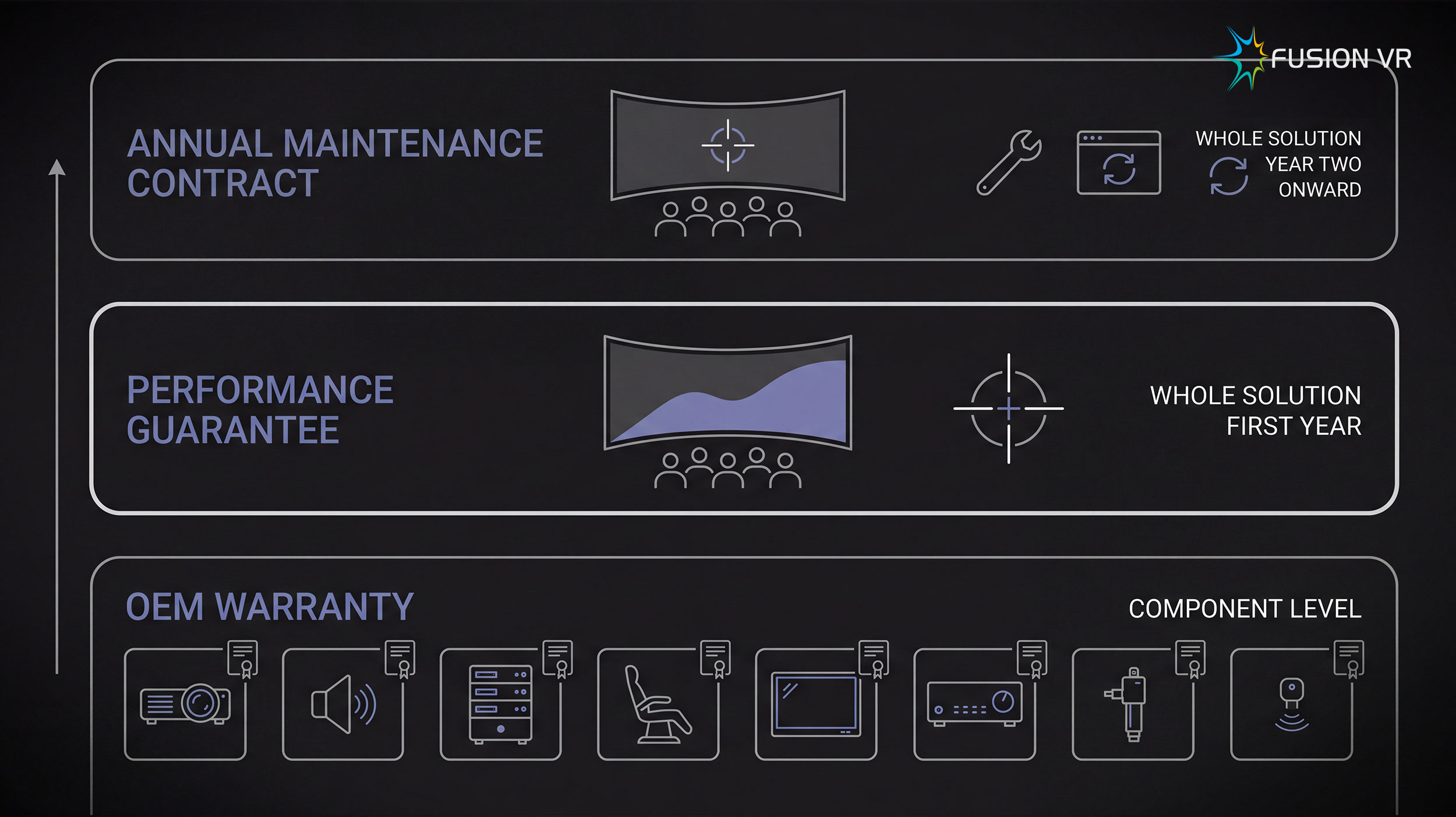
The OEM warranty is the manufacturer's promise, and it stops at the component. Every actuator, special effect, digital display, projector, server and audio processor carries its maker's warranty, each on its own terms: six months, one year, three years. In an integrated installation, we manage them all from our end, because we supplied and integrated the equipment as one solution. You hold something simpler: one performance guarantee, then one AMC.
The Odyssey of Hanuman 7DX - Sankat Mochan Gallery shows the scale of that gap. Its visual subsystem alone uses fourteen projectors from one OEM to form one seamless 28K passive stereoscopic 3D (14K per eye) image across a 100-foot, 180-degree curved silver screen, fed by six playback servers from another OEM, running playback and mapping software from yet another. This is one subsystem of several.
Around the visuals sit a 64-channel spatial audio subsystem, the 7DX motion seat subsystem and a multisensory special effects subsystem, each built from many components. A long list of OEMs stands behind the gallery, and every one of them limits its warranty to its own product working to its own specification. A projector is not designed expecting thirteen neighbours; no OEM tests for that.
The performance guarantee is ours, and it covers what no OEM will. Replace one failed projector under its warranty, and the repair disturbs the mapping: the entire fourteen-projector image must be recalibrated, which no OEM covers. If playback stutters, the server OEM is not necessarily at fault; the content might need optimising. Aligning fourteen projections into one seamless passive stereoscopic picture is neither the projector maker's job nor the software maker's.
Nobody on that list owns the solution. That is where the Fusion VR performance guarantee comes in: for one year from handover it covers the entire integrated solution, hardware, software and content together, as it was proven on handover day, at no additional cost. A client holding a full folder of valid warranty cards could still not bring that performance back. We can, and we commit to it.
The AMC carries the museum from year two onward. Over months of daily operation, every subsystem and its components drift from their calibrated state, and no individual OEM can bring the whole gallery back to its original form. The annual maintenance contract exists for exactly this: preventive servicing, recalibration, software support and committed response, renewed year by year for the life of the museum.
The three layers in one view.
OEM Warranty
Performance Guarantee
AMC
Read together, the layers close every gap. A component that fails is the manufacturer's to replace, arranged by us. An experience that underperforms is ours to put right under the guarantee. And the routine care that keeps everything calibrated, updated and reliable, year after year, is what the AMC exists to do.
The First Year: What the Performance Guarantee Covers
The first year of a digital museum's life is covered end to end. From the day of handover, every Fusion VR installation carries a one-year performance guarantee on the entire integrated solution: the hardware, the software and the content, together, at no additional cost. This section states what that means in practice, so you know exactly what you hold.
The benchmark is handover day itself. Acceptance testing was witnessed by your own officers, signed by both sides and recorded on video, so the standard the guarantee protects is not a description in a brochure. It is the proven, working state of your digital museum on the day you took it over. If anything performs below that state in the first year, we bring it back.
Coverage runs across all three things a digital museum is made of. Hardware kept performing as designed. Software faults diagnosed and rectified. And content corrected, optimised or reformatted wherever a defect shows in image, sound or interaction, arising from changes or calibration drifts in the hardware and software around it. One Fusion VR team delivered all three, so nothing carries an additional cost.
One call reaches one responsible party. You report what visitors would notice, in plain words: an image that looks wrong, a seat that moves differently, audio that has lost its depth. Diagnosis is ours from there, and so is everything it leads to: coordinating the OEM, dismantling and shipment logistics if a component travels for repair, reinstallation, and the recalibration that makes the experience whole again.
When the year ends, nothing falls away suddenly. The guarantee's purpose is a first year in which the institution learns its digital museum with complete cover underneath it. Before the year closes, we sit with you and plan the annual maintenance contract from how your museum actually ran: which parts wore, which needed recalibration, what your team now handles on its own, and where our team should continue.
What the Guarantee Does Not Cover, and Why
Every guarantee has a boundary, and an honest one states it plainly. Ours is drawn along a simple line: we stand behind everything we designed, supplied, integrated and produced, and we cannot stand behind conditions we do not control. Fusion VR sets these terms out in writing at handover, and this section explains them in the same plain way.
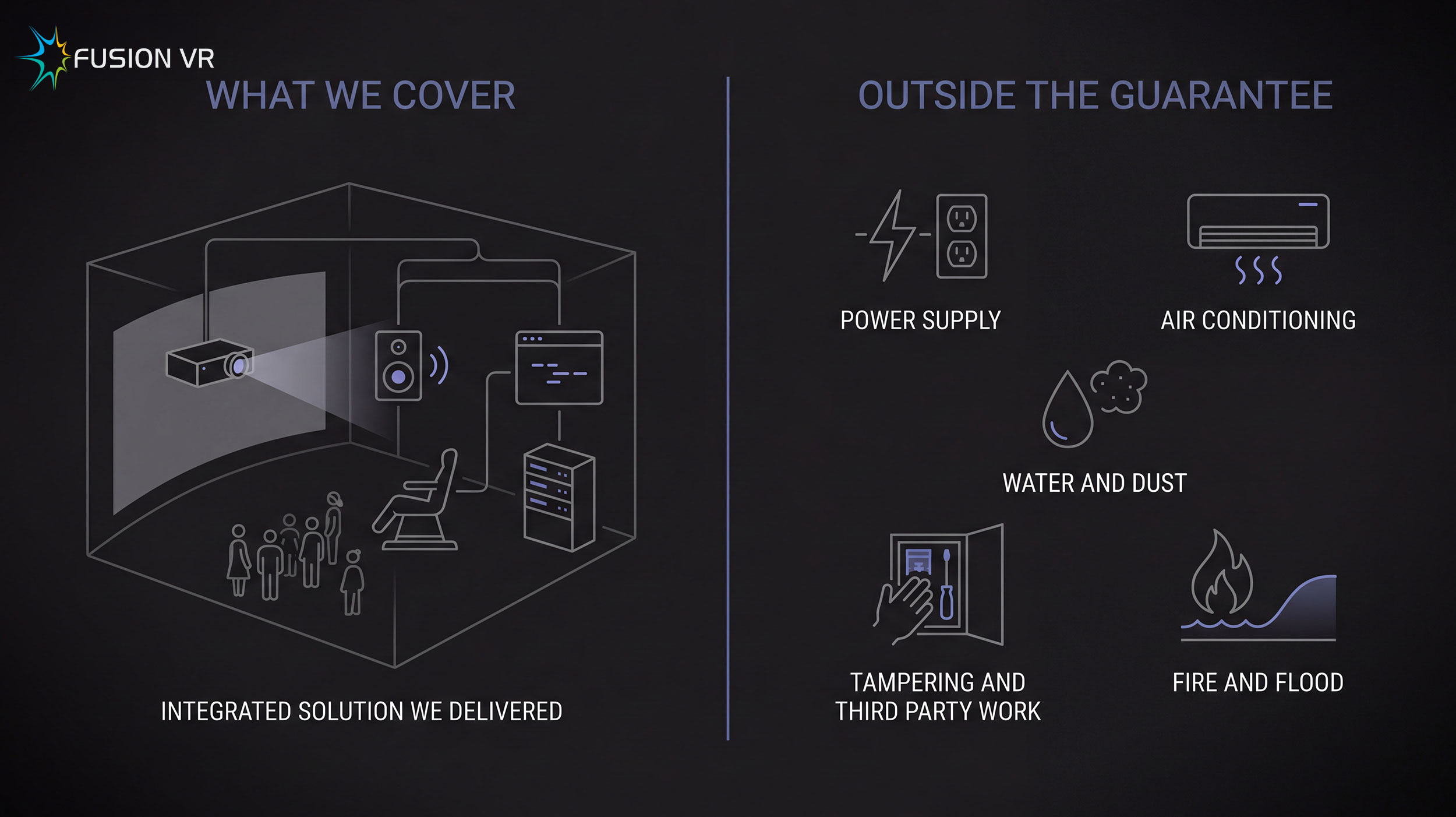
The line follows responsibility, not convenience. What we delivered, we cover: the hardware, the software, the content, and the way they perform together. What sits outside our work, we cannot cover, because no honest company guarantees another party's conditions. Knowing exactly where the line sits protects both sides, and it is why we put it in writing at handover rather than leaving it to memory.
The building's own conditions matter most. A digital museum needs stable power, a dry room, controlled temperature and humidity, and reasonable dust levels, like any high-technology installation. Incoming power supply, air conditioning and the building itself are the institution's, so damage from unstable power, water ingress, dust, pests or a failed air-conditioning plant sits outside the guarantee. We state the required operating conditions clearly, so holding them is straightforward.
Untrained hands are the other common cause. The guarantee does not cover damage from misuse, mishandling or tampering, nor changes made by third parties: a repair, a software update, a modification or a content change carried out without our involvement leaves the system in a state we no longer know. Your trained operating team, following the do's and don'ts from handover, makes sure this exclusion never comes into play.
The remaining exclusions are the ordinary ones. Fire, flood and other force-majeure events are matters for the institution's insurance, not a performance guarantee. Civil works, interiors and electrical works outside our contracted scope belong to the parties who carried them out. None of this is unusual: these are the standard boundaries of any well-written guarantee, stated here so nothing surprises you later.
Held conditions mean the exclusions rarely matter. Across our installations running daily for years, the guarantee has done its work because the conditions around it were held: power stable, rooms dry and cool, teams trained. Fusion VR advises on all of it, from site readiness to daily operating discipline, because the best outcome for everyone is a museum that runs so well the guarantee is never needed.
After the First Year: What an AMC Is, and What It Prevents
When the performance guarantee year ends, the annual maintenance contract begins. An AMC is an ongoing support agreement with Fusion VR that keeps every system in your digital museum running reliably for the public, year after year. This section explains what it is, what it quietly prevents, and, honestly, what happens if you choose to run without one.
An AMC continues the same single-point care. The team that built your digital museum keeps looking after it: scheduled preventive servicing, recalibration, software support and updates, necessary content reformatting and optimisation, remote technical assistance, and committed response when something needs attention. Cover is tailored to your museum, from essential support to a fully managed package, and the next section explains those levels.
On content, one phrase matters: maintained as delivered. Our commitment is that your multimedia content keeps performing exactly as it was handed over on inauguration day. If changes in the hardware and software around it affect that performance, we reformat, re-render or optimise the content so it adapts seamlessly to the new environment. That work is inside the AMC, and it protects what you approved.
What the AMC does not include is new content. Changing the story, modifying visuals or audio, or re-editing an experience is content production, not maintenance. Institutions sometimes ask for this, especially when leadership changes and a revised storytelling is wanted. Such work sits outside the AMC's commitments: we quote it separately, case by case, as its own commissioned project, while the AMC continues preserving what exists.
When you do want the content revised, we are the practical choice. Safe backup copies of the original project source files, the 2D and 3D assets and the audio masters sit in our archives for every experience we produce. Revisions start from the originals, not from scratch, which makes the work feasible and economical, and keeps the quality consistent with what your visitors already know.
Its real work is preventing failures before they happen. A projector lamp nearing the end of its rated hours is replaced during a scheduled morning visit, before opening time, and no visitor ever knows. The same lamp failing mid-show closes the gallery, and now a part must be sourced urgently and an engineer must travel at short notice. Prevention is quieter, faster and far cheaper.
Unsupported, small issues grow into expensive ones. Without scheduled preventive care there are no committed response times, no covered repairs, and nobody watching for the slow drifts described earlier on this page. Sourcing spares and expertise after a fault is always slower and costlier than planned upkeep, and the downtime lands where it hurts most: in front of your visitors.
The quieter danger is degradation without failure. A drift in projection alignment, in spatial sound calibration, or in a simulation platform's movement as mechanical parts wear is not a visible breakdown like a projector refusing to switch on. The experience still runs, so operators and visitors rarely raise a complaint. But the immersion quietly degrades.
What was the finest experience on inauguration day now delivers only part of itself, and nobody notices it happening. The investment and effort that built that experience are at stake, one small unnoticed drift at a time. Catching exactly this is what scheduled preventive care exists for, and it is work no breakdown call will ever trigger.
If you choose not to renew, here is the honest picture. Your digital museum keeps running, and nothing is switched off or withheld. But the safety net is gone, and the risks become yours to carry. We plainly advise against running a public-facing institution unsupported, because its reputation depends on running flawlessly. The choice, stated with respect, remains entirely yours.
And the door stays open. If you re-engage later, a system health-check comes first, so full cover resumes from a known, verified state. One-off chargeable support visits can bridge the gap in between. Your complete documentation and handover materials remain with you throughout, because they were always yours. Fusion VR earns each year's renewal through its service, never by making your museum depend on us.
Three Levels of Cover, and How to Choose One
No two digital museums need the same depth of cover, so the Fusion VR AMC comes in three levels: Non-Comprehensive (Basic), Comprehensive, and Comprehensive+ (Managed). The right one depends on your footfall, your installation's complexity, and how quickly the museum must recover when something needs attention. This section explains each level plainly, and how institutions choose between them.
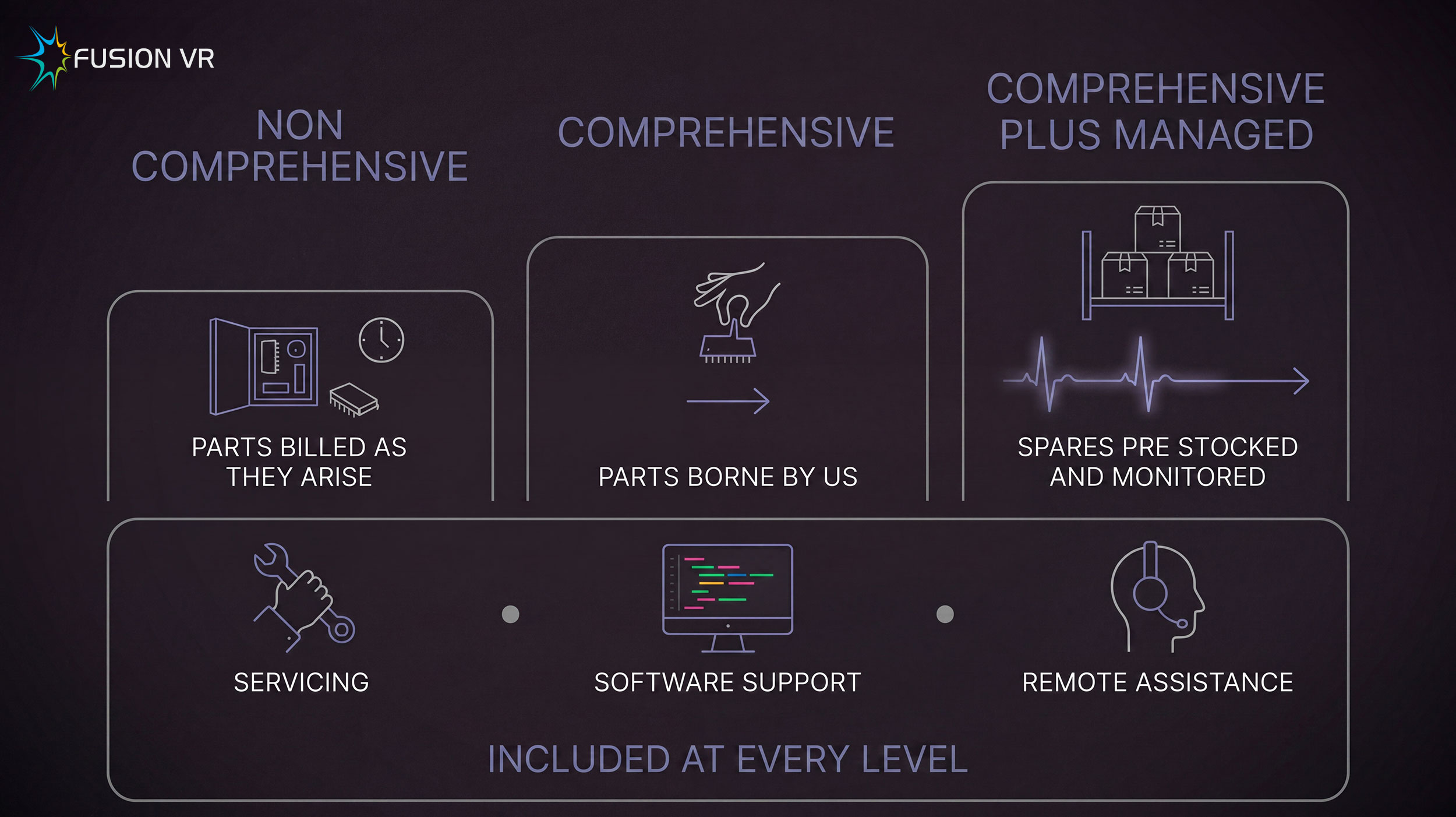
The three levels at a glance.
Non-Comprehensive (Basic)
Comprehensive
Comprehensive+ (Managed)
01. Non-Comprehensive (Basic) cover provides the discipline. Scheduled preventive servicing, recalibration, software support and updates, and remote technical assistance all continue, which keeps the slow drifts this page has described under watch. Unplanned visits, labour and replacement parts are billed separately as they arise, and no spares are held for your museum, so some waiting on component lead times is to be expected.
It suits institutions with modest footfall, a simpler and more robust installation, or a budget process that prefers paying for repairs as they occur. The essential protection is real: the museum is inspected, serviced and watched by the team that built it. What you carry yourself is the cost and the waiting time whenever a part fails.
02. Comprehensive cover moves the risk of parts onto us. Repair and replacement of failed components are borne by Fusion VR within the contract, with priority on-site response when something needs attention. Beyond basic consumables, no expensive spares are pre-stocked for your museum; they are sourced at standard lead times. For most public museums this is the sensible middle: a failed component never becomes a budget discussion.
03. Comprehensive+ (Managed) is built for museums that cannot wait. Critical spares are pre-stocked for your installation, so recovery does not depend on a supplier's calendar. Remote health monitoring watches the systems continuously, and response commitments are the fastest we offer. On-site manpower and full operation and maintenance support are available as additional add-on options at this level, both explained later on this page.
Choosing comes down to three honest questions. How many visitors would a dark experience disappoint? How complex is the installation, and how specialised are its parts? And how quickly must the museum recover when something needs attention? We advise plainly on where your museum sits, and the choice is revisited at every renewal as your museum's life changes.
Response, Spares, and the Honest Problem of Ageing Components
When something in a digital museum needs attention, what happens next was decided long before, in how the support was planned. Fusion VR works remote-first, sends engineers with the diagnosis already made, and plans spares by category rather than waiting for failures. This section explains how response works, how spares are managed, and the honest problem of ageing components.
Remote support comes first, and it closes more issues than most institutions expect. Your operators describe what visitors would notice, our engineers connect to the systems or guide your team step by step, and a large share of issues end there: a stalled service restarted, a setting restored, a sequence brought back in order. No travel, no waiting, no lost show day.
When a visit is needed, it begins informed. The engineer arrives knowing what failed and why, because the remote diagnosis already happened, and carries the part where one is pre-stocked. Response commitments follow your AMC level: on earliest availability under Non-Comprehensive (Basic), priority under Comprehensive, fastest under Comprehensive+ (Managed). Meanwhile we work with your team so the rest of the digital museum runs normally for visitors.
Spares fall into four categories, each planned differently.
Consumables
Replaced during scheduled visits, before failure.
Standard components
Sourced through OEM channels; critical items pre-stocked under Comprehensive+ (Managed).
Custom-engineered items
Identified at the design stage; spares planned from day one.
Discontinued items
Watched continuously; early advice; proven replacements identified.
Consumables are the predictable ones. Lamps, filters and similar wearing parts age on running hours, so they are replaced during scheduled preventive visits before they fail, and stocking them is straightforward. Visitors never see this category at all; it is handled inside the maintenance calendar, quietly, before opening time.
Standard components are a matter of lead time. Projectors, servers, sensors and audio equipment are sourced through OEM channels when needed. Under Basic and Comprehensive cover they follow standard lead times; under Comprehensive+ (Managed), critical items are pre-stocked for your installation, so replacement starts from our shelf, not from a supplier's calendar.
Custom-engineered items need the longest view. In our flagship, The Odyssey of Hanuman 7DX - Sankat Mochan Gallery, the fourteen custom polarised 3D glass filters, the custom-engineered hydraulic actuators of the motion platforms, and their imported proportional control valves each carry lead times of around three months. No supplier holds them on a shelf. Items like these are identified at the design stage, and spares planning for them starts there.
And here is the honest problem: OEMs discontinue products. Technology generations turn over, and a component running faithfully in your digital museum may leave its maker's catalogue. We watch for this across every installation under Fusion VR's care, advise you early, pre-stock where it matters, and identify proven replacements. When a component family truly reaches end of life, we tell you plainly and engineer the path forward.
The same watch covers cloud services. Some software applications depend on subscribed cloud APIs for functions such as speech, translation or intelligent interaction, and a provider can discontinue a service just as a hardware OEM discontinues a product. When that happens, we identify a suitable alternative, integrate it, and bring the application back to its original functionality.
AMC or Full Operation and Maintenance: Who Runs the Digital Museum Daily
Someone starts your digital museum every morning, runs its shows through the day, and shuts it down carefully every night. The real question of long-term support is who that someone is. Fusion VR offers two proven answers: your own trained team with us behind them, or our deployed team running everything. Both models are at work today, running government digital museums for the public.
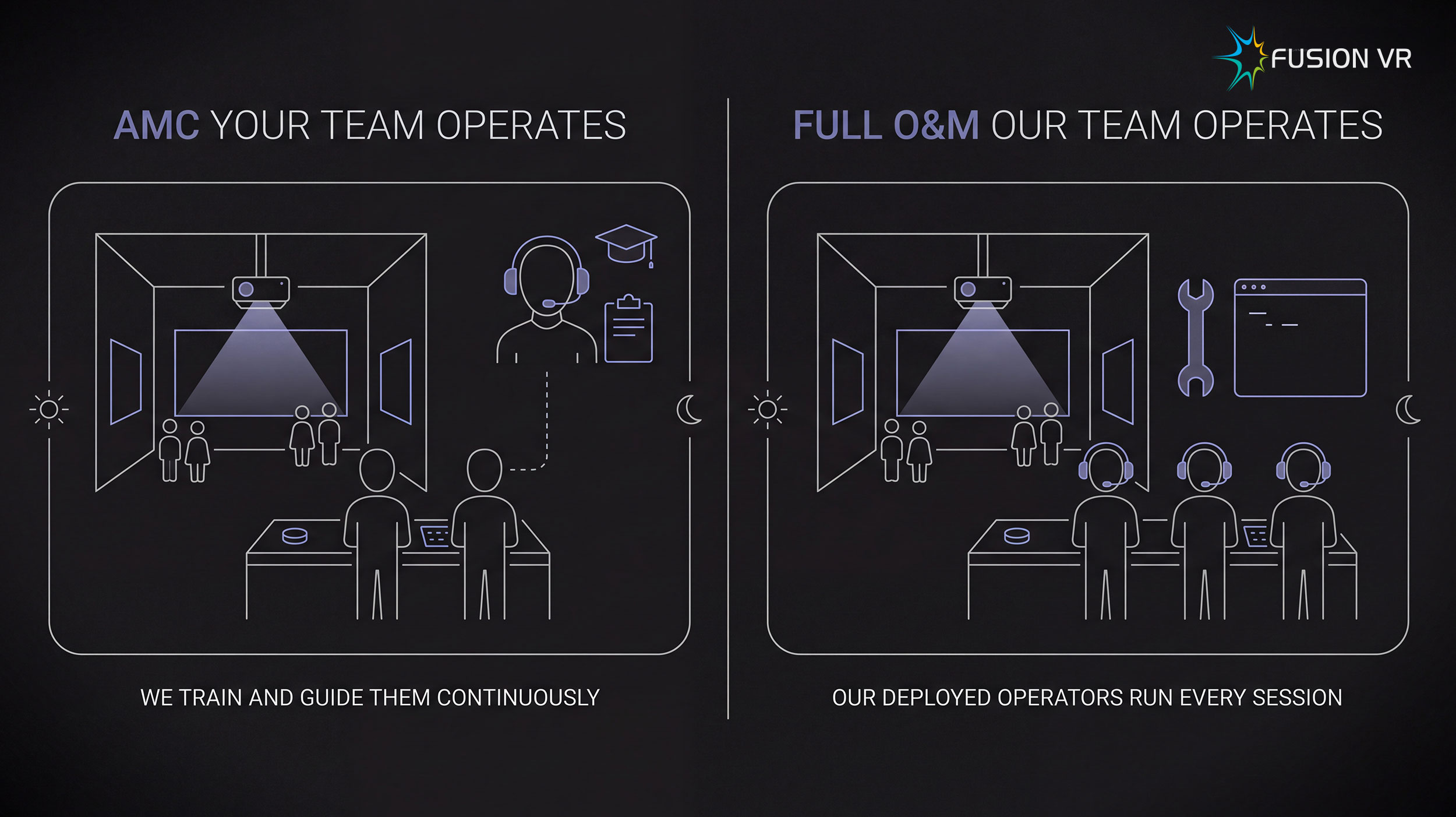
The two models at a glance.
Your team operates
Our team operates
Under an AMC, your team operates and we stand behind them. The institution's own staff handle daily start-up, session running and shutdown, while we maintain the systems and remain their technical backbone: remote guidance whenever they need it, scheduled visits, and regular follow-up. This is how most digital museums under our care run today, reliably and for years.
And we help you build that team. Fusion VR supports the selection of your operating staff, trains them hands-on before opening day, and stays engaged long after: guiding, answering, following up as routine. They are your employees, never left alone with the technology. That continuing guidance is one quiet reason why forty-seven digital experiences delivered for governments and institutions have run so well since their inauguration days.
This model stands behind thirty-one individual experiences: at the TNPAGE Experience Centre, the Ramakrishna Mission digital museums, the Porunai Museum, Ajanta VR, the VR Experience Centre at IITM Pravartak, the soon-opening Aurobindo Digital Discovery Center and the Odyssey of Hanuman 7DX - Sankat Mochan Gallery, delivered and awaiting an opening date to be announced by the institution, the operating teams are employed by the institutions, with our support in their selection and training, and our guidance continuing every day after.
Under full operation and maintenance, our own team runs it all. We deploy trained operators who open the digital museum, run every session, manage visitors' technical experience, resolve first-line issues on the spot, and close down at night, with maintenance woven into the same responsibility. One party holds the whole installation, every day. It is available as an add-on under Comprehensive+ (Managed).
The proof stands in two memorial digital museums for the Government of Tamil Nadu Public Works Department. Sixteen experiences have been operated by our own deployed team since inauguration day: at the Amma Memorial since 2021, and at the Kalaignar Memorial since February 2024. Every morning start-up, every visitor session, every shutdown, ours. Institutions visiting either memorial see the model working, not a description of it.
One note keeps all the numbers straight. Every experience under our maintenance also receives operation support; that is forty-seven today. Sixteen of them are operated end to end by our own deployed team at the two memorials. The other thirty-one are run by institution-employed teams we helped select, trained, and continue to guide, with one experience at the Odyssey of Hanuman 7DX gallery delivered and awaiting an opening date to be announced by the institution.
Choosing between them is an institutional decision, not a technical one. An in-house team builds your own capability and costs less each year; a deployed team removes the entire operating burden and answers for everything with one name. We advise honestly on both, and the decision can change at a renewal as your institution's needs change.
Remote Health Monitoring, and What Leadership Sees
Some problems announce themselves loudly: a lamp fails, a screen goes dark. The more dangerous ones build quietly, and remote health monitoring exists to catch those early. Under the Comprehensive+ (Managed) AMC, Fusion VR tracks the condition of your digital museum's critical equipment continuously, often catching an issue before any visitor could notice it. Here is how it works.
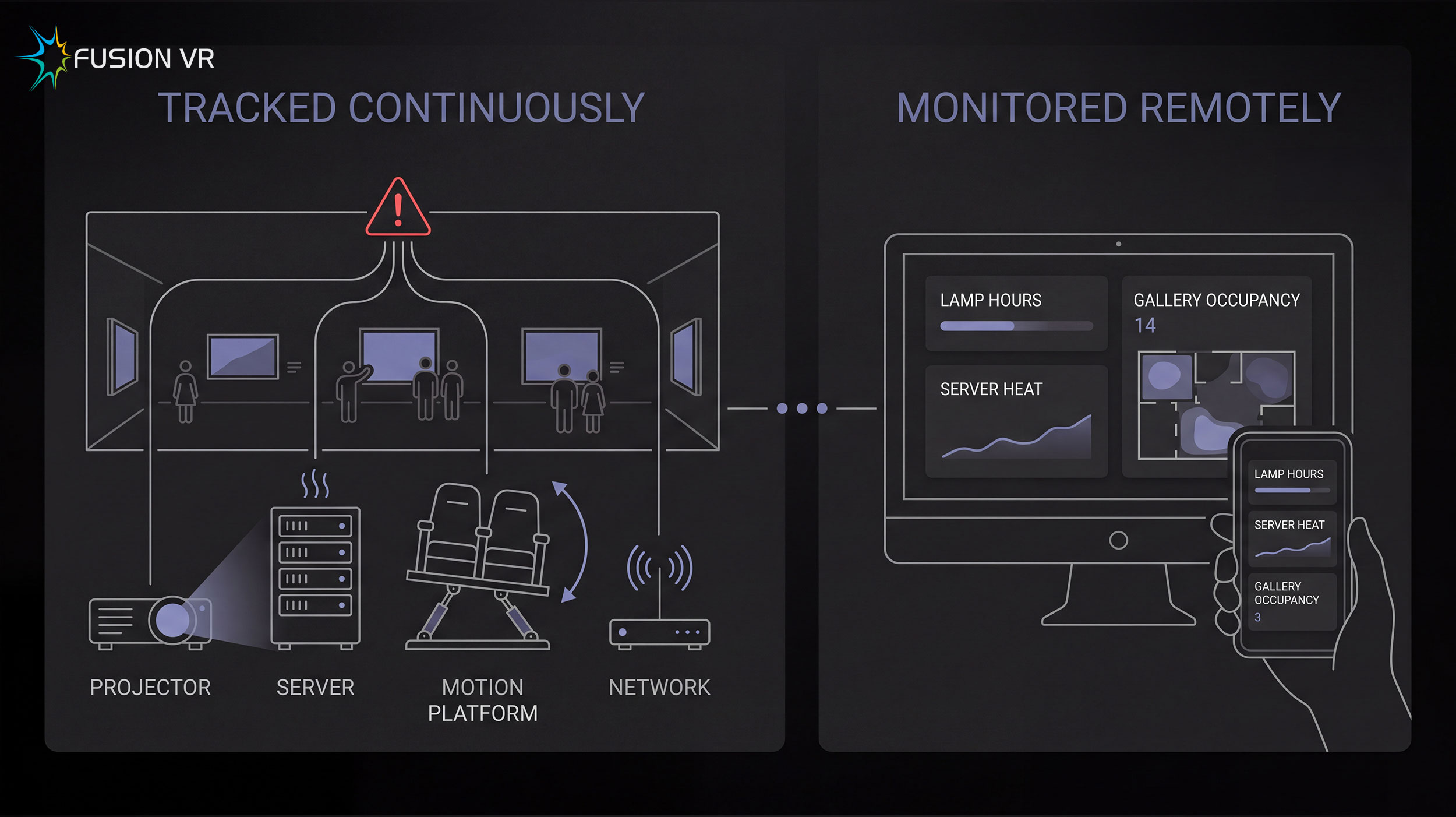
Anything sensor-readable can be watched. Where monitoring is deployed, equipment condition is IoT-connected to Fusion VR engineers: a projector lamp approaching the end of its rated life, a server running hot, hydraulic oil temperature rising on a motion platform, a device dropping offline, or any abnormal reading. CCTV monitoring of the galleries can run alongside, giving remote eyes as well as remote instruments.
Our flagship, The Odyssey of Hanuman 7DX - Sankat Mochan Gallery, already has this engineered in. The movements of the motion platforms' 6DoF actuators are tracked in real time, and any movement beyond its safe limit raises a remote alert. Hydraulic oil pressure and temperature are interlocked with operation itself: unless both sit within their operating range, the interlock will not permit the platforms to start.
Further safety interlocks guard the platforms in operation. If two platforms move toward each other, the anti-collision interlock stops the movement, and while the boarding staircase sits close to a platform, that platform cannot operate at all. Safety engineering of this depth is designed in from day one, not added afterwards.
For maintenance, those interlocks speak through the data. Whenever any interlock halts movement, the actuator readings tell our engineers remotely what happened and when, so an incident investigation starts from evidence rather than guesswork. The same readings that protect visitors and machinery in the moment also feed the health record over time.
Where a centralised museum control system and RFID-based visitor movement tracking are deployed, the monitoring grows richer still. Dashboards then show gallery-wise occupancy counts at any given moment, and gallery-wise equipment operation status alongside them, as live numbers and visual heat maps laid across the digital museum's galleries and corridors on its layout plan. We have already designed exactly this for an upcoming national-scale digital museum.
And where AI anomaly detection is opted for on the CCTV layer, the same remote monitoring application raises alerts on abnormal visitor behaviour too, so an unfolding situation on the floor reaches the right people early, alongside the equipment alerts.
Early warning changes what a fault costs. A lamp flagged two weeks before failure is a scheduled morning replacement; the same lamp failing unannounced is a dark experience with a queue outside. Watching trends rather than waiting for breakdowns means most interventions happen quietly, on our initiative, before opening hours, and often before your own team knew anything was building.
Leadership sees it in plain language, not engineering. A health dashboard shows system status across the galleries at a glance. Uptime and availability are reported over time. Periodic reports summarise activity, issues resolved and upcoming needs, and early alerts flag components approaching end of life, so replacement enters next year's budget calmly instead of arriving as an emergency.
The record itself becomes an institutional asset. Directors and trustees hold documented evidence that the digital museum is managed proactively: what its uptime has been, what was caught early, what is planned next. For a government institution answerable for public investment, that documented health record answers questions before they are asked.
Standby for Inaugurations and National Events
An inauguration is the one day a digital museum cannot have a second chance. A dignitary walks the galleries once, the cameras run once, and everything must work the first time. For these days, Fusion VR does not rely on remote response: our engineers are physically present, prepared, and standing by through the event itself.
The preparation begins days before the event. Every experience is fully checked and stress-tested. The complete show sequence is rehearsed, end to end, exactly as the dignitary will walk it. Spare hardware for critical components is on hand, redundant content and tested start-up routines are in place, and our engineers stay on site throughout, monitoring and ready to respond in real time.
The rehearsal is the quiet secret of a flawless day. An inauguration follows a sequence: the entry, the walkthrough, the seated show, the moment everything must begin on cue. We rehearse that sequence itself, not just the equipment. Who stands at which station, who supports whom: every role is decided in advance, and everyone plays their role multiple times during rehearsal, until the day holds no surprises.
This readiness carries a weight we never forget. A failure on inauguration day would never be ours alone: it would fall equally on the department's secretaries, directors and senior officers who own the occasion, standing before dignitaries and cameras. We prepare knowing exactly whose day, and whose reputation, depends on every experience starting at the right moment.
The record speaks plainly. Almost all of our digital museums and immersive experiences have been inaugurated by Hon'ble State Chief Ministers and Central Ministers, and once by the Hon'ble Prime Minister of India. In our entire history, we have never failed at an inauguration. That is the track record.
The same standby cover is there for the museum's whole life. A visiting head of state, a national event hosted in your galleries, an anniversary broadcast live: whenever a day matters that much, event standby can be arranged under your Fusion VR AMC, and the same discipline arrives with it: checks, rehearsal, spares, and engineers beside the systems until the day is done.
The Decades Proof: Sites You Can Walk Into Today
Every promise this page has made is testable, because the evidence is open to the public and running today. Fusion VR's first digital museum installation has run daily since 2010, and it is still under our care. This section gathers the proof: the sites, the years, and what has actually happened across them.
The proof at a glance: notable installations and deliveries.
| Where | Experiences | Since | What we do there |
|---|---|---|---|
| Ramakrishna Mission digital museums | 7 | 2010, 2012, 2015, 2019, 2020, 2022, 2025 | Maintenance and operation support |
| Immersive experiences for GTRE, a DRDO laboratory | 4 | 2012, 2019, 2024 | Maintenance and operation support through the contract period |
| Immersive interactive VR experience, Yokogawa Engineering Asia, Singapore | 1 | 2013 | Maintenance and operation support through the contract period |
| ImmeX Zones, India, Singapore and The United Arab Emirates (Dubai) | 20 | 2014 | Maintenance and operation support through the contract period |
| Chronicles India 7DX Theatre, Mahabalipuram: stereoscopic 3D immersive experience on History | 1 | 2014 | Maintained and operated by our own team through the contract period |
| Chronicles India 7DX Theatre, Mahabalipuram: stereoscopic 3D immersive experience on Adventure Ride | 1 | 2015 | Maintained and operated by our own team through the contract period |
| TAFE Experience Centre, Chennai | 1 | 2017 | Maintenance and operation support through the contract period |
| ITE College East, Government of Singapore | 4 | 2019 | Maintenance and operation support through the contract period |
| Immersive XR experience for a Malaysian client | 1 | 2019 | Maintenance and operation support through the contract period |
| Immersive Stereo3D VR experience for BDL, Ministry of Defence | 1 | 2020 | Maintenance and operation support through the contract period |
| Immersive Interactive Stereo3D VR experience, Honeywell Technology Solutions Lab | 1 | 2020 | Maintenance and operation support through the contract period |
| Amma Memorial | 11 | 2021 | Full operation and maintenance (O&M) by our own deployed team |
| 100+ immersive VR labs, colleges and universities across India | 100+ labs | 2021 | Maintenance and operation support |
| Kamarajar Port Limited, VR180 immersive experience | 1 | 2023 | Maintenance and operation support through the contract period |
| VR Experience Centre, IITM Pravartak | 1 | 2023 | Maintenance and operation support |
| Kalaignar Memorial | 5 | February 2024 | Full operation and maintenance (O&M) by our own deployed team |
| Tales of Ajanta (Ajanta VR) | 1 | December 2024 | Maintenance and operation support |
| Porunai Museum | 3 | December 2025 | Maintenance and operation support |
| TNPAGE Experience Centre | 12 | February 2026 | Maintenance and operation support |
| Aurobindo Digital Discovery Center | 6 | Soon opening | Maintenance and operation support |
| The Odyssey of Hanuman 7DX - Sankat Mochan Gallery | 1 | Soon opening | Maintenance and operation support |
| Digital museum experiences under our maintenance and operation support today | 47 |
It began at the Ramakrishna Mission. Our first installation opened at Vivekanandar Illam in 2010, and it has run daily ever since. Across the years that followed, we have kept adding new experiences for the Ramakrishna Mission digital museums every few years, the newest in 2025, making this the longest continuously supported relationship in our portfolio, and one that is still growing.
The two memorial digital museums prove the operating model. At the Amma Memorial since 2021 and the Kalaignar Memorial since February 2024, both for the Government of Tamil Nadu Public Works Department, our own deployed team has run every day of public operation since inauguration, alongside full maintenance responsibility.
The wider portfolio proves it scales. Across the TNPAGE Experience Centre, the Porunai Museum, Tales of Ajanta, and the soon-opening Aurobindo Digital Discovery Center, and at the Odyssey of Hanuman 7DX - Sankat Mochan Gallery, which is delivered and awaiting an opening date to be announced by the institution, institution-employed teams are on the floor with our training and continuous guidance behind them, and every installation stays under our maintenance.
The record reaches back further than today's portfolio. Chronicles India, the 7DX theatre at Mahabalipuram, ran under our own team's full operation and maintenance from 2014 through its contract period. The ImmeX Zones across India, Singapore and The United Arab Emirates (Dubai), the TAFE Experience Centre, immersive experiences for GTRE, a DRDO laboratory, ITE College East in Singapore, and the VR180 immersive experience for Kamarajar Port Limited were all supported through their contract periods.
And the same support discipline runs beyond digital museums altogether. Since 2021, more than a hundred immersive VR labs delivered for colleges and universities across India have been under our maintenance and operation support, a scale of distributed care few companies in this field have ever managed.
And visitors confirm it in their own words. Vivekananda House has drawn over ten thousand public social media reviews since its multimedia overhaul, with visitors specifically praising the immersive experience. The Kalaignar Express 7DX Train Simulator is a proven crowd-puller, and the Porunai Museum's VR Boat is a central attraction, both drawing footfall daily.
Forty-seven experiences, one responsible team, and a record that began in 2010. That is what lifetime support means when it is real: not a service brochure's promise, but installations you can walk into today, running as they were delivered, looked after by the same Fusion VR team that built them.
Questions Institutions Ask About AMC and Lifetime Support
Some questions arrive in almost every AMC discussion, so here are the six most common, answered plainly. Each answer below is the short form; the Fusion VR FAQ carries the full detail behind every one of them, and your own agreement will state the committed terms in writing.
Yes, because they protect different things. An OEM warranty covers one component working to its own specification, and nobody's warranty covers all the components working together as one experience. The performance guarantee covers that integrated whole for the first year, and the AMC continues the same whole-solution care afterwards. Holding every equipment warranty still cannot bring back the performance of the whole gallery.
Yes, and it is handled in a clear way. New galleries, exhibits or fresh content are scoped and quoted as a separate project. Once delivered, the new work is brought under your existing performance guarantee and AMC coverage, so the whole digital museum stays under one support agreement. Very minor content tweaks may be accommodated within the AMC as goodwill, subject to validation.
No, and the reason is engineering, not commerce. A digital museum gallery is one integrated solution, engineered and calibrated so hardware, software and content handshake seamlessly. If a third party services or supplies the hardware, we cannot guarantee the integrated performance, and responsibility for the combined result must then rest with that agency, not with Fusion VR. A single AMC with one responsible party holds true accountability.
Your digital museum keeps running, and nothing is withheld: your documentation and training remain yours. But scheduled preventive care, committed response and repairs under AMC coverage all end, and the risks transfer to you. We plainly advise against it for a public-facing institution, while respecting that the choice is yours, and the door back is always open.
It is a documented inspection of every system before full AMC coverage resumes after a gap. Our engineers verify the state of projection, servers, software, sensors, motion systems and content playback, correct what has drifted, and record the verified baseline. AMC coverage then restarts from a known state, which protects both sides of the renewed agreement.
Wherever feasible, yes. If a simulation platform is down, the maintenance work can be scheduled for the night, so daytime visitors still watch the experience in 3D with the special sensory effects, only without the seat movement. The show stays alive while the repair happens out of sight.
The same thinking applies to projection. If one projector in a stereoscopic 3D system has an issue, the show can still run in 2D during museum hours, and the repair work to bring back full stereoscopic 3D is scheduled during non-operating hours. Visitors keep experiencing the digital museum; the fix never takes the stage.
Every number below is explained somewhere above on this page, and every one of them can be verified by walking into a digital museum that Fusion VR supports today. Behind them stand inaugurations at the highest levels of government, and years of quiet daily running.