Virtual Reality has moved out of the gaming arcades and into the mainstream, especially in engineering, design, healthcare, and skills education. Universities around the world and more and more across India are hurrying to build dedicated VR/AR labs, so that students finish their program with real-time immersive technology capability, not only with theoretical exposure. Still, making a university VR lab isn’t really as easy as purchasing a few headsets and saying it’s done. There’s a lot of careful planning involved, budget wise, infrastructure wise, curriculum matching, faculty readiness, and then also those long term maintenance details that people forget.
This blog walks through a practical, end-to-end roadmap. Any institution an engineering college, a design school, or a research university can use it to construct a VR lab that actually gets used day to day, and not one that just gathers dust after the inaugural ribbon-cutting moment.
Why Universities Are Investing in VR Labs Now
The need for XR (Extended Reality) talent has been growing like, way faster than the supply of people who are actually trained graduates. Sectors such as automotive, oil & gas, healthcare, manufacturing, and defence are actively hiring VR/AR developers for things like digital twin simulations to safety training, and all of it. But still, most universities don’t really have a structured curriculum that matches what industry wants, students are mostly left in a sort of self-teach mode, with not much access to pricey hardware.
Starting from the 2023-24 academic year, the All India Council for Technical Education (AICTE) has approved “Virtual and Augmented Reality” as a valid minor/honours degree specialization for engineering colleges. So institutions get this kind of clear academic nudge to formalize XR education. This regulatory green light, plus the industry demand that’s steadily increasing, is exactly what’s pushing universities to shift away from random VR demos toward labs that are properly built.
The Roadmap at a Glance
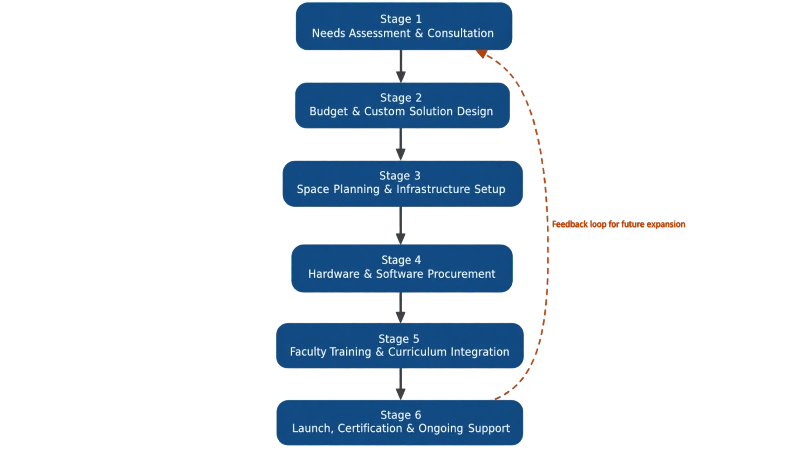
Before diving in each stage, there’s the general flow a university usually follows when setting up a VR lab – starting from that first internal discussion and ending with a fully running, yeah, revenue-generating facility. The diagram below kind of maps the six stage journey, and it also shows a feedback loop that carries the learnings back into next planning, so the whole thing keeps improving
Stage 1: Needs Assessment & Consultation
Every successful VR lab, sort of starts with a clear-eyed check on why the institution wants it in the first place. Like, is the objective to roll out a formal minor/honours degree in VR AR, or is it more about setting up a research nucleus? Perhaps the intent is to give mechanical, or civil engineering students a way to “see” 3D designs in a more hands-on manner, or it’s simply about giving learners a sharper edge during placements.
At this point, universities usually:
- Run consultation sessions with department leads, the placement cell, and likely industry collaborators, to pin down real skill shortages.
- Compare against peer institutions that have already gone through XR deployment.
- Decide which faculties (Computer Science, Mechanical, Design, Architecture, Healthcare Simulation) will be the main day-to-day users.
- Choose if the space will back a standalone specialization/minor degree, short duration certification modules, or honestly both
If you get this early phase correct, you avoid the classic problem of pouring money into hardware that no one ever uses, because it wasn’t tied to an actual academic plan, or a clear industry requirement
Stage 2: Budget & Custom Solution Design
Once the “why” is sorted out, the “how much” kind of becomes the next thing people ask, right. VR lab budgets end up swinging all over the place, mostly based on scale—like a 10-seat lab for one department is not the same universe as a 50-seat, multi-room XR center that supports an entire university.
Some key line items to keep in mind (and, yes, actually price out early):
- Capital expenditure (CAPEX): Headsets, high-performance PCs or workstations, haptic gloves, motion trackers, and projection or wall-mounted displays.
- Operating expenditure (OPEX): Software licenses such as game engines like Unity, plus content authoring tools, annual maintenance contracts, and those smaller consumables that always seem to pop up.
- Curriculum licensing: If you’re teaming up with a training provider, you can run into per-student or per-seat licensing costs for structured courses, and sometimes LMS access too.
- Faculty development budget: Train-the-trainer programs aren’t free, and they’re arguably the most crucial line item in the whole list, even if budgets often try to shuffle it down.
Most institutions will work with a specialized VR AR solutions partner at this stage, mostly to pull together a detailed technical proposal, a cost estimate, and an implementation timeline rather than attempting to assemble the hardware and curriculum on their own, piece by piece.
Stage 3: Space Planning & Infrastructure Setup
VR labs have physical requirements that a usual computer lab doesn’t, not really. Room-scale VR still needs that clear floor space, often like 2m x 2m minimum per station, with no weird obstructions in the way. You also have to think about ceiling height, and that cable management stuff, because trip hazards are sneaky and happen fast, even when people are being “careful”. On top of that, high-performance PCs can run hotter than what you’d normally expect from typical lab machines so cooling plus the power load should be checked before you commit anything.
Then there’s other infrastructure, like a dependable high-bandwidth network path. For wireless headsets and cloud content, Wi-Fi or wired connectivity has to hold up consistently. Also, dedicated power circuits should be sized for several people working at the same time, not just one station doing a casual demo. If the lab is also used as a demo or experience area for visitors and recruiters, then acoustic control and lighting design matter more than you might guess. And don’t forget basic safety signage, plus clearly marked zones, because once someone wears a headset they literally can’t see their physical surroundings in the normal way.
Institutions that skip this planning phase often end up redoing rooms after the equipment arrives, which is expensive and disruptive, more than most teams expect.
Stage 4: Hardware & Software Procurement
This is the stage most people picture when they think of “setting up a VR lab” – but honestly it should come after the first three stages, not before, really. What people usually buy or procure at this point looks like a mixed bundle, something like this, typically:
- VR headsets (standalone or PC-tethered, depending on the use case and budget).
- Workstations with GPUs that can handle real-time 3D engines, smoothly.
- Haptic feedback devices plus motion trackers for the more advanced simulation work, like surgical training or industrial maintenance practice.
- Development and authoring software licenses, most often Unity, along with 3D modeling tools.
- Learning Management System (LMS) access if the curriculum runs inside a structured, trackable platform.
And if you can get a turnkey lab setup service, where a technology partner designs, customizes, installs, and then verifies the whole lab end to end, instead of the university hunting down each component in isolation, it tends to cut down a lot of the integration headaches… plus it gets you to a working, usable facility faster.
Stage 5: Faculty Training & Curriculum Integration
A VR lab is only as good as the people who can teach inside it. Kind of simple, but somehow universities still underinvest in that part the most, and it’s also the part that tends to decide if the lab gets used year after year. Not just at the start, but after, you know.
When faculty readiness is handled well, it usually means things like, train-the-trainer programs where a small group of faculty members go through hands on project style training first, before rolling it out to students. It also means curriculum mapping, aligning VR/AR modules to what already counts for credit, like a specialization, an honours track, a minor degree, or even a short term certificate and diploma, AR VR course. Then there’s project-based learning design, because VR/AR is not great as a lecture-only thing, it’s better through building real applications, and then iterating. Finally assessment design, mixing project submissions with a more theoretical evaluation component, often MCQ based tests, for certification.
Universities that get through this stage well often end up with faculty who feel confident enough to operate the lab on their own within one or two semesters, so there’s less long-term reliance on external trainers.
Stage 6: Launch, Certification & Ongoing Support
The labs opening day is not really the finish line – more like the beginning of a working rhythm that needs steady, sometimes even annoying, attention. At that stage, a few things tend to matter a lot, almost like they’re quietly pulling the whole system forward:
- Student certification and assessment, which gives the students a credential that is more or less useful on resumes, and not just a “nice paper”.
- Annual Maintenance Contracts for both hardware and software upkeep, because VR gear tends to demand constant care, think regular firmware updates lens or sensor cleaning, plus license renewals that sneak up when you least expect it.
- Remote technical support for daily troubleshooting, so that classes don’t get interrupted by small glitches, or those “it works but only sometimes” hardware issues.
- Periodic refresher training for faculty, as software and hardware evolve – VR/AR keeps changing fast, and if the curriculum doesn’t get adjusted within 2–3 years it can start feeling stale, out of date, even when the content sounded fine before.
- Placement and industry engagement, including internship pipelines, guest talks, and joint research or innovation projects together with industry partners.
And yeah, this is also where the feedback loop in the roadmap diagram actually becomes important: student results, placement data, and faculty feedback should come back into future needs assessment. Then the lab can expand into new specializations, or grow into additional departments over time, without losing the plot.
Common Pitfalls to Avoid
A few mistakes keep popping up again and again in university VR lab projects, like the same pattern shows up across semesters.
- Buying hardware before you really define the curriculum. If equipment gets purchased without a clear teaching plan, it often ends up kind of underused, even though it looks important on paper.
- Skipping faculty training. Without instructors who feel confident, even a well-equipped lab can stall after that first semester, and then nobody knows why attendance drops
- Ignoring space and safety planning. Trying to retrofit a lab once the equipment arrives is usually more expensive than doing the layout and safety work upfront.
- Treating it like a one-time project. VR/AR technology and the industry skill requirements change fast, so labs should run an annual review cycle, not this “set and forget” approach that sounds easy but fails quietly.
- No certification pathway. Students often want a recognized credential, so a lab without structured evaluation and a proper certification track loses a lot of its resume weight, right when students need it.
Final Thoughts
Setting up a university VR lab is kind of both an academic venture and a more organized operation, not just a technology buy. The institutions that end up doing it right seem to treat it like a stepped, multi stage path, where you start with a real needs assessment, then you move into careful budgeting. After that there’s the infrastructure planning, the actual procurement, faculty readiness, and only then you launch, with ongoing support and a form of certification too.
When it’s done well, a VR lab turns into more than one of those nice show-and-tell spaces for campus tours. It can actually become a working pipeline for skill building, research partnerships, and better student employability, all in a field that is still growing unusually fast. And generally speaking, universities that don’t rush straight into hardware procurement are the ones that keep the lab running smoothly and still relevant even five years later.