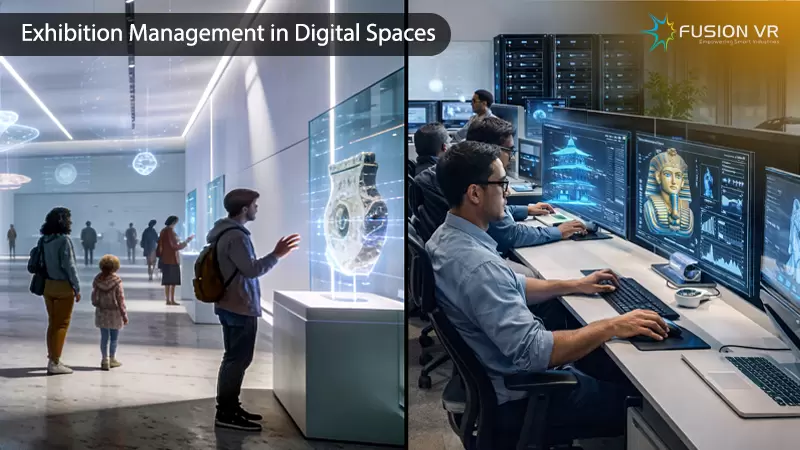
The alteration of the economics of virtual curation is a fast process that is influencing the way exhibitions are thought of, run, and kept in the digital age. With the operational costs for museums, galleries, cultural institutions, and even corporates that provide customer experiences going up and the audience wants changing, digital spaces that are based on virtual reality are coming up as a financially reasonable and also a strategically good alternative to the usual exhibition models. Indeed, it is not anymore a trial that relies on technology, but rather an economic framework of virtual curation that lets the institutions to optimize their resources, widen their reach, and get the sustainability in the long run while offering the audience immersive and meaningful experiences.
New-age exhibition management is complicated and at the same time costly because it is built on cost structure. Physical exhibitions require a huge outlay on real estate, construction, transport, insurance, climate control, security, staffing, and maintenance. Each exhibition refresh or rotating show adds to these costs to a greater extent. Virtual curation breaks this monopoly by transferring costs from the recurring physical overheads of the galleries to the digital assets that can be scaled up. Once a virtual exhibition environment is created, it is possible to reuse, adapt to and expand with very little additional costs. This major shift changes the cost-benefit ratio in favor of the digital-first strategies.
The cutting-edge economic benefit of virtual curation is the fall in costs connected to infrastructure. Physical exhibitions need a lot of space, usually located in the center of a city, and also require strict environmental conditions to keep artifacts protected. Digital spaces wipe out all these conditions. A digitally curated exhibition occupies the space on the servers instead of taking up the physical space in a gallery, thus enabling institutions to move money that would have otherwise been spent on rent, utilities, and the maintenance of physical parts to the areas of content quality, research, and audience engagement. Ultimately, this redistribution not only results in financial planning that is more flexible but also in greater investment return as a result of better planning and practice.
Moreover, the logistics are another important consideration. The transportation of exhibits, mainly those that are rare, delicate, or expensive, often incurs high costs and carries significant risks. The premiums for insurance, custom packaging, and specialized handling are some of the factors that rapidly cause the budgets to rise. The digitization of collections through photogrammetry, 3D scanning and immersive storytelling makes the virtual curation possible. After the digitization, the artifacts can be displayed over and over in different virtual venues without any additional cost related to transport or insurance. This not only cuts down the cost but also opens up access to the collections that would have been otherwise limited by geography or logistics.
Digital spaces also cause staffing economics to change. In-person fairs are in constant need of personnel for reception, security, cleaning, and management, while the staff of virtual fairs consists of only curators, digital designers, developers, and content managers. Even though there is an initial expense for skilled workers, the monthly running costs are much less. This change is also creating a need for skilled personnel, thus making Virtual Reality development and design courses ever more important for people who are going to work in the cultural as well as exhibition sectors. These courses allow people to acquire the skills required for the effective design, creation, and management of immersive digital environments, thereby making virtual curation even more economically feasible.
Scalability is yet another significant economic benefit. Physical exhibitions have limitations such as visitor capacity, working hours, and location. In contrast, virtual exhibitions can scale up without any difficulty. A digital space can be visited concurrently by thousands of visitors without any additional cost incurred for each visitor. The scalability changes the revenue picture of exhibitions completely. Various ticketing schemes can now be offered that consists of global access passes, subscription-based memberships, educational licenses, and corporate partnerships. The institutions can keep on earning money all the time instead of being restricted by the duration and the number of people that can attend the physical show.
Digital analytics still serve as a key factor in the cost-effective management of exhibitions. In places where the exhibitions are held physically, knowing the behavior of the visitors depends on a combination of the manual observation, surveys, and estimates. The virtual condition gives exact data on the visitor’s movement, the time they stay in one place, the pattern of their interaction, and how much they engage with the content. This piece of information is enabling the exhibiters to improve their shows according to the real users’ behavior and thus, allowing the distribution of resources in such a way that the maximum impact is created. Moreover, the adoption of data-driven curation gradually eliminates the costs associated with trial-and-error methods and results in more efficient planning of content.
Looking at it from the sustainability angle, virtual curation provides economically indirect benefits that are and will be increasingly important in the making of the funding and policy decisions. Lesser material consumption, lower energy use, and no travel contribute to reduced carbon emissions. Many funding agencies and donors have now set up their criteria to be environment-friendly initiatives, thus making digital exhibitions more grant and partnership-worthy. The concordance of economic efficiency and sustainability has been the very reason why virtual curation models are considerably more likely to survive in the long run.
Education and skill development play a pivotal role in sustaining the ecosystem. With the virtual curation gaining popularity, institutions will need people who can comprehend not only the cultural stories but also the immersive technology. This is the very moment when VR development classes and VR design classes come into the picture and are strategically important. These classes enable and support the collaboration between creative vision and technical execution, thus allowing the institutions to build in-house capabilities instead of totally depending on external vendors. Internal expert development will lead to a decrease in long-term costs, a faster pace of iterations, and more control over intellectual property and creative direction.
The monetary aspect of content longevity also supports the case of virtual exhibitions. The most common reason physical exhibitions are limited in time is their deterioration and the then sometimes very strict limitations on where they can be displayed. On the other hand, virtual exhibitions can change constantly. Without the need to demolish or construct new environments, new content layers, interactive features, and narrative updates can be added. This modularity not only prolongs the exhibition’s life but also makes the most of the initial investment. In terms of returns over the years, one virtual exhibition can easily outperform several short-lived physical installations.
The economic impact is also increased by accessibility. Virtual exhibitions can be visited by anyone through any device and anywhere, thus opening new audience territories for the institutions that would never have visited physically, for instance, due to physical, financial, or geographical constraints. The accessibility improvement comes out to be a wider audience, better educational outreach, and more cultural importance. Such a scenario is overwhelming for educational institutions and training providers as this accessibility compels more VR development and VR design courses for the professionals of the future to be the ones who create experiences that are inclusive, intuitive and adaptable across platforms.
Virtual curation is also changing the landscape of corporate and institutional collaborations. Companies, sponsors, and educational cooperators are more and more attracted to digital environments that provide global and measurable visibility. Online exhibitions bring in customizable opportunities for sponsorships, interactive zones for branding, and engagement metrics supported by data. Such features enable partners to express their value positions to a greater extent and thus, sponsorship negotiations are made less opaque and more economically efficient when compared to traditional physical branding placements.
Most importantly, the role of curators is not gone with the virtual curation; rather it is transformed. The curators become the architects of experience and work with the designers and the developers to create the narratives in the three-dimensional interactive environments. This collaboration between different disciplines not only allows the use of new skills but also makes the structured learning pathways, like the VR design courses focused on spatial storytelling, user experience, and interaction design, more relevant. When curators become aware of the digital production costs, they are then able to make choices that will not only consider the financial side but also the creative aspect.
As tech progresses along with time, the price to enter virtual curating gradually goes down. The hardware is being sold at lower prices, software tools are getting easier to use and workflows are becoming more and more consistent. This opening up of the market gives the digital exhibition economy to small institutions, freelance curators and up-and-coming artists who were, until now, not really able to participate. If full training by means of VR development classes is provided, even a small team can create a first-rate virtual exhibit that will attract attention all over the world alongside the major competitions.
To sum up, the economic aspects of virtual curation signify a radical transformation in the whole process of managing, funding, and experiencing exhibitions. The other side of this, the digital space with its advantages like lower costs for infrastructure and logistics, global scalability, data-driven insights, and content longevity, has become a very attractive alternative to the traditional models of exhibitions. The focus on skill development via VR development and design courses places the institutions in a position of acquiring the necessary support to keep continuity in this transition. When they become high-quality and mainstay technologies, VR and virtual curation will surely be recognized not only as the most advanced and creative innovations but also as the most economically available and prepared-for-the-future ways of managing exhibitions in a more digital-centred art world.