Museums have always been places where people connect with history, culture, art, science, and human achievement. But the way visitors consume and interact with that knowledge is changing rapidly. A traditional museum experience often follows a fixed structure: visitors enter a gallery, read descriptions, observe artefacts, listen to an audio guide, and move from one exhibit to another. While this model remains valuable, modern audiences increasingly expect experiences that are interactive, responsive, accessible, and relevant to their individual interests.
Artificial intelligence is helping museums make that shift. Instead of presenting exactly the same information to every visitor, AI can support experiences that respond to who the visitor is, what they are interested in, what questions they ask, how they interact with exhibits, and even how they choose to explore a museum.
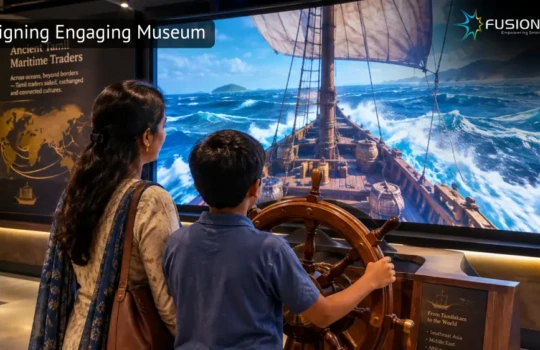
This is where the idea of the intelligent museum becomes particularly powerful. AI can work alongside virtual reality, augmented reality, holography, projection mapping, interactive displays, spatial audio, and other immersive technologies to transform a museum from a collection of static exhibits into a responsive environment. Fusion VR describes this evolution through its vision of “Museum 2.0,” where visitors can interact with AI avatars, explore recreated historical environments, and become active participants rather than passive observers.
Personalization is one of the most important ways AI can influence this transformation. Every museum visitor arrives with a different background. A school student, a historian, a tourist, a family, and a first-time visitor may all stand in front of the same artefact but want completely different information. AI makes it possible to adapt the presentation without requiring the museum to create an entirely separate exhibition for every audience.
Imagine entering a museum and being offered an AI-powered digital companion. Instead of simply following a predetermined tour, you could tell the companion what interests you. If you are fascinated by archaeology, it could emphasize excavation discoveries, ancient technology, inscriptions, and historical context. If you are visiting with children, it could simplify explanations and introduce interactive questions or challenges. If you are a researcher, it could provide deeper contextual information and direct you toward related exhibits.
This creates a fundamental change in museum storytelling. The museum is no longer simply asking visitors to follow its narrative. It can allow visitors to explore the narrative according to their own interests.
AI-powered personalization can begin even before a visitor reaches an exhibit. A digital museum platform can potentially understand preferences selected by visitors at the beginning of their journey and use those preferences to recommend galleries, experiences, or thematic routes. Instead of every visitor receiving an identical tour, different visitors can discover different pathways through the same museum.
For example, a museum dedicated to a region’s history could provide several experience routes. One visitor might choose architecture, another might choose social history, while another might be interested in technology and scientific development. AI can help organize relevant content around these interests while still maintaining the museum’s overall curatorial structure.
This approach is particularly useful in large museums where visitors can easily feel overwhelmed by the amount of available information. Personalization can turn an enormous collection into a manageable and meaningful journey.
One of the most visible applications of AI in museums is the intelligent virtual guide. Traditional audio guides usually provide predetermined information. Visitors select an exhibit and hear a recorded explanation. AI-powered guides can potentially make that interaction conversational.
A visitor could ask, “Why is this artefact important?” The system could answer. The visitor might then ask, “How was it made?” followed by, “Was anything similar discovered elsewhere?” Instead of forcing the visitor to search through a catalogue, the AI can respond within the context of the exhibit.
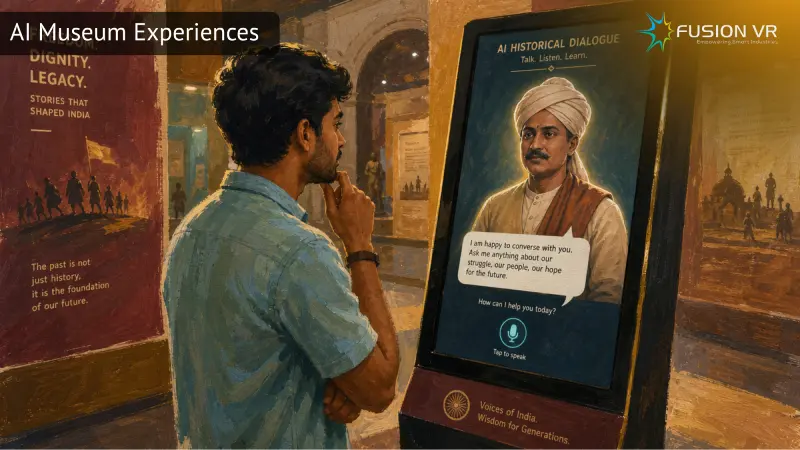
AI avatars can make this interaction even more engaging. Rather than interacting with a text-based interface, visitors can converse with a digital character representing a historical figure, scientist, artist, craftsperson, cultural personality, or fictional guide designed specifically for the exhibition.
Fusion VR’s approach to immersive museums includes AI-powered interactive experiences and AI avatars as part of the broader Museum 2.0 concept. Its projects combine these capabilities with VR, AR, stereoscopic 3D, holographic storytelling, projection mapping, interactive exhibits, and multisensory technologies.
The real advantage of such systems is not simply that an avatar can speak. The value comes from its ability to respond appropriately to the visitor. A younger visitor may need a simple explanation, while an adult may want historical context. Someone unfamiliar with a subject may need an introduction, whereas an expert may want more advanced information.
AI can help create these different levels of engagement within the same exhibition.
Language is another area where personalization can significantly improve accessibility. Museums frequently attract visitors from different linguistic backgrounds, particularly in countries such as India where multiple languages are widely spoken.
An AI museum companion could potentially allow visitors to interact with an exhibition in the language they are most comfortable using. Fusion VR has previously highlighted multilingual AI museum companions as a way of making museum information accessible in languages such as Tamil and Hindi rather than restricting visitors to the language used on traditional exhibit panels.
This can make a major difference to the visitor experience. A person may understand a historical event far better when it is explained in their preferred language. It can also make museums more welcoming to domestic tourists and international visitors.
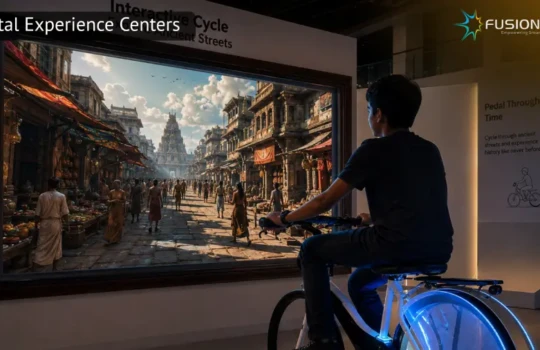
AI personalization can also work together with virtual reality to create immersive historical journeys. Instead of simply seeing an artefact from behind glass, visitors can potentially enter the environment in which it existed.
Consider an archaeological museum displaying remains from an ancient settlement. A conventional display may show the artefact alongside photographs, drawings, and written information. A VR experience could reconstruct the settlement and allow visitors to explore it as it might have appeared centuries or thousands of years ago.
AI can make this VR environment more responsive. Visitors could ask questions while exploring, choose where to go, interact with digital characters, or request additional explanations about objects they encounter.
Fusion VR’s work in immersive heritage experiences demonstrates how VR can be used to recreate historical and cultural environments. Its Ajanta VR experience, for example, is described as a stereoscopic 3D VR recreation of a UNESCO World Heritage site, while its wider museum work combines immersive technology with research-driven storytelling.
This combination of AI and VR changes the relationship between visitor and story. Instead of watching history unfold, visitors can participate in it.
AI can also make museum experiences more adaptive through visitor interaction. A traditional exhibition generally does not change depending on whether a visitor spends ten seconds or ten minutes at an exhibit. Intelligent digital systems can potentially respond to these interactions.
If a visitor repeatedly explores a particular subject, the system could offer related information. If they appear to be moving quickly through a gallery, it could provide concise explanations. If they spend considerable time examining an exhibit, it could offer deeper context or suggest related experiences.
This does not mean that museums need to track visitors invasively. Personalization can be designed around explicit visitor choices, voluntary profiles, anonymous interaction data, or session-based preferences. Responsible design is essential because museums are trusted cultural institutions, and technology should enhance that trust rather than undermine it.
The goal should therefore not be to collect as much visitor data as possible. The goal should be to use the minimum information necessary to make the experience more relevant, accessible, and useful.
Another important application is adaptive education. Museums are increasingly important learning environments for schools, colleges, families, and lifelong learners. Yet learners do not all absorb information in the same way.
AI can support different educational approaches within the same exhibit. A student might be given questions and challenges. A teacher might receive discussion prompts. An individual visitor might receive a narrative explanation. A specialist might be offered additional technical or historical detail.
Interactive quizzes can also become more intelligent. Instead of presenting a fixed set of questions, AI can adjust difficulty based on responses. Visitors who answer introductory questions correctly could progress to more challenging content, while those who need additional context could receive explanations before continuing.
This creates a learning experience that feels less like an examination and more like exploration.
AI can further enhance museums by connecting individual exhibits into larger stories. Visitors often see collections as separate objects even though they may be historically or culturally connected. An intelligent system can help reveal those connections.
For example, after viewing an ancient tool, a visitor might be shown how the technology influenced later craftsmanship. An artwork might be connected to a political movement. A historical personality might be linked to places, events, inventions, and other people represented elsewhere in the museum.
The result is a network of stories rather than a collection of isolated displays.
This idea fits naturally with immersive museum design. Fusion VR emphasizes that digital museums should combine multiple technologies into a curated visitor journey rather than treating technology as a collection of independent gadgets. Its approach integrates storytelling, visitor flow, immersive media, interactive systems, and technology architecture at the gallery level.
Personalization can also extend beyond individual exhibits to the entire museum journey. A visitor might begin with an interactive introduction, enter a VR experience, interact with an AI avatar, explore a holographic display, and then receive recommendations for another gallery. Each interaction can contribute to a coherent journey.
This is particularly important because immersive technology by itself does not automatically create a meaningful museum experience. A spectacular VR headset or projection system may attract attention, but the underlying story determines whether the experience remains memorable.
For this reason, AI should be treated as part of a broader museum strategy rather than as a standalone feature. Research, curatorial accuracy, storytelling, accessibility, interaction design, hardware, software, audiovisual engineering, and visitor-flow planning all have to work together.
Fusion VR’s turnkey digital museum model reflects this philosophy by covering areas ranging from museum consulting and research to storytelling, experience design, technology delivery, integration, training, maintenance, and long-term operation.
There is also an opportunity for AI to make museums more inclusive for visitors with different accessibility requirements. Voice-based interaction can reduce reliance on touchscreens. Conversational interfaces can provide information without requiring visitors to read lengthy panels. Adjustable explanations can help visitors who need more time or simpler language.
Combined with AR and spatial technologies, AI can potentially provide contextual information without requiring visitors to move away from an exhibit.
For museums, this creates an important opportunity: personalization does not have to mean creating completely different exhibitions. Instead, the same underlying content can be presented in multiple ways.
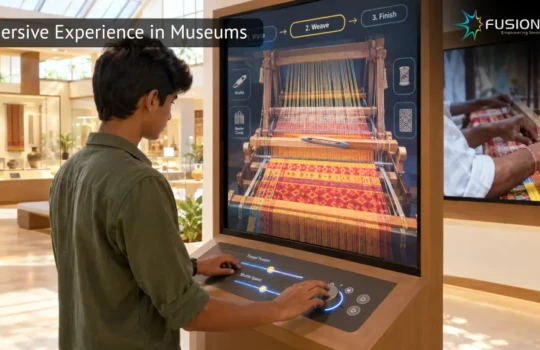
One visitor may watch a short film. Another may explore a 3D reconstruction. Someone else may speak with an AI guide. A child might participate in a game. A researcher might explore detailed digital archives.
The physical museum remains the same, but the experience becomes flexible.
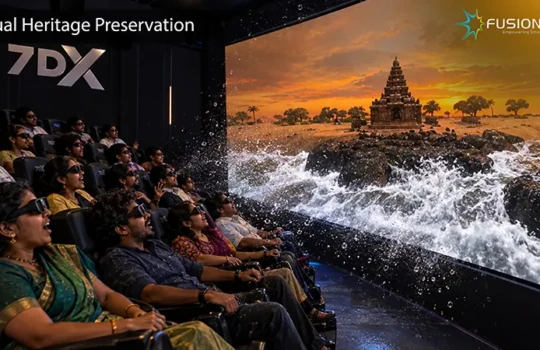
The future of museum personalization will likely involve an increasingly close relationship between AI and immersive technologies. AR could place digital information directly over physical objects. VR could transport visitors to reconstructed environments. Holographic systems could bring digital characters into physical galleries. Projection mapping could transform architectural spaces. AI could provide the intelligence connecting these experiences.
Fusion VR already works across this broader ecosystem, combining AI-powered interactives with VR, AR, MR, holography, projection mapping, stereoscopic 3D, spatial audio, and multisensory experiences.
The most successful museums, however, will not necessarily be those that use the greatest number of technologies. They will be the ones that use technology with purpose.
AI should not replace historians, curators, educators, artists, or human museum staff. Instead, it can support them by making knowledge more accessible and creating additional ways for visitors to engage with collections.
There are also challenges to address. AI-generated information must be carefully controlled because historical and cultural content requires accuracy. Museums need reliable content sources, human oversight, appropriate privacy policies, and transparent approaches to AI interaction. The technology must also remain accessible rather than becoming a barrier between visitors and authentic artefacts.
Cost, maintenance, infrastructure, staff training, and technology lifecycle management are equally important. An immersive museum is not simply installed once and forgotten. Hardware, software, content, networking, and interactive systems need ongoing support. Fusion VR emphasizes long-term maintenance, remote monitoring, operational support, and staff training as part of its museum delivery model.
Ultimately, AI is changing the question museums can ask. Instead of asking, “How can we show this information to everyone?” museums can increasingly ask, “How can we help each visitor discover this information in a way that works for them?”
That is the essence of personalized museum experiences.
The museum of the future may not feel like a place where visitors simply walk from one display to another. It may feel more like an intelligent story world—one that listens, responds, explains, adapts, and encourages exploration.
A child could discover history through games. A tourist could experience a heritage site through VR. A student could question a virtual historical character. A researcher could explore deeper layers of information. A visitor from another country could experience the entire journey in their preferred language.
The collection remains at the heart of the museum. Technology simply creates new pathways to it.
AI personalization therefore represents more than another technological trend in the cultural sector. It offers museums a way to become more interactive, inclusive, educational, and visitor-focused while preserving the authenticity and importance of the stories they are responsible for telling.
As digital museums continue to evolve, the most powerful experiences will likely be those where technology becomes almost invisible and the story becomes unforgettable. That is where AI, VR, AR, immersive storytelling, and thoughtful museum design can come together not to replace the museum, but to help visitors experience it in a deeply personal way.
For institutions exploring this transition, Fusion VR provides end-to-end expertise in digital museums and immersive experiences, from concept and storytelling to technology integration and long-term museum operations. Its portfolio includes heritage, archaeology, memorial, science, spiritual, and institutional experiences across India.