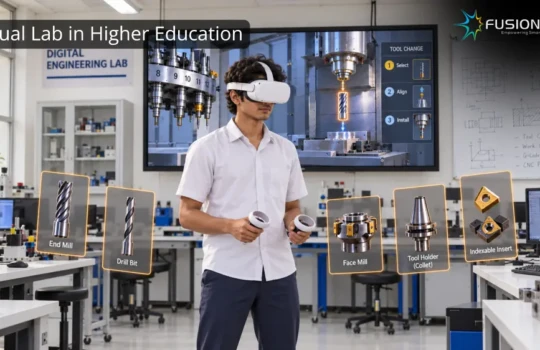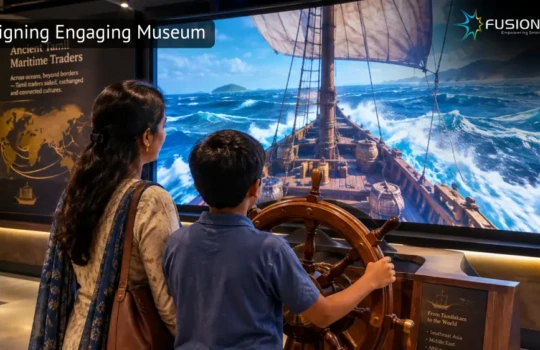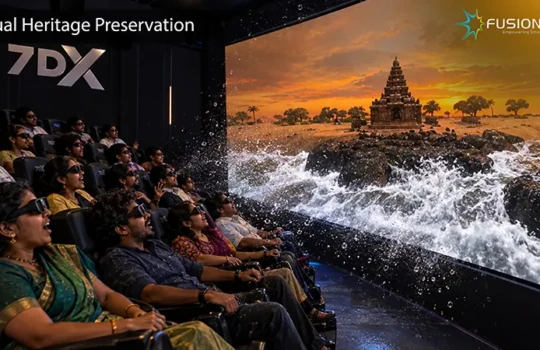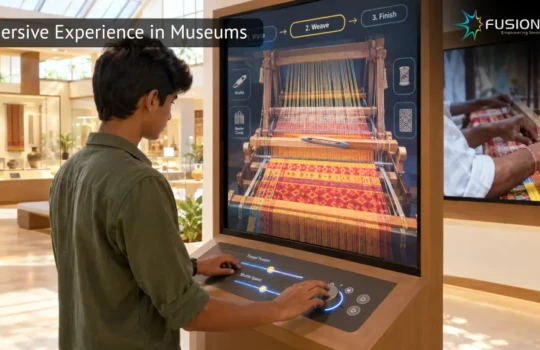
Virtual Reality (VR) labs are coming up to be the one of the most important elements in modern education and professional training. In the case of immersive environments, they are actually transforming the way of learning from a university and skill-development institutions to even corporate learning centers. The major concern is no longer whether the institution has good quality content and hardware but rather if the environment has good safety, security, and responsible usage. To be more specific, the major issues in the VR labs are safety, security and responsible usage.
A VR lab is a shared ecosystem of physical space, advanced hardware, software platforms, network infrastructure, and human interaction. Virtual Reality environments, in contrast to classical computer labs, add new dimensions of movement, sensory immersion, data flow, and psychological impact. By the way, without the well-defined safety protocols, the same immersive power, which makes learning more effective, can also introduce risks from physical injury and eye strain to data breaches and system misuse. Therefore, the establishment of robust safety protocols for VR labs is not an option but rather a necessity.
Understanding the Unique Safety Challenges of VR Labs
The VR labs experience is completely different from that of normal classrooms or IT labs. The people in the VR head-mounted displays are disconnected from the physical world and this enhances the chances of accidents happening like bumping into things or falling over. Other factors like moving around while using different interactions, handles controllers, and room scale tracking also have a big impact on the dangers involved. Students taking VR development classes usually work for long hours on testing simulations or debugging environments and experimenting with interaction mechanics, this increases their exposure to both physical and digital strain.
One more major difficulty is noted in the area of common use. Usually, VR laboratories consist of several people that share headsets, controllers, and other devices for different sessions. This leads to concerns about cleanliness, the reduction of life of the equipment, and problems with the settings not being the same all the time. Furthermore, VR technologies deal with huge amounts of data concerning the user’s movements, biometric characteristics, voice inputs, and even sometimes facial expressions thereby making the issues of privacy and security very critical.
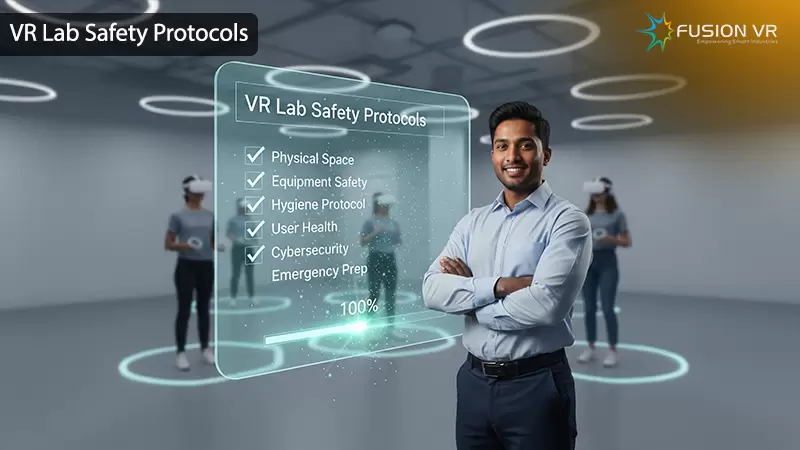
A unified framework must be built by combining physical safety, digital security, operational discipline, and user awareness to holistically cover all these dimensions in an effective VR lab safety protocol.
Physical Space Planning and Environmental Safety
The first step in ensuring the safety of virtual reality (VR) labs is the clever design of the physical space. Virtual reality laboratories should always be bigger than the usual computer labs so as to allow unrestricted movement. The presence of open areas, soft corners, and furniture made in a rounded design ensures that the possibility of accidents happening is very low. Allocating spaces for sitting VR, standing VR, and room-scale VR respectively, also helps in controlling how users move around easier.
Markings on the floor and virtual boundary systems have to be coordinated. Most of the VR systems do come with some kind of guardian or boundary features, but the users get an extra assurance of being aware of their surroundings through the physical floor cues when they take their headsets off for a moment. Right lighting also plays a very important role. Although the VR experiences might be visually engaging the instructors still monitor the users and the eye fatigue during the transitions gets reduced through the ambient lighting
Surprisingly, ventilation and temperature control take on a very important role. Heat is generated by VR equipment, and it is common for users to undergo a rise in body temperature during their immersive sessions. Proper airflow and temperature management not only make the user feel comfortable but also fight off the tiredness, especially during the longer sessions that are frequently held in VR development courses where the students may be testing the environments over and over again.
Hardware Safety and Equipment Handling
VR hardware is a big investment, and if it is not handled properly, not only can it get damaged but also the user can get injured. Every time a new user comes in, he/she/they should be fitted properly by adjusting the strap tension, aligning the lenses, and setting the interpupillary distance. Fitting the headset wrong can cause eye strain, headaches, and neck discomfort after some time.
Controllers, trackers, and haptic devices are to be checked before each use. Loose straps, cracked casings, or drifting sensors will lead to inaccurate tracking and unexpected user movement. There should be well-defined charging stations that are safely wired to avoid tripping and electrical risks.
The need for supervision becomes even more important in VR labs that support VR development courses, where students often connect external sensors or test experimental hardware. Hardware modifications, firmware updates, and peripheral connections should all have clear rules to prevent accidents like damage or unsafe configurations.
Hygiene Protocols for Shared VR Equipment
Hygiene in shared virtual reality environments is a significant issue. The headsets are very close to the human body and hands, which are the parts of the body that come in contact the most with the machines and are therefore potential carriers of microorganisms. Good hygiene practices not only lead to users’ health but also to the equipment’s durability.
It is a must that every VR user has disposable or washable face covers. Headsets should be disinfected after every single use by the application of alcohol-free, lens-safe wipes. Sweat-absorbing materials should be sanitized or replaced frequently. Handwashing before and after every single use of the VR headset should not be compulsory, but it should be very encouraged as a proper practice.
The scheduling of a buffer between sessions enables the cleaning staff to perform their work properly without being under pressure. In the case of labs with a lot of use where continuous virtual reality development courses are held, it would be great if the assignment of a lab assistant or the rotating of a student for the responsibility of hygiene of equipment helped in maintaining consistency and accountability.
User Health, Comfort, and Ergonomic Best Practices
The VR experience can be very strong and powerful, especially for the new users. If the VR sessions are not done correctly, motion sickness, eye fatigue, dizziness, and cognitive overload are the common problems that may arise. The safety measures should set the maximum duration of the session with the mandatory breaks between the immersive experiences.
Orientation sessions are very important for the beginners. The users should be taught how to in and out of the VR experience safely, be aware of the signs of discomfort, and be able to pause or end the session on their own. In VR development courses, where the student may be testing the system to its limits, it becomes increasingly significant to know your own physical limits.
For the users who find standing or room-down experiences discomfort, they should be offered seated VR options. Ergonomics seating, adjustable workstations and posture training are some appreciated measures that help in making the practitioners comfortable during the long development and debugging phases.
Instructor and Supervisor Responsibilities
No VR lab without trained supervision is to function. Safety measures and emergency handling are the areas where Instructors and lab coordinators are indispensable. They should have a good grip not just on the VR systems’ technical operation but also on the first-aid basics concerning dizziness, eye strain, or minor physical injuries.
Communication that is clear is a must. Instructors should inform the users about the safety rules, emergency exit procedures, and behavioral expectations before each session. During the sessions, the supervisors must keep an eye on the user movement, equipment performance, and the overall lab condition.
In the courses related to VR development, instructors are often the ones who have to handle the situation of safety and creative freedom at the same time. Experimentation is welcomed, but it has to be done within safe limits that are clearly defined to avoid unsafe practices, unauthorized software installations, or misuse of lab resources.
Cybersecurity and Data Protection in VR Labs
VR labs are not only digital but also physical environments. VR systems are usually linked to local servers, cloud platforms, and third-party development tools which thus making it very important to have cybersecurity as a part of the safety protocols. The integrity of the institution and the privacy of the users can be endangered by an unauthorized access, malware, or data leaks.
The user accounts should be organized according to roles and students, instructors, and administrators should have their access permissions restricted. The development builds and the experimental applications should be tested in a sandbox environment before they are put on the shared system. The regular software updates and the antivirus protection can make the system less vulnerable.
In the VR development courses, students might have to deal with sensitive project data, proprietary simulations, or user analytics. It is necessary that very clear data governance policies dictate what data is to be collected, how it is to be stored, and who will have access to it. Consent and transparency are vital, especially when it is about biometric or behavioral data.
Emergency Preparedness and Incident Response
No matter how careful you are, accidents happen. In a VR lab, safety protocols have to be very detailed and at the same time, they must have a good emergency response plan. These plans should include all the possible scenarios including physical injury, sudden illness, equipment malfunction, power failure, or fire alarms.
It is a must to have the emergency exits well marked and free from any kind of obstruction. Headset users should be gently and safely assisted out of the immersive experiences in case of an evacuation. Items like the first-aid kits, emergency contact numbers, and incident reporting procedures should be located in places that are easy to reach.
Drills and protocol reviews should be conducted regularly to ensure proper preparedness. In places that provide VR development courses for a longer term, they will have continuous improvement of lab operations through periodic safety audits and feedback sessions.
Ethical and Psychological Safety Considerations
Immersive environments have the potential to produce very intense emotional reactions. It is necessary to take great care with simulations that involve realism, conflict, or very strong sensory input. The establishment of proper content guidelines will make it possible to prevent people from going through experiences that might cause them distress or psychological discomfort.
In schools, however, the principle of inclusivity complemented with accessibility is still prevailing. VR labs should be designed in such a way that it is easy for different users who may have different physical capacities, and sensory sensitivities and learning needs to access the resources. The option of learning via other methods should be provided whenever VR participation is not suitable for certain individuals.
Ethical training should be incorporated into the curriculum for VR development courses. The students should not only learn to create immersive experiences but also to understand the responsibility connected with this type of design that impacts people’s perception, behavior, and emotions.
Building a Culture of Safety in Immersive Learning
Safety in the VR lab therefore is not merely a matter of regulations and checklists; it is rather a matter of the whole institution’s approach. The compliance of users who know the reason of the protocols and take part in the safety maintenance, becomes a native supply instead of a forced one. Orientation programs, visual cues, and constant dialogue are among the ways that culture is built over time.
Institutions that offer VR developer courses are the ones that can lead by example most effectively with the adoption of VR in the education and industry sector growing steadily. They do so by not only equipping their infrastructure with safety measures but also incorporating such measures in the curriculum thus, teaching students how to use immersive technologies not only effectively but also safely.
A VR lab that is secure and properly managed will inspire more confidence, creativity, and learning outcomes. When safety measures are well thought out, and all the time practiced, the immersive learning environments can truly live up to their promise giving learners the ability to explore, innovate and virtual reality’s future without risking their health or the security of the lab.