The digital economy, which is constantly fast-changing, puts the universities under the enormous burden of closing the skills gap that is being created by the difference in the academic learning and the industry expectations. Every year, there are hundreds of thousands of graduates who are ready to get jobs but still companies in various fields such as manufacturing, engineering, healthcare, etc., and even the latest technologies keep complaining about the lack of job-ready talent. This discrepancy occurs not because of lack of intelligence or hard work but due to the gap between the teaching and the demands of the modern workplace. VR training that is competency-based has become one of the most effective ways to address this issue, allowing universities to create new curricula that are highly experiential, outcome-oriented, and in alignment with the exact competencies that industries expect from future professionals.
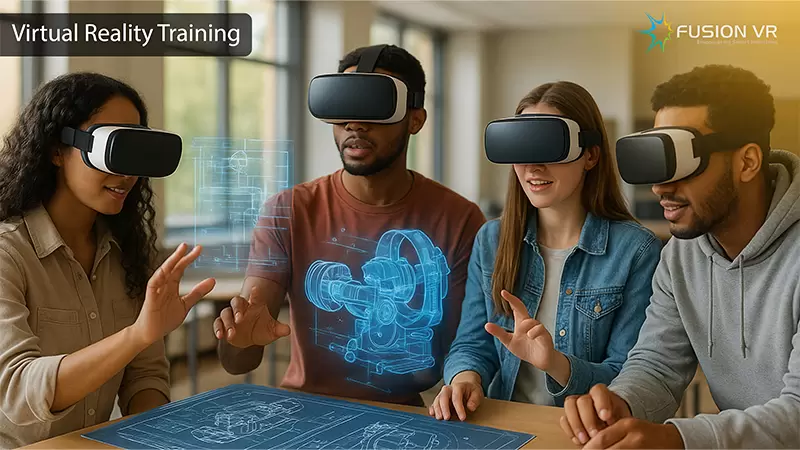
Conventional educational models majorly depend on lectures, strict curricula, and the students’ listening, note-taking, and memory-relying examination practices as their main sources of evaluation. In contrast, the present industries assess the candidates based on a totally different set of skills such as technical skill, spatial awareness, decision-making, problem-solving, process execution, safety consciousness, teamwork, and technology adaptation. An academically successful student may still find it hard to perform in a factory, in a medical simulation lab, at a design studio, or in a high-risk industrial environment because the competence required to work effectively has never been developed in a realistic context. VR allows universities to turn theoretical knowledge into practical skills, thus students are able to learn through the highly immersive, controlled, repeatable, and safe virtual ecosystems.
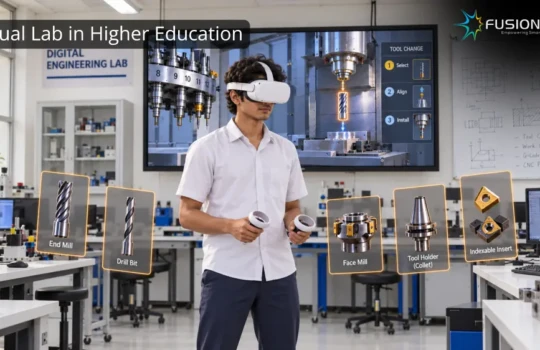
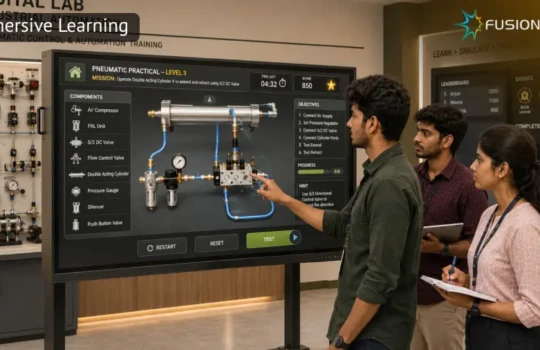
VR training based on competencies rather than time spent in class shifts the focus to skills developed through experience. Students are not limited to learning engineering processes from diagrams, for example, they can do the whole cycle of virtual assembly of machines, operating industrial equipment, or diagnosing and fixing failures. Medical students can perform surgery on patients where the patient’s reactions to the student’s actions are very realistic. Architecture and urban planning students can move around 3D interactive environments, get acquainted with the spatial arrangements, and even pass the design of outcomes before they start building physical models. Industrial safety trainees can learn the most dangerous protocols in virtual high-risk environments without being at risk. Media and design students can experiment with 3D assets, lighting, cinematics, and spatial storytelling in a virtual production pipeline. VR in every instance turns a passive medium into an active skill, thus, the learners being judged only on their performance, decision-making, and accuracy instead of just their memory of answers.
Today, industry partners are looking for graduates who are already able to work with very little training. Competency-based virtual reality (VR) programs University can use to put real industry workflows right into their teaching. Rather than working with abstract ideas, students do specific tasks related to their field that are almost identical to the conditions in the workplace. This cooperation assures that when a student graduates, he or she has already gained the applied skills required for the job. For instance, an engineering student who is adept at using virtual PLC controls, industrial motors, machine maintenance simulations, and AR troubleshooting workflows will certainly be more employable than one who has just been introduced to the concepts. Likewise, a student in medical field who has done hundreds of VR procedure simulations will become more confident, accurate, and skilled in critical thinking faster than someone who has had just a clinical rotation with very limited patient interaction.
Oftentimes, universities are in a difficult position when it comes to updating their curriculum to match the advances made in the industry. VR comes to the rescue by functioning as a modular platform that can be rapidly updated. The VR modules once created can be modified each semester in order to include new technology, new ways of working, and the industry’s changing standards. With the right academic partnership and VR labs, professors will be the first ones to get curriculum updates thus, the syllabus will always be fresh. This scenario presents the universities with a powerful transformation advantage in attracting students who are more interested in getting the skills of the very near future, while the industries get a workforce that is already aware and trained on the current tools and methods.
Another important feature of competency-based VR training is the precision regarding assessment. Conventional tests measure only a few dimensions retention, writing and theoretical skills. These parameters fall short in telling whether a student can really perform a task in the real world. Assessments done through VR create a completely different method for evaluating competence, collecting performance data that include reaction time, accuracy in decision-making, etc. The system can automatically keep track of mistakes, give immediate feedback, and show skill progress over several attempts. This data-rich model of training and assessment not only allows instructors to detect skill deficiencies early on and to deliver customized remedial training, but it also boosts students’ confidence as they can monitor their improvement visually, acknowledge their errors and practice skills at their own pace.
The workforce landscape is getting transformed more quickly than ever before due to the adoption of automation, the implementation of Industry 4.0 concepts, the utilization of AI-powered workflows, smart manufacturing, the application of digital twins, and the use of immersive media pipelines. Employers are now paying more attention to hybrid skills technical knowledge combined with digital fluency, spatial intelligence, and operational proficiency. Competency-based VR training gives the students an opportunity to work with the very technologies that they will be using tomorrow, thus preventing them from getting familiar with digital tools only during their first job. It does not matter whether it is AR-guided instructions, VR-based machine operations, digital twin monitoring, immersive design, or simulation-driven problem-solving; VR is the technology that allows learners to work in the future before actually entering it.
One of the main acceptances of VR in university education is the access to such situations which are infrequent, risky, or quite expensive, or even impossible to create. It is simply not feasible to do repeated practice on accidents in an industry, emergency responses, maintenance of complex electronic parts, or even during space and deep-sea explorations, along with chemical hazards and complicated medical procedures. Virtual Reality has come up with a solution that lets you learn through simulation without any risks. Hence, students can perform hard tasks over and over until they become perfect in their skills. This is an important factor for not just safety awareness but also operational discipline and confidence building qualities that the industries mention as being very crucial yet lacking in the fresh graduates.
VR is quite significant in overcoming barriers like distance and cost. Numerous colleges or universities that are located mainly in underdeveloped areas are struggling with the access to costly lab instruments, physical machinery, or even specialized training setups. VR acts like a laboratory that can reproduce any environment or even equipment in a virtual space, thus allowing all the students to avail themselves of the same standard in training no matter how big the campus is, what the budget is, or what the infrastructure is like. Such a system of group learning based on experience guarantees that all students in institutions, no matter if they are situated in rural, urban, or semi-urban areas, have the same opportunities.
Switching over to competency-based VR learning also aids universities in faculty development. Educators acquire instruments that facilitate their teaching of difficult ideas, while they also become skilled in new technology. Faculty training programs within VR academic partnerships keep teachers updated to the market and at ease when providing future learning experiences. The institution is then viewed as a center of innovation by not being a place where old techniques persist, but rather by the mutual technological advancement of the faculty and students.
The collaboration between the industry and universities is the base of competency-based VR-driven curricula. When universities cooperate with companies that provide immersive training, simulation development, and real-world workflow modeling, they establish a direct communication line with the industry specialists. This lets the AR VR training content be an accurate representation of the tasks that are performed in the field and not a theoretical guesswork.
Industry consultants are able to support educational institutions in specifying exact skill sets needed be it for tech-savvies in engineering, health-related professions, innovators in design, developers of virtual reality, engineers in automobile, safety personnel, or creators of media. Accordingly, VR modules can be created and targeted to those exact skills, thus guaranteeing that students come out of the program with a competitive edge in the job market.
The measurable impacts of virtual reality-based competency education do not only limit to employability. Learners acquire quicker mental processing, improved hand-eye coordination, better problem-solving skills, and the ability to mentally visualize systems in three dimensions. Such intellectual improvements lead to higher grades, better comprehension, and memory retention of the subject matter over a longer period. Additionally, VR has a positive effect on the motivation of students as it makes the learning process fun and engaging, similar to a game, thus students are eager to practice and master new skills.
The practical abilities of candidates are being demonstrated more and more through the use of VR skills portfolios, which are showing their performance metrics, completed simulations, procedural mastery scores and project work in immersive environments. This becomes a strong differentiator during placements, making it possible for recruiters to pick out talents by their proven capability instead of general academic results. Universities that have embraced VR competency pathways are claiming higher placement rates and more convinced recruiters.
India is on the way to preparing a workforce that is future-ready and will be a head in the sectors of manufacturing, healthcare, cybersecurity, media, aerospace, energy, and immersive technology, and competency-based VR training is not merely an innovation but a necessity. Incremental updates of the syllabus or occasional industry workshops cannot close the skills gap. A radical change is needed in the learning delivery, practice, and evaluation. VR is that change because it transforms the learning process into an experiential, continuous, immersive, and real-world expectation-aligned one.
Universities that adopt competency-based virtual reality learning will not only redefine higher education but also enhance the country’s ability to compete in the global digital economy. They will be the source of the graduates who are confident, skilled, flexible, and ready for the job market from the very first day. The VR-enabled learning paths are the sign of the future a future where students will not only grasp theories but practically be inside, express with and skillfully learn through their experiences with the concepts. As industries transform, so will the use of virtual reality as a connecting line that joins theoretical academic knowledge with practical workplace skills, thus preparing the upcoming professionals to not only face the issues of the day but also the revolutions in technology that might come in the future.