Student-Led Innovation: How University VR Labs Become Incubators for Next-Gen Technology Projects
Aadhya: Arjun, I have been listening to a lot these days about how universities have been establishing VR labs and all of a sudden, students are creating groundbreaking projects. Is this really the case, or is it merely a hype cycle?
Arjun: No, it is quite an event. The VR labs turned out to be the present-day “garage spaces” where students come up with ideas, experiment, break things, and make them again, and finally produce something visionary. It is like a fun zone where wild concepts become real prototypes.
Aadhya: I really appreciate the term “garage spaces.” Nevertheless, I’m curious regarding the reason why the VR labs have such an edge over a normal computer lab.
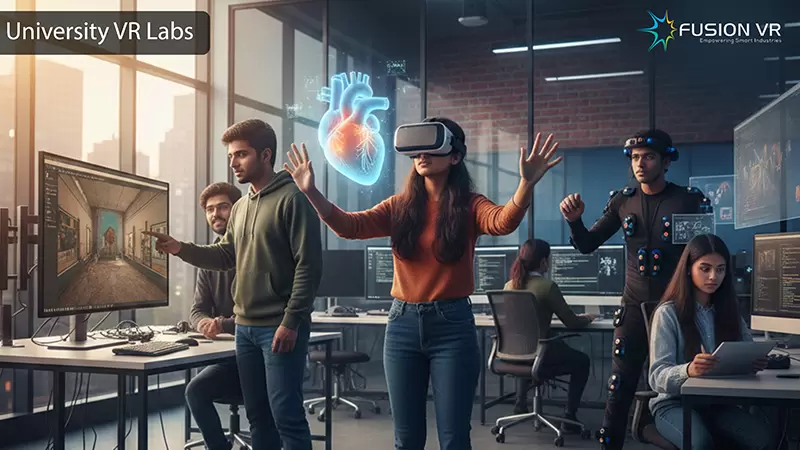
Arjun: A computer lab that is regular provides you with an opportunity to use the technology. A VR lab provides you with an opportunity to make the technology. The difference is enormous. In the VR labs, it is not just the screens that students are looking at, they are getting into the immersive worlds, designing the interactive simulations, making the AR overlays, and testing the real-time physics scenarios. The students are not simply watching the technology, they are living it.
Aadhya: Does the very immersion spark imagination?
Arjun: Definitely. Virtual Reality stimulates the brain to think in terms of space, vision, and interaction. There is a constant flow of ideas when students work on a VR prototype. They discover new problems, new opportunities, and new methods. Creativity becomes unavoidable.
Why VR Labs Are Becoming Innovation Incubators
Aadhya: But here is a query: in what way does a VR lab evolve to be an incubator for the future tech projects? Incubators generally have mentors, money, planned programs… how is an academic lab embracing that role?
Arjun: Very good question. The current VR labs especially the ones linked with industry or run by advanced tech companies give much more than just headsets and computers. They create innovations mini ecosystem. Let me explain.
Aadhya: Go on! I am all ears like a student who is ready with his notebook to jot down the important points.
Arjun: To start with, these laboratories establish the environment of innovation. Students are given the freedom to experiment with their ideas without the worry of being unsuccessful. That’s the first stage.
Secondly, VR laboratories unite the various skills of the professionals involved from students of coding through 3D art, design, psychology, and engineering, medical researchers and even historians. The whole group works together.
Third, the mentioned laboratories and similar ones generally make use of the most state-of-the-art tools Unreal Engine, Unity, motion capture, haptic systems, XR devices, fluid simulation tools, and the like.
Fourth, the majority of universities work together with industry professionals, for example, the teams who create VR museum experiences, corporate experience centres, AR VR training simulators, etc. This type of mentorship fast-tracks the project quality.
Aadhya: That’s a fact. Cooperation among different disciplines can give a lot of power. I mean, the question from someone from the outside, “Why don’t we do it this way?” often brings out the most interesting ideas.
Arjun: Spot on! New things come up when the different minds clash.
From Idea to Prototype – The VR Lab Journey
Aadhya: What is the usual process of a project? I mean, students do not suddenly think: “Let’s create the next-generation simulation!”?
Arjun: Sometimes the answer is yes! But mainly it starts with a problem they want to fix, improve, or visualise something better.
Picture a student of medicine who says:
“Anatomy classes are very dry. Why can’t we have a 3D interactive human body instead?”
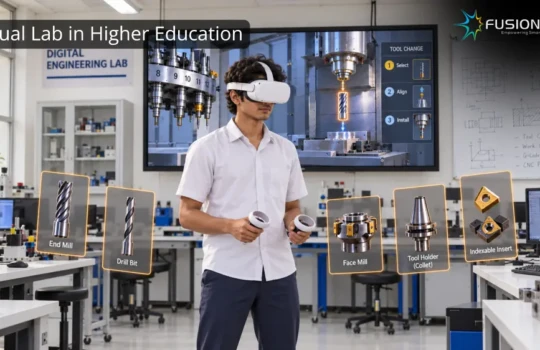
What about a student from the mechanical engineering department who would declare: “A VR simulator for heavy machines is a necessity, and students can work with them safely.”?
And a student from design saying:
“Museum visitors should not just read but rather feel history.”?
Aadhya: I agree with you. Most of the time, the idea for a VR application is motivated by the problems that people face in the real world.
Arjun: Absolutely. The VR labs take the inconveniences of the students and turn them into novel ideas. When they once catch the initial spark, the whole procedure is quite smooth as follows:
- Conceptualization – Spot the problem and propose a possible VR solution.
- Research & benchmarking – Investigate what is out there and what is not.
- Storyboarding & design – Both the technicalities and the user’s experience.
- Prototype building – Using Unreal, Unity, Blender, and motion capture tools.
- User testing – Securing responses from fellow students and the teaching staff.
- Iteration – Making it better according to the feedback.
- Final pilot or demo – Showing the output to students, departments, or even industry.
Aadhya: That’s nearly the same as the process of making startup products!
Arjun: That’s what I mean! A VR lab is like a small startup studio. The students go through the whole product life cycle.
The Role of Faculty and Industry Partnerships
Aadhya: But do universities actually help out with these projects? Or are there just a few eager students who are doing the whole thing?
Arjun: Do you want to know the truth?- all university VR lab winners share one thing in common: constant supervision. Faculty mentors, VR specialists, AR development companies, and domain experts work together.
Aadhya: I have observed that in our laboratories. We had some trainers from the industry visit us and teach us the process of creating VR museums and unexpectedly, half of the students started to come up with their first interactive museum project ideas.
Arjun: That is right. When students receive exposure to the real world, their thoughts become anchored and no way irrelevant. In fact, more and more universities are forming partnerships with companies today that concentrate on museum experiences, industrial VR simulators or AR-based corporate training modules. Consequently, students can use the same workflows that are used in the industry – from creating 3D assets to rendering in real-time to multi-user VR.
Aadhya: You are right. It is the way that university projects get transformed into commercial ones.
Student-Led Innovation: Real Examples Emerging from VR Labs
Aadhya: Great! I’m excited now. Would you mind sharing examples of the innovations students are creating?
Arjun: Of course! Let me list the top areas where students creative minds are really working hard:
- VR Training Simulators
The students have created the following simulators:
- Welding
- Medical procedures
- Robotics
- Manufacturing processes
- Aerospace controls
In this way, simulators have an impact on both training by reducing the risks and on the speed of learning by improving it.
- 3D Interactive Museums
- The students are involved in:
- VR museum experiences
- 3D ancient site reconstructions
- Interactive digital exhibitions
- Cultural visual storytelling with immersive techniques
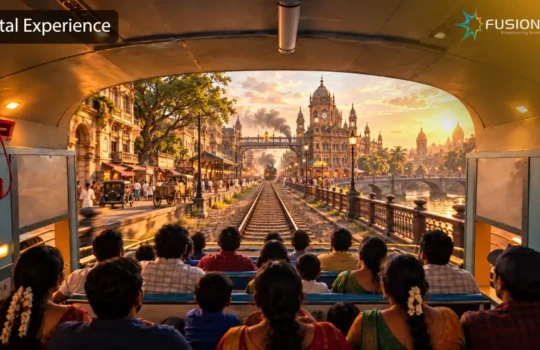
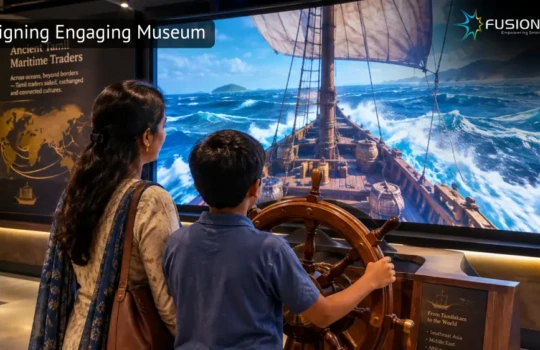
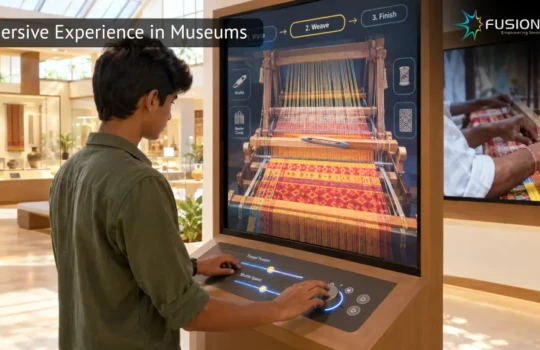
Through the mix of history, design, and VR, the students are producing museum experiences that are almost real.
- AR/VR Courses & Education Tools
There are students of different educational backgrounds who are working on:
- AR tools for the classroom
- VR-based science experiments
- AR modules for anatomy
- VR storytelling classrooms
The education turns out to be engaging and a whole new experience.
- Digital Twins
Engineering and Internet of Things students develop:
- Partial images of the university or laboratory
- Efforts and time taken for equipment monitoring are displayed in real time
- Simulations of smart environments
This is in line with the smart city and Industry 4.0 innovations.
- VR Games and Interactive Experiences
Game design students turn VR labs into a project area where they:
- Design games based on physics
- Build puzzles that absorb players
- Play with touch feedback technology and motion platforms
- Research Projects
Students work in areas with the following departments:
- Psychology (VR therapy, phobia treatment)
- Architecture (VR walkthroughs)
- Medicine (surgical VR)
- Marine sciences (underwater VR simulations)
Aadhya: Incredible! That’s quite a wide range. It is quite understandable that educational institutions refer to virtual reality laboratories as the “classrooms of the future.”
Arjun: They really are! Moreover, there are cases when the universities handle the student projects and turn them into official exhibitions at museums or companies.
Why Students are the Best at VR Innovation
Aadhya: Still, what is it that students come up with the best VR innovations? One would assume that the experienced ones would take the lead in this.
Arjun: That is the very point of student-led innovation. Students bring new ideas to the table, they have no restrictions in their imagination and no fear to try things out. Professionals often limit themselves by their own ways of thinking. Students, on the other hand, do not only cross the lines but also redefine them.
Students are uniquely bringing the following things:
- Bravery – They dare to come up with the most radical ideas.
- Quickness – They quickly build and test their prototypes without analyzing too much.
- Readiness – They are very quick to acquire the new tools.
- Devotion – They are working hard at nights because they are very certain about their idea.
- Teamwork – They mix and mingle between the fields without any difficulty.
Aadhya: That is a fact. Limitations are not a problem for students, they just ask: “What if we could?”
Arjun: Right! And virtual reality laboratories allow them to play with the “what if” scenario.
How VR Labs Turn Students into Innovators
Aadhya: So, what really goes on in the lab that changes the students?
Arjun: I will paint the picture of the atmosphere.
- The Liberty to Experiment
Pupils are allowed to do anything and everything, even if it doesn’t work. Failing is a step of the process.
- Access to Advanced Tools
Headsets, trackers, powerful GPUs, Unreal Engine, haptic devices…
This means providing a painter with the best brushes available in the world.
- Peer Learning
A programmer takes hints from a visual artist.
A visual artist takes hints from a technician.
A historian and a VR developer share knowledge.
The interdependence of collaboration brings forth the power of imagination.
- Exploration Without End
The students’ exploration includes:
- New technologies that are not yet widely used
- Engines that can produce graphics in real-time
- Art in three dimensions
- Augmented reality (AR) toolkits
- Motion tracking
- Project-Based Learning
VR is embracing the learning process by doing rather than just theory-heavy classes.
- Exposure to Real Clients
A few laboratories work together with industries, museums, and corporate centers. The students are receiving real project feedback just like startups do.
Aadhya: To be honest, isn’t this the dream of every dedicated techie out there?
From VR Lab Projects to Startups
Aadhya: You mentioned earlier that VR labs are almost like startup studios. Are there any cases where projects actually became startups?
Arjun: Sure! A number of founders have come to the point where they first used the university’s VR labs. Allow me to illustrate with an example.
Consider a bunch of students who create a VR simulator for safety training in chemical labs. The university is very pleased with the invention. The nearby manufacturing plant conducts a test and their reaction is even more positive. In twelve months, the students have polished the product, made a presentation, and boomed the VR startup is born.
It happens more frequently than you might think.
Aadhya: That’s encouraging. I assume VR labs are the ideal launchpad for students?
The Future: How VR Labs Will Shape Tomorrow’s Innovators
Aadhya: So, what is next? What will be the role of the university VR labs going forward?
Arjun: The future is gigantic. VR labs will turn into:
- Hubs for AR/VR skill enhancement
- Campuses’ innovation boosters
- Immersive learning research facilities
- Intelligent simulations collaboration areas
- Industry-ready training solutions pipeline
Before long, the universities will consider VR labs as core innovation pillars just like they do with the engineering departments.
Aadhya: That’s very thrilling. The students are not only getting to know the technology but also the one’s to give it a shape.
Final Thoughts
Aadhya: After listening to all this, VR labs are the future of education in my opinion.
Arjun: No question about it. They make it possible for students to investigate, be creative, produce and even fantasize. If students are allowed to lead in VR development, the universities will be turned into the birthplaces of the next generation of revolutionary projects.
Aadhya: So, the message is really straightforward?
Arjun: Indeed, just provide students with the proper tools, the right environment, and the future will be created in those VR labs.
Aadhya: I’m really motivated. I’m going to the lab right away. Who knows, maybe my next big idea is waiting for me there.
Arjun: That’s the attitude! You will start innovating the second you enter.