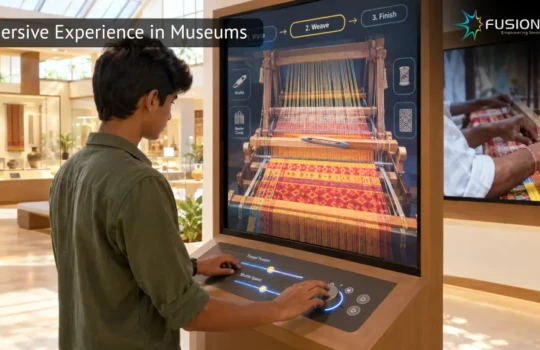
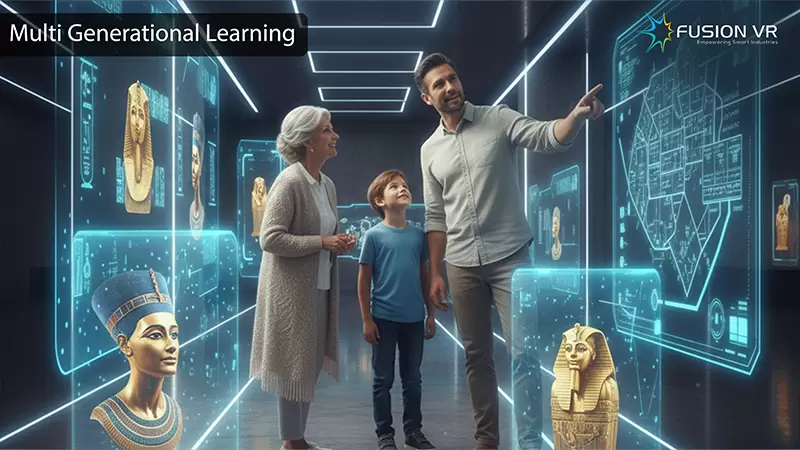
The rapid development of digital technology and communication has a great impact on the learning habits, sharing, and interaction between different generations. In countries like India, which are characterized by the coexistence of the past and the future, the newness of digital museums and immersive experience technologies is opening up novel avenues. The blog will discuss the various ways in which virtual museums are a major force in the field of learning across generations helping the old, the middle-aged, the young and even the whole family to discover culture, heritage and knowledge collectively, thus, among other things, eliminating the gap of age, creating understanding and reinforcing cultural education.
The meaning and value of intergenerational learning
Intergenerational learning is ultimately a mutual interchange of knowledge, life episodes and views among individuals of different age brackets. While the main aspect of it is that younger ones benefit from the older ones, still, the latter ones receive new tools, dynamic viewpoints, and changing cultural landscapes. One study briefly describes it in these words: “a learning partnership based on reciprocity and mutuality, involving people of different ages where the generations work together to gain skills, values and knowledge.
Inter-generational learning is particularly evident in the area of cultural heritage. The older generation has the firsthand experience, along with the customs, the implicit knowledge of the local communities; on the other hand, the younger generation is being characterized by the readiness to explore into the unknown, the computer-savviness and their original inquiries. The use of virtual museum experiences is such a common setting that both parts meet. In this context:
- The elderly people feel that they are respected and their role as the owners of knowledge and narrators is recognized.
- The young ones who are coming to learn are not just being told facts, but are made to feel the subject through personal narratives.
- Each generation is allowed to engage with the content at their own pace but still, it is together.
From the standpoint of pedagogy, this kind of learning offers social unity, it helps to create and establish one’s identity and it also increases participation which is active rather than passive consumption.
Why virtual museums are especially potent for bridging age gaps
Physical museums usually expose multi-generational groups to a number of practical challenges: different mobility and endurance levels, different attention spans, different degrees of prior knowledge, and even tech-related fears among the elderly, sometimes. Virtual museums offer a solution to many of these limitations providing more flexibility and inclusiveness in ways that physical venues cannot match.
Here are some of the major advantages:
Flexibility of pace and place
With virtual models, the participants can easily be pulled in from their house, using their own device, and at a speed that is comfortable for them. Senior citizens who are afraid of long walking tours, or young kids who get easily distracted, can all take breaks, come back to the exhibits, pause, and restart. These aspects are pointed out in the design guidelines for virtual museum programs: asynchronous access, self-paced exploration, and segmented durations for different age groups.
Digital interface shared across all age groups
A virtual museum that has been properly designed provides easy navigation, interactive touch/click, and multimedia content (audio, video, 3D) that are of interest to all the different age groups. For instance, younger visitors are attracted to the interactive features such as AR models, 3D reconstructions, and embedded storytelling while older audience can enjoy through storytelling and contemplation. Research on AR exhibits designed for families indicates more engagement, collaborative talking, and learning together.
Joint exploration and conversation are encouraged
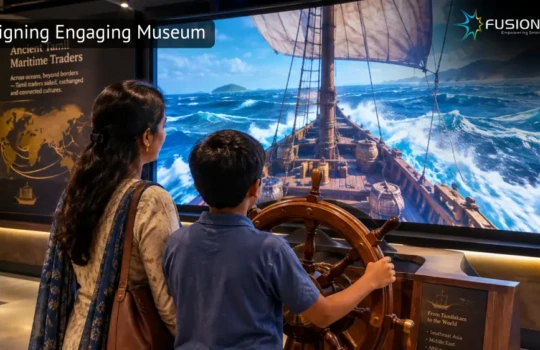
Virtual exhibits with prompts, hotspots, narrative questions are designed to invite family groups to explore, ask questions, and reflect together. Grandparents and grandchildren, for instance, when they visit an exhibit together, stop at the same artifact, talk about what it means, and possibly find stories in the local area that are similar that strengthens the bond. The “playful revolution” in museums is to the extent of their experiences in the form of scavenger hunts, puzzles, AR games that attract all ages.
Heritage that can be accessed
No matter the place or mobility In India, for example, numerous seniors will find it hard to travel great distances and their younger family members might be at work most of the time. Virtual experiences provide the opportunity to visit cultural heritage from any corner at any time. Online digitised collections—for example, the Virtual Collection of Asian Masterpieces (VCM) which shows 2,700 masterpieces—of the Asia Europe Museums Network bring worldwide heritage down to the level of local access.
Multi-sensory and improved storytelling
Heritage can be felt in a variety of ways through the use of multimedia – 360° panoramas, video storytelling, interactive timelines – with virtual museum platforms employing them all. For example, the older generation may find the narrated history of the object quite interesting, whereas the younger generation might get excited about interactive movements or game features. This multi-layered attraction draws all the generations in but in their own respective ways.
The learning benefits for different age groups
Virtually the same multitude of advantages and impacts are scattered across the experimental learning conducted by different age groups in virtual museums, as far as cognitive, emotional and social spheres are concerned, including cultural field as well.
For the youngest participants (children, teenagers)
- Increased questioning and visual literacy: Interactive displays lead to asking, reasoning, imagining more.
- Broadened and deeper knowledge: Gaining access to the heritage, stories and cultural identity that are not the subject of the books anymore.
- Technology as a motivation factor: Digital tools being used makes it more interesting for students to get involved.
- Family ties: Learning with senior relatives turns into being understood, belonging to the community and having a chance to tell your story.
For older adults (parents, grandparents)
- Renewed roles: They take on the role of knowledge-bearers, passing on stories, culture, and identity of the place.
- Cognitive engagement: Digital platforms navigation and communication with kids are good mental exercises.
- Social connection: Participation together with the little ones in activities strengthens the intergenerational relations.
- Lifelong learning: New techs, heritage in new media, can be really exciting and refreshing.
For family as a whole
- Shared experience: Memory creation (we did this together).
- Cultural continuity: Younger generations absorb heritage via older ones and interactive media.
- Meaningful dialogue: Virtual museum prompts encourage discussions (“Why did this artifact matter? What was life like then?”).
- Breaking generational silos: When tech is used not only by younger but by family groups together.
Research in Finnish museum contexts shows that intergenerational learning can contribute to cultural identity and social cohesion.
Designing virtual museum experiences for multi-generational learning
In case one is designing or commissioning virtual museum experiences, especially in the area of interactive museums, VR experience centres, or corporate experience centres, there are some main design strategies to help create a multi-generational engagement.
Inclusive user interface and navigation
- Elderly users who are less familiar with gaming interfaces can use simple and intuitive controls. The adjustable modes can be set to longer text descriptions or short audio narrative.
- To cater to different learning styles, the content can be presented through audio, text and visuals.
- Accessibility features can include large fonts, a combination of colours with good contrast, and possibly voice controls.
Structured content for mixed-age groups
- Tiered layers of content: basic overview for younger/novice, deeper contextual level for older/keen learners.
- Prompts for conversation: “Ask a family member what this reminds them of”, “Compare this with something from your country”.
- Activity-based segments: mini-quests, matching games, hotspots to explore together.
Storytelling anchored in personal or familiar narratives
- Utilize artifacts or concepts that have a wide appeal and are relatable across time (e.g., community arts and crafts, common family customs).
- Let senior visitors narrate their own memories or tell the stories of their places — online museum sites could accept content from users or audio from relatives.
- Storylines that link past → present → future, thus making younger users feel the importance and older ones feel their contribution.
Synchronous and asynchronous options
- In the case of synchronous, live guided virtual tours or talk-through are activities that bring families together at the planned times.
- On the other hand, asynchronous allows different accessibility and time for family members, perhaps the younger during the weekend, the older in the morning, and then they meet later on. The guidebook for virtual programming emphasizes the necessity of both.Facilitate interaction and reflection
- Built-in questions: “What would you have done if you were in their shoes?”
- Shared tasks: the younger user discovers the digital hotspots; the older user gives the story or context and then both of them have a discussion.
- Encourage co-creating: Kids to be allowed to add notes or comments to the digital objects; seniors to write or record their memories.
- Encourage linking to real life: Following a virtual tour, take a walk through local heritage or share pictures of family artefacts.
Technology Layering for Immersive Engagement
- VR/AR enabled exhibits: As an instance, AR cards permitting children and adults to work together on card placement, giving directions to one another. Research indicates family discussions to be among the educational outcomes of these exhibits.
- Virtual reality or 360° tours: Older people are allowed to ‘visit’ far-off heritage locations without going through travel; younger ones appreciate moving around and playing with the system.
How this applies to India / the South Asian context
For a nation like India, where generations of families live together, where there is a variety of cultures and customs and where relatives are sometimes spread over long distances, virtual museum experiences can take on a special meaning. Some of the points are given below:
- In most of the Indian homes, grandparents live with or close to their grandchildren, but at the same time, there are many families who are living in different cities or countries. Virtual museums make it possible for them to communicate their heritage even though the distances are very large.
- The Indian local culture or other areas like history, crafts have in particular a lot of things to offer in terms of virtual museum design: for instance, folk art from different areas, temple architecture, craft practices. Interactive elements in a virtual environment activate younger users and are also the roots connecting older ones.
- Sharing a family tablet or screen usage is the design goal as mobile device penetration among the population is high but varying degrees of comfort exist with the device across the age groups.
- Business experience centres, VR experience centres (e.g. those operated by interactive technology companies) can create special “family heritage days” where diverse age groups can explore, learn and have fun together.
- Cultural education in schools can be transferred and conducted at home: a virtual museum tour followed by grandparents-grandchildren discussion at home about what they saw, what amazed them, what was related to family history, etc.
- Museums and heritage institutions in India can leverage their value proposition in various ways: attract people far beyond their geographical location, offer families new forms of interaction, and eventually expand the museum’s role of cultural education to the home and digital realm.
Conclusion
Learning across generations using virtual museums is not just about giving a tablet to a grandchild and allowing them to click through the displays. It is about creating occasions where all the different generations meet each other, all offering their individual strong points, viewpoints and interest then leaving them all with a common feeling of discovering, relating to one another and understanding the culture.
In 2025 and the years to come, the different types of heritage institutions will continue to change and develop in the areas of virtual reality, interactive museums and corporate experience hubs. During this period, the opportunity will arise to create places where grandparents relive the past, parents act as the mediator and children do the exploring all through technology that does not act as a barrier but rather as a bridge. This way, we make it possible for cultural education to be a family affair, open to all ages, rich in tales and thriving in both the digital and physical realms.