Education has entered a new era, where old school teaching routines are more and more, complemented by immersive digital tools. In that mix, Virtual Reality, paired with gamification, has become one of the strongest options to get student’s interest, boost what they keep in memory, and honestly, make learning feel less heavy. Learners these days, mainly Generation Z and Generation Alpha, have basically grown up in a digital first setting, where hands on experiences grab their focus much faster than plain textbooks or the usual lectures.
Gamification inside VR is reshaping how students engage with learning material. Instead of just receiving information in a passive way, learners are jumping into virtual spaces where they actually work through problems, finish missions, snag rewards, and team up with classmates. The method feels like it also stretches study beyond the classroom, so students can wander through tougher concepts, historical moments, scientific happenings, engineering workflows, and real world situations, all in a way that stays highly absorbing.
As educational institutions start leaning into digital change, VR based, gamified learning is turning into this necessary part of modern education, and it helps schools, colleges, universities, training centers to build real learning experiences. Those experiences are designed to prep students for what’s next, you know, the future.
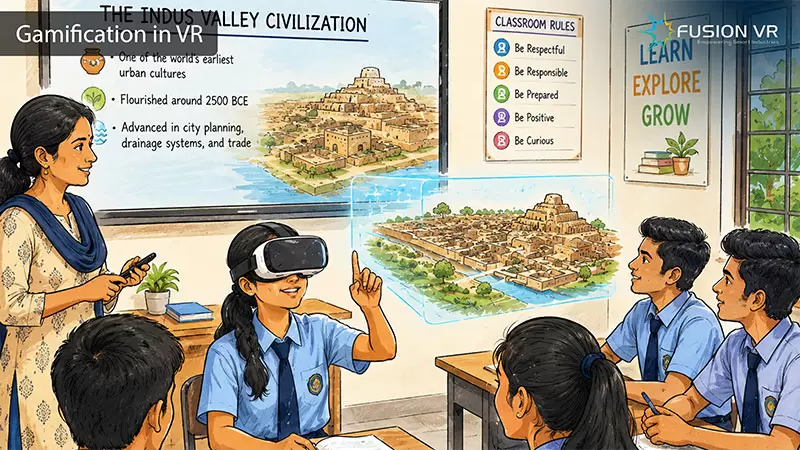
Gamification is basically the idea of taking game mechanics like points, levels, badges, achievements, leader boards, rewards, challenges, and even storytelling, then mixing them into educational activities. And once those pieces get integrated with Virtual Reality, learning starts to feel immersive instead of just being instructional. Like, students are no longer simply reading about a concept, they’re actually encountering it in a first-hand way, right there in the moment.
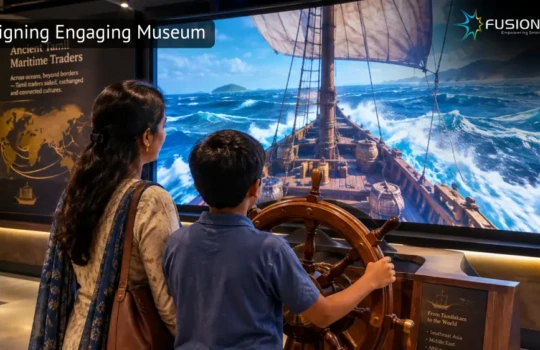
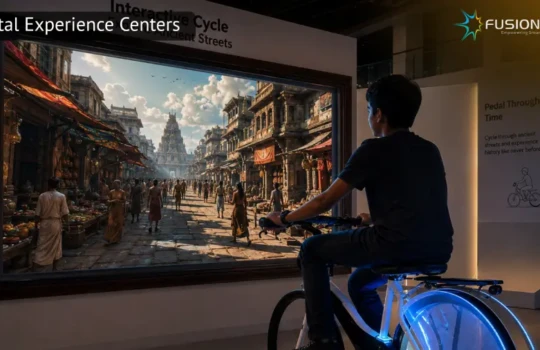
Imagine a biology student poking around the human circulatory system in a virtual way, traveling through arteries and veins, like a field trip, but also grabbing little clues about what each organ is doing. Meanwhile, a history student can jump into an ancient civilization as a real active character, not just, memorizing dates in a straight line. And then engineering students might build structures, spot design flaws, and even run safe prototype trials inside the virtual space, no real damage risk. Overall, these kinds of experiences stir up emotional buy-in, which can seriously boost understanding and also help long-term memory stick around longer than the usual notes and quiz stuff.
One of the biggest advantages of gamified VR learning is how it can keep students attention, you know, like more than regular classes. Keeping your focus during traditional lectures is getting harder, not just because attention spans are shorter now, but also because there’s always some digital distraction popping up. With gamification, the whole thing feels more guided: there are clear goals, quick feedback right away, and small reachable milestones, which pushes learners to stay actively involved, continuously.
In a VR environment, every successful task that gets finished really gives instant rewards, so people keep moving forward. That positive reinforcement kind-a sparks curiosity and pushes learners to take on harder and harder challenges. Instead of learning just because they have to, students start learning because they actually enjoy the whole experience, not only the outcome.
Learning via VR does help experiential education too. A lot of concepts are, honestly, hard to spell out using textbooks alone. For instance physics, chemistry, astronomy, archaeology, architecture, medicine, and environmental science they frequently come with abstract theories or places students can’t really access in real life. VR lifts those barriers by letting students engage directly with virtual simulations, like they can actually touch the situation.
For example, chemistry students can go ahead and do hazardous experiments without the usual headaches tied to real laboratories. Medical students can rehearse surgical procedures again and again, before they step into clinical environments. Geography students can go exploring volcanoes, glaciers, rainforests, deserts, and even underwater ecosystems without ever leaving their own classrooms. These immersive, hands-on experiences tend to build confidence while also cutting down the spending connected to physical training spaces.
Gamification really helps make it easier for students to collaborate, like it nudges them into teamwork, not just individual effort. With modern VR platforms, multiple learners can step into the same virtual space at the same time. Then students work together, to solve puzzles or finish missions, but also to run experiments, or even to construct virtual projects. These shared experiences build up teamwork, help with conversation, and bring out leadership abilities plus sharper critical thinking which is honestly super valued in school and in the professional world too.
Unlike the usual classroom stuff where, say only a few students show up and talk a lot, VR flips that. It nudges every learner to get involved, even the ones who’d normally stay quiet. For introverted students in particular, virtual spaces can feel more safe and easier to approach, so they end up chatting and collaborating with more confidence. On the teacher side, it also helps because they can keep an eye on progress, spot where learning gaps are hiding, and offer more tailored guidance based on what students actually do inside that environment.
Another big advantage, is personalized learning, because every student basically learns in their own odd way. Some go for visual learning, others get the idea better through hands on experience, or by doing the same thing again and again. With VR gamification the learning content can flex and adjust to each learner pace and capability, like it is not a one size plan for everyone.
Students who are having a hard time with particular topics can run the simulations again and again, with no worries about judgment or embarrassment. Meanwhile, the more advanced learners can unlock the tougher stages, and those levels push them into deeper exploration, at a faster pace. This adaptive learning setup makes sure that every student gets a learning path matched to their own individual needs, not some plain one-size-fits-all thing.
Motivation stays one of the biggest troubles in education, frankly. Most traditional grading systems, seem to focus on the end result only, not so much the learning journey. Gamification flips that view because it keeps praising ongoing progress not just what you got at the end. Little wins like finishing a module, really taking hold of a skill, beating a tricky challenge, or assisting teammates, they all stack up and point toward bigger educational goals.
These achievements push students to stay driven, even when the subjects get rough and difficult. Instead of being scared by failure, learners start seeing each mistake as a chance to get better, like moving through stages in a game. That growth mentality builds resilience and tenacity, along with confidence that doesn’t just stop at academics, but carries into other parts of life too.
Virtual Reality also gives pretty big perks beyond regular classrooms, I mean it kind extends the whole experience. Distance learning and hybrid education have been getting more popular in many places worldwide. Even if online learning offers flexibility, keeping students engaged still feels like a stubborn problem. VR tackles it by recreating immersive class settings, so learners can feel like they are there, even if they are split by distance.
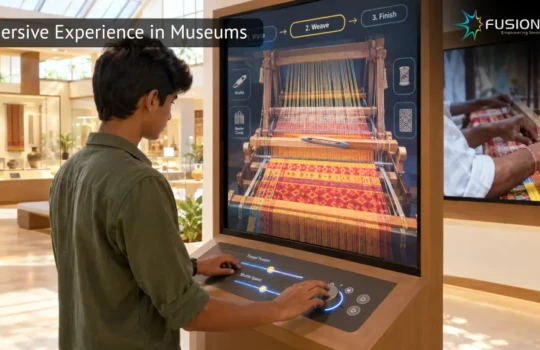
Virtual campuses, laboratories, museums, industrial plants, cultural heritage places, and scientific research centers can end up being reachable through VR, not just like, in theory. With it students can do field trips, join hands-on collaborative workshops, and practical drills, even if they are not in the same area physically. That access lets educational institutions offer more layered learning chances while also lowering travel costs and cutting down on those logistical headaches.
Career readiness is one more area where gamified VR learning really shines. In today’s industries they tend to want employees with hands on skills, solid problem solving, clear communication, flexibility, and also tech know how. Usual classroom education though, can have trouble bridging that gap between what people learn in theory and what is actually expected on the job, it’s like there is a disconnect.
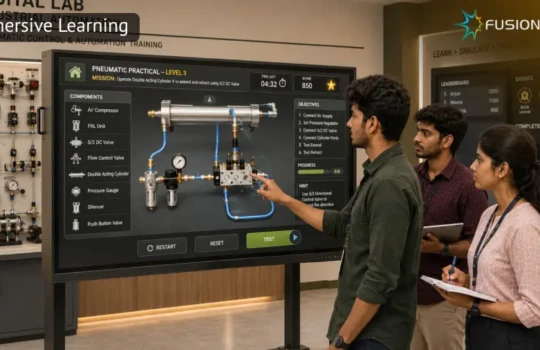
VR simulations let students experience realistic workplace situations in a range of industries, and it feels hands on. For engineering majors they’re usually given the chance to troubleshoot machinery, while in healthcare programs they can interact with virtual patients, and for aviation trainees they practice emergency procedures. Meanwhile, business students often join simulated negotiations. The gamified challenges push learners to respond fast, but still in a safe space where any errors turn into useful lessons instead of expensive failures.
Educational institutions are also finding out that gamified VR, as an immersive way, that really boosts knowledge retention. Research keeps showing, pretty consistently, that experiential learning helps students remember material better than the more passive methods. When people actually work with the content, using several senses at once, the brain ends up building more robust neural links so the information is simpler to bring back later on.
This can be especially useful when the topic is about process based know how, complicated systems, or something that needs good spatial perception. Learners tend to recall what they actually go through, not just what they read, or what they hear in passing, because that real experience sticks. In other words it’s less about the words on a page, and more about the lived, small but meaningful steps they feel.
Another big advantage is assessment or something similar to that. Traditional tests tend to check memorization more than actual understanding, i mean what’s really going on. VR lets educator’s judge students through real world performance inside simulated settings, which is a bit more practical.
Instead of just ticking answers on multiple choice questions, students show what they can do by tackling real, everyday problems, finishing practical tasks, teaming up with classmates, or making informed calls on their own. Teachers then get richer analytics, not only about scores but about how students actually act, how they decide, how long things take, what they tend to do well, and where they need more coaching , maybe even some less obvious weak spots. With that perspective, assessment becomes more exact, and instruction can be supported in a more tailored way, like a guided adjustment rather than a generic plan.
Accessibility is another crucial thing. In today’s VR apps they are increasingly adding features that fit diverse learning needs, adapt to different people. For example adjustable difficulty levels, multilingual support, audio guidance, subtitles, and visual help, plus interfaces you can tweak, all of that makes it more likely that students from different backgrounds can join in, and not feel left out. And as the hardware gets cheaper, educational institutions are noticing it’s becoming more and more practical to plug VR into regular learning spaces.
Gamification also nurtures creativity. Students are pushed not just to consume information, but also to come up with solutions, to design projects, to experiment with ideas, and to innovate inside those virtual spaces. Creative thinking seems to grow more naturally when learners get open ended challenges instead of predetermined answers.
This creative freedom gets students ready for the future work where innovation, being adaptable, and interdisciplinary thinking are no longer “nice to have” but actual core skills. Be it when they are designing sustainable cities, building engineering prototypes, reconstructing archaeological sites, or crafting virtual art installations, they pick up real, practical know how that standard teaching, however well done, just can’t mirror as easily.
Putting Artificial Intelligence into VR gamification, boosts the whole learning vibe more than you might expect. With intelligent tutoring systems, you can watch a learner’s progress in real time, and then automatically-tune the difficulty to match what they’re doing. They also can send personalized guidance or small hints, and even nudge learners toward extra practice tasks, based on how they perform day by day. In the end, it builds a flexible educational environment, where each learner keeps getting steady backing, and the instructors don’t get overloaded or overwhelmed.
Educational institutions worldwide are starting to notice that immersive learning technologies aren’t just short lived hype, but long term investments in academic excellence, and that matters. So schools, colleges, universities, vocational institutions, museums, corporate training centers and research organizations are all looking at VR solutions, to boost engagement and improve learning efficiency in a more measurable way. They also want to help students get ready for digitally connected careers, because honestly the future is already here.
Organizations focused on immersive learning are really helping this shift along, by building bespoke VR applications that tie together learning goals with fun, interactive moments. In a way, these experiences go past just entertainment, aiming instead at learning results you can actually measure, better skill development, and smoother curriculum integration.
The future of education is mostly about making experiences, not just handing students information. Right now students are more of expecting learning spaces that feel interactive and engaging, also collaborative, and actually meaningful too. With gamification in VR you can turn learning into this really exciting journey, where curiosity pushes exploration along, and achievement becomes like a normal part of everyday learning.
As technology keeps evolving, VR is going to be more available across educational institutions of every size. With better wireless headsets, cloud computing, Artificial Intelligence, spatial computing, and shared virtual spaces working together, the door is opening wider for immersive learning. And yes, Students will get the chance to reach more advanced training activities from classrooms, homes, libraries, and community learning centers, no real geographical limitations. It will feel almost like distance is less of a thing, even if the setup is different.
For institutions trying to boost student engagement past the usual classroom setup, putting money into gamified VR learning is turning into a smart strategic move, not just some risky experiment. When you blend immersive technology with experiential learning and game-based motivation, you end up with an educational ecosystem where learners stay switched on, sharpen practical skills, hold onto knowledge more reliably, and gain confidence through ongoing exploration.
Ultimately, gamification in VR is reshaping education, by nudging learning away from being passive and toward being active. It also pushes students to be more collaborative rather than stuck in isolation, and more experiential, rather than strictly theoretical. In a way, it bridges that gap between imagination and reality, which lets immersive learning turn students into curious explorers, solid problem solvers, and lifelong learners. And as education keeps evolving in the digital age, gamified Virtual Reality feels like one of the most promising innovations for increasing student engagement, beyond the walls of classrooms. It also helps prepare the next generation for a world that is becoming more and more technology-driven.