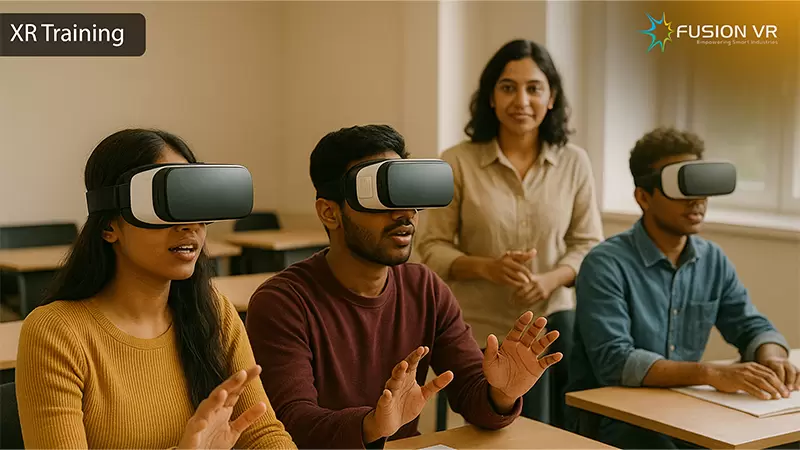
In the 21st century, education is experiencing a massive transformation. The use of XR, which is the combination of virtual reality, augmented reality, and mixed reality, is bringing forth a next generation of learning similar to the digital learning platforms that took over the classrooms in the last two decades. However, XR technologies are not the only ones that can create interactive, immersive learning environments. Their maximum potential will depend on the ability of teachers to manage digital classes with confidence, not just in terms of technology but also in terms of teaching method.
This blog discusses the necessity of faculty development in the XR age, what it would look like, and how educational institutions can support the transition from the use of XR as a tool to its complete incorporation into the learning process as a noticeable factor.
Why Faculty Development Matters in the XR Era
Bridging the Technology–Pedagogy Gap
Giving a teacher a headset and a virtual environment to access is one thing, but helping the teacher to design meaningful, learner-centered experiences in that environment is quite another. If we used a solid teaching foundation, XR tools may end up being little more than novelty or “gadget-oriented” experiments instead of being transformative educational platforms.
The integration of XR technology implies new ways of thinking about student engagement, collaboration, and reflection. Professors must move from simply delivering the content to creating immersive experiences, directing exploration, conducting review sessions, and providing cognitive process support in virtual settings.
Addressing Barriers to Adoption
When adopting new educational technologies, faculty usually mention time constraints, lack of technical knowledge, inadequate support, and fear of failure. XR training can make those barriers larger with its heavy hardware, software, and spatial design requirements. Professional development that is well-structured will help to eliminate these frictions by providing safe spaces for experimentation, peer support, and institutional scaffolding.
In addition, institutions need to ensure equity: devices, software, and infrastructure have to be available to all. Otherwise, faculty will have a hard time providing the same high-quality, inclusive experiences in all their classes.
Ensuring Scalability & Sustainability
Small XR pilot projects, while certainly inspiring, will not be sufficient to scale across departments and disciplines hence, faculty will require continuous development, community backing, and institutional policies. Deliberate capacity development takes XR that is still in a niche status, up to being the fabric of teaching and learning.
Dimensions of Effective Faculty Development for XR
The following is a conceptual framework for the elements that should make up faculty development in the XR era.
Technical Familiarity & Tool Fluency
-
- Hands-on workshops: Teachers get experience with VR headsets, spatial mapping tools, gesture controllers, 360° content editors, mixed reality toolkits (e.g., MRTK)
- Scaffolded “sandbox” spaces: Places like labs or virtual testbeds where teachers can experiment with lessons without fear of failure
- Peer mentoring / “XR champions: Experienced faculty who have used XR support newcomers
- Access to XR equipment: Lending programs or departmental pools, to get rid of hardware barriers
Pedagogical Training & Instructional Design
Backward design for XR: start with the learning outcomes, and then map them to virtual activities, assessment, and reflection
- Scaffolding immersion and debriefing: the use of immersive experiences without any kind of assistance will probably result in the experience being either superficial or misleading. The faculty have to create a framework for exploration and reflection to guide
- Differentiation and accessibility: the XR experiences should take various learners into account, as well as those who suffer from motion sickness, high cognitive load, and those who need alternative access modes
- Iterative design and evaluation: the faculty should apply cycles of prototype → test → revise → deploy
- Discipline-specific models: Chemistry VR labs, architecture AR overlays, and medical simulation MR — design templates tailored to each field
Community & Culture
- Faculties learning communities (FLCs): instructor groups getting together to share experiences, creating XR modules in collaboration, and discussing practices
- Showcase events and peer sharing: “XR in classrooms” fairs, micro-presentations, gallery walks
- Interdisciplinary cooperation: XR is basically a common theme; humanities, STEM, arts, and social sciences can learn from one another
- Institutional rewards and acknowledgement: grants, awards, teaching credits, or support for XR-pedagogy innovations (for instance, Indiana University’s XRI Fellows)
Support Infrastructure & Services
- Instructional technologists & XR design teams: personnel that collaborate with instructors to create and maintain XR modules
- Software licensing, content libraries, and procurement: obtain legal rights to VR/AR platforms, asset marketplaces, and secure infrastructure
- Policies, guidelines & ethics: managing student data, privacy (e.g. biometric data, location tracking), accessibility requirements, and content moderation
- Technical support & maintenance: hardware calibration, troubleshooting, and version updates
From Pilot to Scale: A Phased Approach
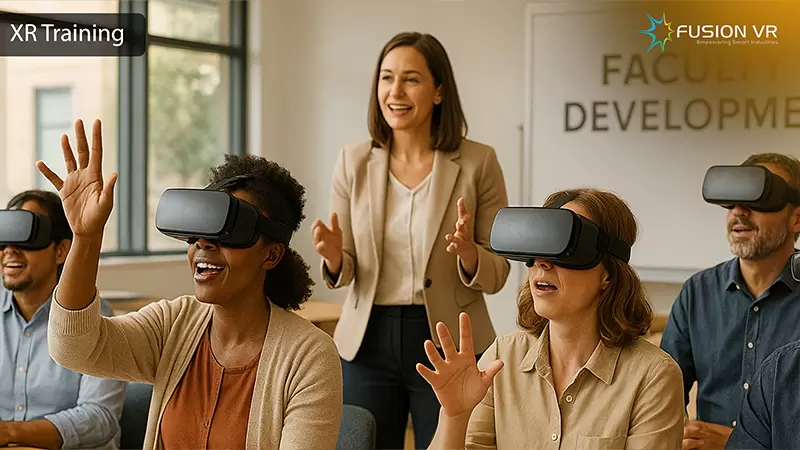
Institutions can map the XR faculty development initiative as a gradual process flowing through multiple phases:
Exploration & Awareness
- Immersion demos, XR exhibitions, and guest lectures should be organized.
- Proposals for small grants to support pilot lessons should be recommended.
- Increase curiosity and diminish the risk that is perceived.
Capacity Building & Prototyping
- Training bootcamps in the areas of hardware, software, and design should be provided.
- Collaboration between faculty and instructional support staff should be created.
- Conducting low-stakes pilot classes with small groups.
Integration & Adoption
- Faculty members start incorporating XR modules in their courses.
- Sharing of templates, shared content libraries.
- Learning outcomes, student feedback monitoring and evaluation.
Sustainability & Scale
- XR support in teaching & learning centers becomes an institutionalized practice.
- “XR academies” across disciplines are to be created.
- Establishment of reward structures, faculty fellowships, and ongoing refreshers.
According to the EDUCAUSE XR adoption framework, institutions not only have these phases to deal with but also the formation of an XR management team and the drafting of policies regarding licensing, data, and content strategy.
Emerging Challenges & Considerations
Challenges will still be there even the best-laid faculty development will face some troubles. The following are some issues that can be predicted:
Cognitive Load & Attention
If learning experiences are not well designed, learners can be overwhelmed. Eye-tracking and physiological feedback can be used for real-time adjustments to keep engagement at the right level by changing the level of difficulty or pace. There are some recent studies in XR biofeedback that are dealing with how to adjust systems to learner attention and thereby reduce overload.
Equity & Access
Some students (and faculty) will not be able to access expensive headsets or high-speed internet equally. The development of XR must involve fallback modes (web-based 360°, AR on phones) and make sure accessibility (motion safety, captions, alternative navigation) is taken care of.
Content Creation Bottlenecks
Producing realistic XR experiences (3D models, narrative flow, and interaction logic) is time-consuming and requires many hands. Faculty development has to deal with this by introducing teachers to rapid authoring tools, modular assets, and collaboration with specialists. Many colleges and universities alternate between creating their own content and using pre-licensed platforms.
Assessment & Evidence
How is it possible to evaluate learning in immersive environments? Regular exams might not be aligned. Teachers will have to create assessments, portfolios, reflective journaling, or in-world tasks that match learning outcomes and use assessment that is continuous research and feedback loops are vital.
Institutional Buy-In & Governance
Without support from senior management, the money for hardware will dry up, and the XR initiative will not receive the institutional strategy alignment it needs, and then XR may die. Faculty development is most effective when XR is not an optional add-on, but part of a strategic vision that includes teaching and learning.
Illustrative Examples & Case Studies
- An institution that created a VR lab on-site held a faculty development workshop on VR which resulted in the integration of VR in courses across humanities and sciences.
- The University of Michigan’s Center for Academic Innovation works together with professors to co-develop XR courses by providing consultation, access to equipment, and media design support.
- Purdue University’s “XR in the Classroom” project provides use cases, teacher support, and infrastructure considerations to facilitate the journey of faculty from theory to practice.
- Stanford and its partner schools utilized VR and AR for remote students to learn anatomy and emergency response during the COVID-19 pandemic, thus overcoming bandwidth and geographical restrictions.
- The ChameleonControl system tests a combined telepresence + XR setup that allows remote teachers to conduct hands-on activities in the classroom through gestures in mixed reality.
These illustrations confirm that faculty development should not be an abstract affair through pairing tangible pilots, cross-disciplinary support, and institutional scaffolding.
Sample Agenda for a Faculty XR Bootcamp (3 Days)
Below is a suggested structure for a faculty development workshop:
Day 0 / Pre-work
- Introductory reading: XR fundamentals, real-world examples
- Survey: faculty members’ involvement, areas of expertise, and predictions
Day 1: Orientation & Discovery
- Immersive lab: showcase of VR/AR/MR applications
- Faculty-led exploration: trying out spatial mapping, navigation and interactions
- Discussion + review session: which strategies worked? What was unexpected?
Day 2: Creation & Teaching
- Short lecture: XR teaching, gradual help, evaluation criteria
- Design group: in academic groups, plan learning outcomes → virtual activity → assessment
- Tech basics: easy XR creation tools, importing assets, spatial sound Day 3: Prototyping & Testing
- Develop a micro-XR experience (5–10 mins) in the sandbox
- Peer demo, feedback loop
- Implementation planning: timeline, support needed
- Showcase + next steps: formation of FLCs, project proposals
After the bootcamp: continuous “office hours,” drop-in support, peer mentoring, and regular co-development meetings.
Tips & Best Practices
- Start small: pilot with XR modules for one or two classes instead of redesigning the whole course all at once.
- Utilize templates and modular assets: reuse instead of reinventing — a scaffolded library of XR modules is a great help.
- Include reflection and debriefing: the luxury of immersive experience is enriched with guided questioning and metacognitive prompting.
- Rapidly iterate: think of it as going through several versions; the faculty should consider XR modules as prototypes.
- Create ripple effects: support the early adopters to coach others, share their resources, and participate in faculty forums.
- Impact measurement: feedback from the students, learning analytics, retention, and attitude shifts should be collected and used for approach refinement.
- Ethics should be an ongoing consideration: biometric data (eye, motion), privacy, wellness (motion sickness), and inclusive design need to be integrated into the framework.
Vision for the Future & Call to Action
The XR era has brought along a new dimension to learning spaces that can now exist without any walls. Students can now visualize and walk through molecular structures, move back and forth in time to various historical periods, mimic the behavior of ecosystems, and even share virtual worlds that are beyond their geographical limitations.
But still, the revolutionary tools will not be enough. The future will be shaped by skilled and assured teachers who will be able to create, guide, and support learning in digital classrooms. Faculty development is viewed as a necessary evil, but it is really the bedrock of the future.
The institutions should dedicate themselves to a long-term investment in human resources as a primary focal point rather than in hardware. Set up XR centers, partnerships with instructional designers, fellowships, and implement policies that mainstream immersive pedagogy into the institutional strategy.
If you are a teacher, an instructional designer, or an administrator who is receiving this message: start talking about it today. Lay down a pilot project, gather the colleagues who are interested, ask for XR exposure, promote faculty learning communities, and help make immersive learning not only possible but also guaranteed in your institution’s future.