Introduction
Cultural heritage is more than historic buildings, ancient artifacts, traditional art, and archaeological sites. It also has those less obvious pieces, like the stories people tell, languages that carry meaning, customs, the sounds in music, crafts, and beliefs, plus festivals and the shared memories that sort of form the identity of whole communities. Still, a lot of this heritage can get worn down by time, environmental damage, and urban development, not to mention conflict. And then there are changing lifestyles, you know, and the slow fading of traditional knowledge which makes everything a bit more fragile.
Digital technology is making new ways to protect this heritage while, at the same time, giving wider access to modern audiences. In many cases one of the more effective routes is the making of Digital Experience Centersplaces where tech, culture, learning and narrative, all blend together, so people can live through more engaging experiences rather than just observe.
Unlike the conventional exhibitions, which mainly rely on physical displays Digital Experience Centers can make use of interactive screens, projection mapping, augmented reality, virtual reality, 3D models, immersive audio, artificial intelligence, digital archives ,and multimedia storytelling too. In a way these technologies can help document cultural assets then reshape them into moments people can wander through, grasp, and keep in mind, long after they leave.
Digital Experience Centers kind of serve a double purpose, you know, they help preserve cultural heritage in a digital way, but at the same time they make sure that heritage stays relevant, and is still easy to access for future generations.
What Are Digital Experience Centers?
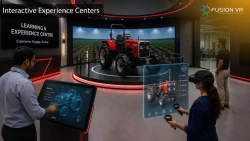
A Digital Experience Center is basically a technology-enabled physical or virtual space, set up so visitors can get interactive and immersive experiences. It can show up in a museum, a heritage site, a cultural institution, a tourism destination, an educational campus, a community center, or just in a public space, in general.
The goal is not only to show information, digitally. Rather, the center creates an environment where people can truly participate with stories, places, individuals, and cultural objects, not just watch them.
For example, rather than just looking at a photograph of an ancient monument, visitors can, get into it with a detailed 3D reconstruction of the monument. They may walk, kind of virtually, through the parts that are inaccessible, plus learn the background of the place via interactive storytelling. Or they can use AR so they can see how the site might have looked centuries ago.
This mix of tech and narrative, in a way, makes cultural heritage feel more immediate for audiences who are used to digital styles of communication.
1. Digitizing Fragile Cultural Assets
One of the more important contributions of Digital Experience Centers is the digitization of cultural assets, like, it’s a big part of keeping things alive even when the original material starts to suffer.
Physical items are always at risk of deterioration. Manuscripts can get damaged, sculptures can slowly erode, paintings can fade, and historic buildings or structures can be affected by weather, pollution, natural disasters, or even human activity, which is pretty common.
With digital technologies organizations are able to create high-quality copies, records, and all that. High-resolution photography, 3D scanning, photogrammetry, digital mapping, and other documentation approaches can collect fine details that might otherwise disappear.
Then once an artifact or a site has been digitally documented, the information can be stored inside digital archives and it can be used for education, research, exhibitions, plus restoration projects too.
And digital preservation doesn’t really replace the need to protect the real, original artifact. It rather adds an extra protective layer and makes sure that the valuable information stays accessible even if the physical object becomes damaged.
2. Creating 3D Digital Replicas
Three-dimensional technology has, it’s become, pretty valuable for cultural heritage preservation, like in a real everyday sense. With it, a 3D model can digitally recreate an artifact, monument, archaeological site, a traditional object, or even a historical environmentbasically the whole context. People can look at the model from different angles and dig into subtle features that might not be visible in a standard, static display, or you know in that kind of setting.
For instance, a Digital Experience Center might create a 3D version of an ancient temple and then let visitors explore its architecture virtually. If there is a damaged area, that part can be reconstructed in digital form, so it shows what it may have looked like in its original state. The idea is a kind of mindful, reconstructed view, not just a picture.
Also, these digital replicas are useful for researchers, architects, conservators, and educators. They give a digital reference that can be consulted without having to repeatedly handle the original object, which is usually safer and calmer for both the item and the people involved.
3. Preserving Intangible Cultural Heritage
Cultural heritage is not only physical stuff. Actually some of the most valuable traditions are more intangible, less tangible maybe.
Traditional songs, oral histories, indigenous languages, folk performances, cooking methods, rituals, crafts, storytelling customs, and local knowledge can start vanishing when they are no longer handed down from one generation to the next.
Digital Experience Centers can assist with documenting and sharing these traditions using multimedia, not just text.
A visitor might listen to recordings of traditional music, watch conversations or interviews with artisans, practice a regional craft via an interactive digital tutorial, or even browse through an archive of oral histories.
This really matters too, because intangible heritage leans on people rather than physical objects. When digital platforms record voices, techniques, stories, and the everyday experiences of cultural practitioners, they can help keep that knowledge alive, before it is gone.
4. Bringing History to Life Through Immersive Storytelling
One of the limitations with traditional heritage interpretation is that visitors might find the historical information kinda hard to picture in their mind, like it stays flat, not quite “there” even when it’s explained well.
Immersive technology can shift this whole experience.
For example projection mapping can turn walls and architectural spaces into storytelling surfaces, which sounds simple but it really isn’t. With large-scale digital projections, the place can start to look like a historical environment again, whether that means key events, old landscapes, or even artistic traditions shown in a clear and engaging way.
Then VR can take people to locations that are hard to reach, costly to maintain, or just impossible to visit in person. AR, on the other hand, can place historical details right on top of real-world locations, so visitors can follow how a site changed over time, layer by layer.
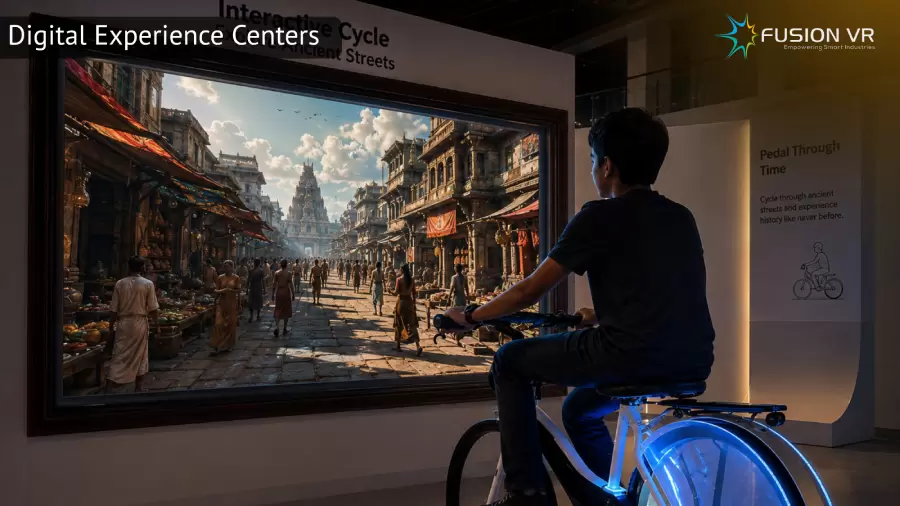
So instead of just reading that a historic city used to be a major center of trade visitors could actually walk through a digital reconstruction of its streets, markets, architecture, and daily activities.
The end result is a more emotional and lasting connection with history.
5. Making Cultural Heritage Accessible to Younger Generations
Younger audiences deal with information in a way that’s kind of different than what the older generations did. Things like interactive media, gaming, video, social platforms, and immersive moments are already just… part of everyday life.
Digital Experience Centers could use similar kind of approaches to bring younger visitors closer to cultural heritage, but in a more hands-on way, if that makes sense.
Gamification can turn learning into an engaging activity, sort of like a game-adjacent journey. Visitors might try challenges, solve historical puzzles, point out artifacts, wander through virtual environments, or even join in digital storytelling activities.
Those interactive setups can make complicated topics easier to grasp, while still pulling at curiosity, not pushing it away.
And no, this doesn’t mean that cultural heritage should be reduced to pure entertainment. Rather, technology can work as a bridge between traditional knowledge and modern learning methods, so it still feels true.
When young people feel that heritage is interesting and relevant to them, they tend to be more willing to care about protecting it.
6. Preserving Languages and Oral Histories
Language is a key part of cultural identity, especially for communities where their language is spoken by relatively small populations.
Digital Experience Centers can help keep a language alive in a practical way, by recording conversations, interviews, traditional tales, songs, poems, and other kinds of spoken heritage, not just one narrow type of content.
Those recordings can later be arranged into searchable digital archives, and with interactive displays, visitors can discover vocabulary, pronunciation, scripts, and also traditional phrases or sayings.
For communities that are dealing with language loss, this kind of digital documentation may turn into an important support for teachers and for the next generations.
And oral history projects, they can capture the lived experiences of older community members too. Their recollections about festivals, migration, occupations, historic moments, customs, and day-to-day life can become cultural records that might not exist in written archives at all.
7. Supporting Museums and Heritage Institutions
Digital Experience Centers can sort of work alongside traditional museums and heritage institutions, instead of straight up replacing them, or, well, not always.
Museums often run into practical limits, like space constraints, conservation needs, visitor capacity, and the whole physical handling of objects. In that case, a digital setup can widen what an institution is able to show, and not just in a simple way either.
For instance, a museum might own thousands of artifacts, but display only a small fraction of them. A digital archive, or maybe an interactive display can let visitors look into more of the collection, with less friction.
Digital displays can also give richer contextual background without basically jamming physical galleries. And yes, that can matter, because overcrowding can make it harder to appreciate what’s actually in front of you.
If someone is interested in a specific object, they could reach its story, background, cultural meaning, restoration steps, associated items, plus archival material, all via an interactive interface. It’s like the exhibits keep branching off.
So overall it supports a more immersive educational experience while protecting the physical collections, because the originals stay safer.
8. Enabling Virtual Access to Heritage Sites
Not everybody can easily travel to these important cultural places. Because, you know distance and accessibility limitations can stack up, plus cost, weather like environmental conditions, conservation rules, and even political circumstances sometimes it all blocks people from seeing heritage sites in person.
That is where virtual experiences help, because they can open the doors for a much broader audience than usual.
An actual Digital Experience Center can provide virtual tours of monuments, archaeological sites, historic districts, museums, and cultural landscapes. Not in a basic way, more like a guided virtual approach, so people can still get a sense of the place.
So a student who is thousands of kilometers away can explore a heritage site virtually. A researcher might study a digital model of an artifact. And a visitor who has mobility challenges could still experience areas that may not be physically accessible at all.
Overall virtual access widens the reach of cultural heritage, while at the same time lowering the stress on sensitive sites that really need protection.
9. Helping Preserve Heritage at Risk
A lot of cultural heritage, is kind of especially vulnerable to climate change, natural disasters, development and even conflict, yes.
Digital documentation can be a key way to keep a record of sites and objects that are at risk.
For example, if a historic structure gets damaged in an earthquake or a flood, then earlier captured photos, scans, architectural measurements, even 3D models can help conservation professionals figure out what the original structure was like.
In a similar vein, digital records can safeguard details about cultural landscapes and traditional practices, which are shifting very fast these days.
But digital preservation really should be handled like a part of a larger conservation strategy, not a stand-alone solution. A digital copy cannot fully take the place of an original artifact, a living tradition, or the historic setting itself.
Instead, its value is in documentation, access, learning, and also in setting up a base for future study and conservation work.
10. Connecting Communities with Their Heritage
Technology can become powerful when communities take part in the preservation process, not just as watchers but as active people.
Digital Experience Centers can offer a kind of stage or platform where local residents, artisans, historians, artists, elders, and cultural organizations all chip in.
They can share stories, memories, and knowledge that might otherwise fade away. When community participation is real, heritage tends to be shown in a way that feels accurate and also respectful, more or less.
For instance, imagine a center focused on regional culture, it could feature recorded conversations with local artisans, plus live demonstrations of traditional crafts, stories from community elders, photographs that residents contribute, and even written or digital documentation of local festivals.
In practice, this turns cultural preservation from something purely institutional, like only a formal project, into a shared community effort.
And beyond that, it also gives communities more visibility and a real sense of ownership over how their heritage is presented.
11. Improving Tourism and Cultural Education
Digital Experience Centers might help cultural tourism in a more tangible way, by giving travellers some meaningful context before or even during a heritage visit, kind of like a quiet guide in your pocket.
For example, someone could stand in front of an ancient monument and still feel a bit lost about what happened there, or how it fits into the cultural story. Then an interactive setup can unfold the narratives behind the architecture , the traditions, the people and the events connected to the place, in a more clear and lived-in manner.
This can also push responsible tourism along, because when visitors understand the reasons a location must be protected, they tend to act with more care.
And honestly, digital centers can work as orientation spaces right near heritage destinations. People can find out what is expected behavior-wise, what conservation rules to follow, which local customs matter, and what the site’s historical weight really is, before they step inside.
In this way, technology can support both tourism and preservation.
12. Creating Educational Resources for Schools and Universities
Digital cultural heritage resources can help stretch learning beyond the classroom, a bit more like a living space rather than just pages.
Teachers might take advantage of immersive content, to bring students into older time periods and related themes. Think historical eras, traditional arts, architecture, archaeology and also local culture, all in one flow that feels more real.
Rather than leaning only on textbooks, students can wander through digital reconstructions. They may look closer at artifacts in 3D, listen to oral histories and even tap or interact with historical maps, kind of like a guided curiosity.
Universities too can lean on digitized collections for research, and for teaching as well, not only for lectures.
So, Digital Experience Centers can become something like educational infrastructure that matters, linking cultural institutions with schools and higher education organizations, step by step.
13. Using AI and Advanced Technologies Responsibly
Emerging technologies like artificial intelligence can, in a way expand the capabilities of Digital Experience Centers a lot, almost more than you expect, you know.
With AI you can help organize huge digital archives, and at the same time boost search functions, add multilingual interfaces too, do transcription support, and even shape or refine personalized learning paths.
For instance, visitors might ask an interactive digital guide questions about a historical artifact, then get explanations that are tuned to what they care about and also their age group.
Still, the tech needs to be handled carefully when cultural heritage is involved. Any AI generated reconstructions, or interpretations, should be clearly shown as reconstructions rather than delivered as if they’re historical truths.
Authenticity, cultural ownership, privacy, consent, and community involvement should stay right in the middle of digital heritage work.
Challenges of Digital Cultural Heritage Preservation
Although digital experience centers give real opportunities, they also bring some challenges along, in a way. The whole thing can be pretty promising, yet there’s always some friction too.
Authenticity and Accuracy
Digital reconstructions really do need reliable historical sources, and it helps if those sources are, yeah, dependable in a practical way. When the evidence turns out incomplete or sort of fragmentary, organizations should make a clear separation between what is documented as facts and what is only interpretation, even if that interpretation feels persuasive.
Long-Term Digital Preservation
Digital files are not really automatically permanent. Sure, hardware gets obsolete sooner or later, file formats shift, and storage systems can flat out fail. So organizations should plan for backups, migration, and ongoing maintenance in a way that actually makes sense, not just “someday” thinking.
Cultural Ownership
Communities should get a voice in deciding how their traditions, stories, sacred objects and knowledge are documented and shown, in a way that actually fits them.
Digital Accessibility
Technology shouldn’t leave out people who maybe have limited digital literacy or disabilities, or just don’t have ready access to tech. The whole experience should be crafted with accessibility in mind, not like as an afterthought or a small add-on, because in real life people end up needing different ways to use things.
Cost and Infrastructure
Even with high quality scanning, immersive tech, software development, and the ongoing upkeep, it can demand a serious investment. So, sustainable planning is basically essential, otherwise it gets messy later on.
The Future of Cultural Heritage Preservation
The future of heritage preservation will, more and more, blend physical conservation with digital technologies and you know like those newer platforms that feel almost invisible.
Digital Experience Centers might turn into living cultural hubs, not just where history is kept somewhere in boxes but where it is actually lived through, interpreted in context, and shared with others, even if that sounds a bit dramatic.
In the next wave, future centers may lean on more and more sophisticated 3D environments, spatial computing, AI powered guides, interactive holographic displays, multilingual interfaces, and real-time digital archives. Visitors might move fairly smoothly between physical exhibits and virtual historical environments, like there isnt a real border, even when there is.
At the same time, the best projects will probably stay anchored in human stories.
Because technology is, at the end of the day a tool. The purpose is to preserve meaning, not just pixels.
A digital reconstruction of a building can be useful because it helps people understand the history and culture tied to that place. And a recording of a traditional song matters, too, since it keeps the voice and identity of the people who created and performed it, yes even the small details.
So the mix of technology and human knowledge is what makes digital cultural preservation truly strong.
Conclusion
Cultural heritage connects generations, in a way that feels almost personal. It tells us where communities came from, how societies grew into themselves and what values plus traditions helped shape their identities.
Digital Experience Centers, kind of bring this idea forward with a more modern vibe, so the link doesn’t fade.
With digitization, 3D modeling, immersive storytelling, virtual access, multimedia archives, interactive education, and community participation, these centers can keep both tangible and intangible heritage together. They help fragile artifacts stay reachable without too much physical handling, they can record customs that might be vanishing, and they can show younger people history through experiences that seem relevant to them, not distant or stiff.
Most importantly, Digital Experience Centers can turn cultural heritage from something people just watch, into something they actually step into, explore and understand.
And as technology keeps moving ahead, the goal isn’t only to create digital copies of the past. It’s more about building meaningful digital experiences that help people appreciate, safeguard, and pass cultural heritage forward.
If digital tools are used responsibly, they can make sure that the stories, traditions, knowledge, and memories of today remain available for generations to come.