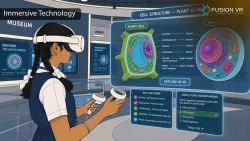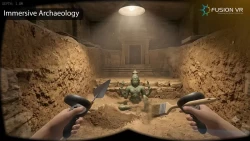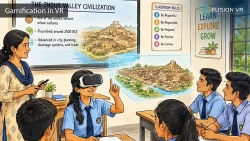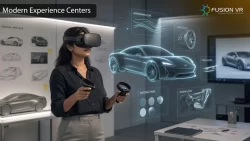

The structure of Virtual Reality in education and technology is ever-changing, and this tool is transforming the ways teaching, learning, and deep interaction with concepts are perceived by everyone. From immersive labs for science to virtual field experiences and engineering simulations, the scope for VR to transform learning outcomes is tremendous. For VR to scale, academicians and industrialists would need to join hands in designing curricula that would be both acceptable to academics and relevant to industry. This synergy forms the core of wealth-producing VR education programs that impart skills that are futuristic yet immediately realizable in the employment market.
The Need for Co-Designed VR Curricula
Due to VR evolving at such a fast pace, traditional academic structures are kept rooted in a slow-paced process and cannot keep up independently. Universities, on the other hand, are the birthplace of methods and theoretical frameworks, while industry stakeholders bring in the newest tools, platforms, and applications in the real world. Allowing VR curricula to be co-designed provides educational institutions with an opportunity to align learning outcomes with industry requirements while remaining at the forefront of innovation.
Thus, this collaboration addresses some of the core needs:
- Closing the skills gap: Nowadays, many graduates lack the hands-on skills required by employers. Integrating real-world tools of VR gives students that practical skill set.
- Encouraging technology uptake: Due to the usual constraints of limited budget or a lack of adequate expertise, universities sometimes fail to embrace a new technology and hence partnerships with tech firms enable granting access to the latest tools and infrastructure.
- Increasing employability: The learners are trained on platforms and workflows that are in actual use in the field, as part of a co-developed VR program with industry partners.
- Curriculum relevance: Industry trends keep changing very fast. Regular interfaces are needed so that the syllabus can be tweaked frequently to respond to new developments.
Models of Collaboration
Collaboration may never be one-size-fits-all. There are many models and variations which an institution or company may have decided to adopt depending on their purposes, resources, and scope of involvement.
1. Committees for Curriculum Co-development
An academic-industry committee is formed to develop the curriculum and maintain periodic review and iteration of the curriculum. Instructional design and subject-matter considerations for the academic side; industry experts recommend tools, technologies, and case studies to blend.
Best Practice: Should include VR designers, instructional technologists, domain experts (medicine, engineering), and HR representatives so the curriculum is balanced toward theory and practice and employment.
2. Industry as Training Partners
Technology companies or VR startups act as certified training partners. They present the hardware and software platforms while also organizing laboratories, workshops, programs of certification, and hands-on labs with a real-world application approach.
Example: A university might have an enterprising partnership with Unity or Unreal Engine to offer official modules as part of the coursework.
3. Industry-Institution Incubators
Some academic institutions go a step further and set up joint innovation labs or incubation centers focused on research and development in VR. Students receive exposure to industry projects, while the company obtains unique perspectives and research help.
Best Practice: Get students to work on industry-sponsored capstones to promote creativity and real-world problem-solving.
4. Internships and Co-op Programs
Another model of collaboration could involve a paid internship or cooperative education program where students work at VR companies during the semester or summer break. Internships expose students to actual development pipelines and working dynamics.
Example: Students from a VR design course could intern at some gaming studio or industrial simulation firm to apply what they have learned in a professional setup.
Key Components of a Co-Designed VR Curriculum
A VR curriculum, to be successful, must maintain equilibrium, featuring some foundational knowledge, a measure of technical know-how, and a bit of industry relevance. These components are required:
1. Core Theory
Before engaging with VR tools, students must learn:
- Human perception and immersion
- VR hardware and optics
- Spatial interaction and ergonomics
- Cognitive load and UX in VR
- Design thinking and prototyping
This theoretical basis equips students to think critically about applications for VR and to design immersive experiences that attendees find intuitive and impactful.
2. Technical Tools and Platforms
Students should acquire hands-on experience with these tools:
- 3D modeling tools (e.g., Blender, Maya)
- Game engines (e.g., Unity, Unreal Engine)
- VR SDKs (e.g., OpenXR, SteamVR)
- Programming languages (C#, Python)
- AR/VR hardware (Oculus Quest, HTC Vive, HoloLens)
There should also be VR production in the courses, starting from the stage of idea creation to actual deployment.
3. Industry Case Studies and Scenarios
Real-life implementation scenarios across industries could be incorporated into the modules:
- Healthcare: Virtual anatomy labs and surgical simulations
- Engineering: Digital twin simulations and equipment training
- Architecture: Immersive walkthroughs and BIM visualizations
- Education: Virtual classrooms and interactive storytelling
- Marketing and Retail: Virtual showrooms and customer experience simulations
Such cases strengthen the levy of VR for practical uses and inspire applications in their respective domains.
4. Ethics, Privacy, and Safety
As is given for any emerging tech, VR poses its ethical and safety concerns:
- Data privacy in immersive environments
- Psychological effects arising due to long VR usage
- Accessibility and inclusivity in virtual experience
- Copyrights and intellectual property on virtual content
Students need to be trained in responsible design and in understanding the social connotations of VR.
5. Soft Skills and Interdisciplinary Exposure
In essence, top-class professionals in virtual reality do not merely have technical know-how; they communicate, narrate a story, and think about solutions. The layers of the curriculum should cover:
- Teamwork and agile development
- Meaningful communication and presentation
- Interdisciplinary projects with students focusing on design, psychology, and business
Best Practices in Co-Designing VR Curricula
A few collaborations internationally have propagated successful VR education programs. Studying those reveals the following best practices:
1. Begin with Outcome-Based Design
Identify the competencies that students should gain by the end of the program. The curriculum should be structured using backward design so that every module speaks toward those outcomes.
2. Iterate and Pilot
Start with pilot courses co-designed and set up with an industry partner of choice. Capture feedback from students, faculty, and industry reviewers who will use the curriculum. In turn, these inputs should be used to improve the content before final roll-out.
3. Invest in Faculty Training
Even the most well-designed curriculum will fail if the faculty who teach it are not prepared to do so. To better prepare educators in VR development and pedagogy, hold regular workshops, webinars, and certification programs with industry involvement.
4. Establish Governance Mechanisms
With a view to protecting prolonged collaboration, the partnership may be formalized through MoUs or joint advisory boards. These boards will undertake periodic review and changes in future to maintain curriculum relevance.
5. Build on Remote and Online Platforms
Not every institution may be able to build a full VR lab. Industry partners might give cloud-based access to development environments, VR asset libraries, and remote collaboration tools so that access could be democratized.
6. Include Micro-Credentials and Certifications
Challenge the notion of a diploma as the one ultimate authentication of knowledge through stackable credentials, micro-credentials, badges, or certificates endorsed by industry practitioners. Beyond supplementing a regular degree, this puts any job seeker in a better position for a job.
Case Study: Fusion VR’s Academic Alliance
The Fusion VR Industry-Academic Alliance may be considered the leading instance for the co-design of VR curricula. Design and engineering colleges partnered with Fusion VR in creating learning modules that meet academic outcomes but also satisfy market requirements.
Examples of industrial use cases presented in these courses are:
- Use of VR for process-based manufacturing training
- Safety simulation in hazardous environmental conditions
- Augmented maintenance guides for field engineers
Fusion VR also provides internships, faculty training programs, and simulation platforms, thus providing a whole ecosystem for developing the next generation of VR professionals.
The Road Ahead
This means that the development of immersive VR education is being strongly influenced by the universities and industry. The academic worldview emphasizes structured learning and research, whereas the industrial perspective is one of innovation and application. Together, they can formulate curricula meant not only for using VR but also for working on its implications for the very future of learning, working, and interaction.
Such institutions will not merely graduate highly capable manpower but will further contribute to forming a strong pipeline of VR talent much needed by countries aspiring to become leaders in the fourth industrial revolution.
Final Thoughts
VR stopped being a new thing for education and became a need. However, the effective integration of VR demands a paradigm shift in the design, delivery, and assessment of curricula. Through proper collaboration, constant iteration, and shared vision, universities and industries can jointly develop VR applications that are not only engaging but also ethical and employable.
The future of learning is an immersive one, and the first stroke on its canvas is collaboration.