
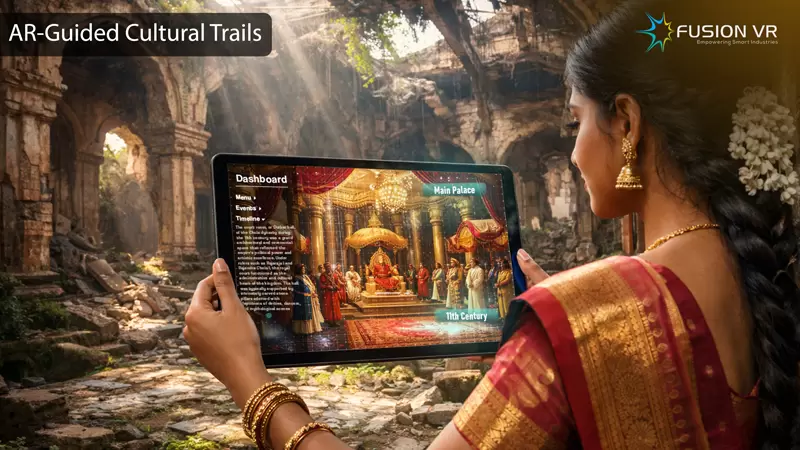
Cultural tourism exists to establish relationships between visitors and the historical past and the local community and its cultural heritage and the stories that define the specific location. People now establish new methods to discover cultural sites because digital technology has become the primary force that shapes contemporary society. Augmented Reality (AR) has evolved from its initial status as a gaming and entertainment technology into a dominant force that combines physical travel experiences with virtual storytelling. This development has created a fresh type of augmented reality cultural pathways which connect digital and physical elements of tourist experiences.
The experience begins when you stand at an ancient palace ruins or walk through a historical district. Your smartphone or AR glasses let you see the world around you because you need these tools to explore the space instead of using traditional signage, brochures and audio guides. The hidden sightlines now reveal their complete historical history through three-dimensional visualizations and historical storytelling and animated figures and sounds from previous centuries and interactive elements which respond to your movements. The experience goes beyond traditional sightseeing because it enables you to fully understand the local culture and historical background which surrounds you while it creates lasting impressions that persist beyond the walking paths. The heritage exploration process receives alteration because these technologies create a new way to connect historical times with current events.
The AR-guided cultural trails combine digital experiences with physical locations which enable visitors to AR in museums and historic city districts and landmarks and archaeological sites to access digital content that shows historical information about their surroundings. The first moment of virtual reality-based experience creates deeper user connection because it transforms traditional sightseeing into interactive exploration. Digital overlays can show, for instance, how a temple front exterior would have looked several centuries ago, display the day-to-day life of people who lived centuries back, or project animated guides narrating local traditional stories and legends from their respective eras. The destination offers visitors more than mere facts because it provides them with emotional experiences through its narrative interpretations of the landscape.
The digital experience centres created by Fusion VR utilise AR and virtual heritage technologies to convert traditional museum displays into interactive spaces which allow visitors to participate in their presentations. Museum 2.0 initiatives use AR content together with physical displays to create more engaging exhibits which enable visitors to experience exhibits through different methods that go beyond direct object contact. The cultural trail provides visitors with an experience that allows them to observe historical objects or cultural items through immersive displays, showing how these objects were used during their actual historical period and the situations that led to their creation..
Tourists today are increasingly demand-driven by experience and personalisation. AR fulfils both in powerful ways. The standard guided touring process requires fixed routes and pre-established scripts, whereas AR experiences provide visitors with tailored content that adapts to their specific interests and language needs and walking speed and interaction methods. The modern cultural traveller now has access to a complete travel experience which provides real-time adjustments to their journey. Interactive maps can guide users to points of interest with relevant AR stories, QR codes can trigger multimedia historical short scenes at key landmarks, and mobile AR can overlay interpretive content as visitors move through heritage spaces. The combination of relevant AR content with personalised user experiences creates deeper connections between visitors and their present location.
The effects of augmented reality go beyond its ability to create instant user interaction. Educational programs and emotional experiences form the foundation of cultural tourism, which augmented reality technology successfully delivers. The digital overlays enable users to access multiple knowledge levels, which traditional signboards and text descriptions do not provide. The research shows that augmented reality technology enables users to understand and appreciate historical objects and landmarks by presenting their historical context and cultural importance through visual displays. The additional elements visitors learn about create an experience that stays in their minds. Users experience augmented reality through different time periods and cultural perspectives when they walk through an ancient bazaar or listen to a storyteller who shares the history of a monument.
Cultural trails have long existed in tourism, which lead explorers through dynamic street routes that present heritage walks and architectural tours, and indigenous culture routes. The implementation of augmented reality (AR) technology transforms these trails into interactive ecosystems that combine real-world spaces with digital immersive storytelling elements. A cultural trail in a historic town uses AR technology to show visitors the history of its major buildings while displaying animated historical scenes from their original locations and providing interactive quests that unlock secret traditional legends and stories information. This method of storytelling creates an engaging experience, which helps people remember information better, thus improving their cultural tourism experience.
The use of AR technology enables people from all backgrounds to access tourist sites that traditional tourism methods fail to provide. Digital experiences can be designed to accommodate diverse needs offering visual, auditory, or language accessibility options. People from all backgrounds can now access cultural heritage through this system which provides educational materials that people can use regardless of their physical or linguistic abilities. The system enables users to explore distant heritage locations through virtual tours which they can access from their personal devices before making actual visits.
The economic importance of this matter exists. The implementation of augmented reality cultural trails creates fresh opportunities for tourism businesses to generate income while maintaining sustainable environmental practices. The implementation of digital trail experiences which enhance trail appeal will result in increased visitor numbers and higher spending by tourists at local businesses. The monetisation of augmented reality experiences will occur through the sale of premium content and establishment of business partnerships and development of sponsorship frameworks dedicated to preserving cultural heritage. The extended visitor dwell time at heritage sites, together with improved visitor satisfaction, will provide local tour operators and heritage sites an advantage over competing destinations that depend exclusively on conventional tourism practices.
The system needs to be tested under various conditions to establish its performance limitations. Users need to handle augmented reality experiences with caution because these experiences require protection of authentic elements and cultural elements and essential operational elements. The physical locations lose their natural qualities when digital material exceeds the appropriate limits of artistic display which leads to an excessive level of digital content distribution. Designers of augmented reality applications need to create their systems according to three principles, which require them to develop applications that show respect for cultural elements and historical elements, and the original heritage elements of their projects. To create AR narratives that enhance cultural experiences, historians and technologists, local communities, cultural custodians, and tourism stakeholders need to work together.
The upcoming combination of AR with AI and spatial computing will improve cultural trails through its advanced technological capabilities. AI creates customized visitor experiences that change according to visitor preferences while spatial computing interfaces which include AR glasses and wearable sensors and geo-anchored content will create new possibilities for interactive storytelling. The cultural trail would detect your location to modify its story during your visit while the AR experience would change its content based on what the visitor shows interest in. The new technologies will create opportunities for deeper visitor engagement while building informative cultural tourism experiences that provide complete personal immersion.
The implementation of augmented reality augmented cultural trails which serve as tourist attractions, establishes a new tourism model. This model preserves physical heritage while using advanced digital technology to present historical narratives. The combination of virtual and physical elements in tourism experiences attracts modern travellers while safeguarding cultural heritage for upcoming generations. The experience enables visitors to explore the site beyond its existence as a permanent structure, which contains an active story that they can discover through exploration and comprehension. The progression of technology, together with the development of innovative storytelling methods will create a more immersive cultural heritage experience than any previous time.


