
In today’s truly digitized market, the concept of Digital Twin is far from blacksmithing workshops, power generation plants, and aircraft engines. In its own right, it has a powerful industrial setting and is now redefining how we interact with museums and heritage sites. Constructing a Digital Twin for a museum would seem a futuristic concept a few years ago and might well be an increasingly operative solution today. This approach addresses developer concerns by integrating services such as immersive technologies, cultural preservation, and enhancements to the visitor experience.
So, what does it actually mean to create a Digital Twin for a museum? And why must museums around the world embrace this transformation? Inquire further.
What is a Digital Twin?
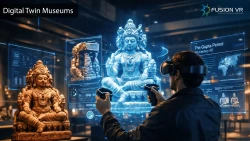
A Digital Twin, in very simple words, is a virtual, real-time replica of an object or a process or an environment. It duplicates one or more machines, factories, or systems, assisting engineers in monitoring, simulating, and optimizing them. In the museum application, the Digital Twin is a living copy of the museum building along with its galleries, collections, artifacts, and visitor experience.
That said, the twin is not just a run-of-the-mill 3D model; it is interactive, data-driven, and immersive. A diverse audience of visitors, curators, researchers, and learners located remotely may engage with the twin in a dynamic way. It is anywhere and everywhere the entire museum in one fist available through VR headsets, AR apps, web browsers, or that might even entertain a holographic interface!
Why Do Museums Need Digital Twins?
Museums, traditionally, have been homes for history, culture, and knowledge. But today, they confront special challenges:
- Accessibility: Not everyone gets to go to the beautiful museums like the Louvre in Paris or the Indian Museum in Kolkata. A digital twin offers all access.
- Preservation: Artifacts get destroyed by time, weather, or even an accident. A digital twin keeps them preserved forever, retaining their original glory.
- Engagement: Today, the audience, especially the younger generation, seek exciting interactive experiences. Passive viewing does not get them very excited.
- Education: Schools and universities can take museums to their classrooms, turning history lessons into immersive experiences through digital replicas.
- Revenue: Ticket sales through websites, online tours, and digital exhibitions offer new sources of income.
In a nutshell, creating a digital twin means future-proofing a museum to stay relevant, engaging, and sustainable in this digital age.
How Are Digital Twins of Museums Built?
Creating a digital twin of a museum is a multidisciplinary subject with fields such as scanning, modeling, data integration, and immersive storytelling. Let us dissect the process:
1. Capturing the Museum Space
The first step is to do 3D scanning and photogrammetry. Such technologies include LiDAR scanner, drone, and 360° cameras, which will capture every design or detail of the museum architecture-from grand halls to small carvings. High-resolution accuracy and authenticity must be ensured through such images.
2. Digital Modeling
After the raw scans have been captured, it is time for the modelers to create 3D models for the spaces and artifacts. Each sculpture, painting, or exhibit is digitally reconstructed, often in ultra-high resolution so users can zoom in and see details imperceptible to the naked eye.
3. Integration of Metadata
Of course, a digital twin is not just about visuals-it is about information. Metadata is embedded by curators and researchers: artifact origins, historical context, restoration particulars, and expert commentary. In such a way, the digital twin becomes an environment full of knowledge.
4. Immersive Technologies
VR, AR, MR, and holographic projection essentially remind a twin to come to life. Imagine just aiming your phone at a painting in the real museum, and the digital twin overlays animation of how it was created centuries ago.
5. Simulating Visitor Experiences
The digital twin is designed around visitor journeys. Users can virtually explore the museum, select guided tours, or interact with digital avatars of historians and curators.
6. Real-Time Updates
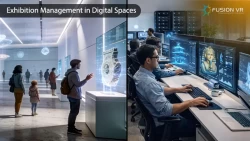
One of the greatest strengths of a digital twin is that it is never static. From the moment new exhibits are installed, renovations are made, or artifacts rotated, the twin is updated in real time, so it always maintains accuracy and continuity.
The Visitor Experience: Walking Through a Digital Twin
Imagine yourself logging into the digital twin of a museum via VR headset. You enter the grand lobby and are greeted by the holographic guide. With no fixed track, you pick where to go–maybe into the ancient civilization wing. When you approach an Egyptian item, a 3D animation reveals the process of its excavation. You can touch a button, and then get virtually teleported right into the actual reconstruction of an Egyptian marketplace where the object operated.
Or think about visiting the digital twin of an art museum, with your friends all around the globe. You all log in and move as avatars; chatting about paintings as if you had been standing there. Fully social and immersive and highly customized!
Beyond Preservation: Storytelling with Digital Twins
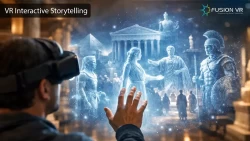
Among the captivating aspects of digital twin construction is storytelling. The objects become alive-not as static things but as gateways into their stories. For example,
- A bronze sculpture can be augmented with AR animations showing its forging by artisans.
- A medieval sword can be used to trigger a VR scenario of the battle where it was wielded.
- Ancient manuscripts may be opened, translated, and narrated interactively in digital form.
Digital storytelling will convert museums from object repositories into experience centers that fill visitors with awe and wonder.
Benefits for Museums and Society
Those represented by a twin industrial prototype in museums have a large choice:
- Global Reach: Millions will study cultural heritage without boarding a plane.
- Preservation: Digital archive guarantees against catastrophe and decay.
- Inclusivity: Persons limited in movement can explore this way.
- New Learning Models: Education stays interactive and fun.
- Collaboration: Museums all over the world can link their digital twins and hence create a global network for virtual museums.
- Sustainability: Lessening of physical wear on artifacts and lower dependency on physical travel thereby reducing their carbon footprints.
Challenges in Building Digital Twins
The road that connects reality with its reflection is not alone without obstacles:
- High Costs: Scanning, modeling, and integrating an advanced technique does yield high costs.
- Technical Expertise: There is a need to bring together curators, technologists, and designers.
- Data Management: Large quantities of metadata must be managed and updated.
- Authenticity Concerns: It is tricky to balance digital storytelling without distorting history.
- Accessibility: Digital twins must be accessible on a rather wide range of devices and not just high-end VR systems.
Yet, as technological advances, costs descend, and expertise increases, these challenges become easier to deal with.
The Road Ahead: Future of Digital Twin Museums
The future is bright for digital twins in museums:
- AI-Powered Curation: Artificial Intelligence might indeed suggest personalized tours based on each visitor’s interests.
- Metaverse Integration: The museums could become part of larger metaverse ecosystems where users roam between cultural spaces worldwide.
- Haptic Feedback: Users might virtually “feel” the texture of artifacts through gloves and suits.
- AR Field Trips: Students could visit the Louvre or Ajanta caves right from their classrooms through AR-enabled devices.
- Crowdsourced Storytelling: Visitors may share their experiences, thus enriching the digital twin.
In the end, digital twins will democratize culture, with particular attention to making heritage captivating and inspiring for generations to come.
Conclusion
To craft digital twins for museums is more than just a technological upgrade-it’s actually a cultural revolution. By fusing heritage with innovative immersive technology, museums can transcend geography, freeze in time an artifact, and build that magical experience. Museums no longer need to be quiet corridors filled with objects; they can become a very beautifully living, breathing worlds where history takes life and narratives flow free.
Fusion VR, among others, is really at the forefront of this change, helping museums and cultural institutions gain footing as they step into the future. With the world heading toward digital-first and interconnected, it is now a question of when and not whether museums will embrace digital twins.