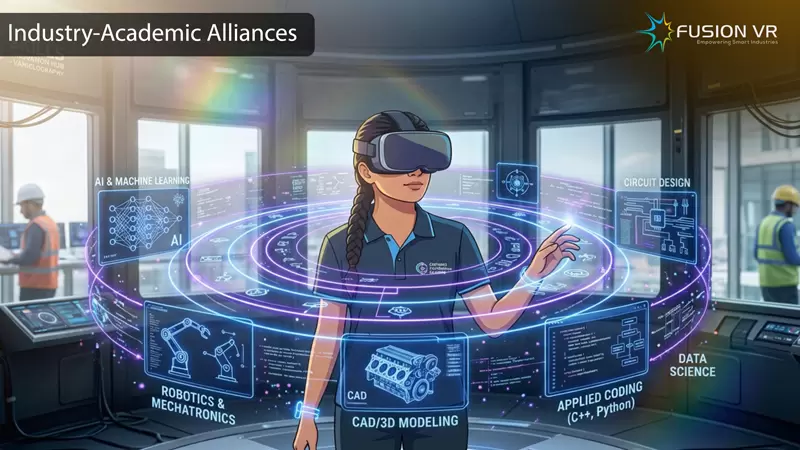
Introduction: Engineering Education Must Move Beyond Theory
Engineering education has traditionally focused on classroom teaching, theoretical concepts, and standard lab exposure. The current requirements for student preparation need more than the existing essential elements which continue to hold significance. Employers today require graduates who have both academic qualifications and practical experience in digital skills which enables them to perform their job responsibilities from their first workday.
The academic alliance programs create a significant impact on educational institutions. Universities and training ecosystems are increasingly adopting digital platforms, virtual reality (VR), and augmented reality (AR) as part of their curriculum delivery to bridge the gap between academic learning and industry readiness.
The technology-enabled learning models assist students to develop active learning skills. Students can now study systems, machines, workflows, and industrial environments through interactive practice and immersive simulation experiences. The process establishes superior comprehension which results in improved memory retention and increased self-assurance and better readiness for actual work situations.
The future of engineering education requires academic institutions to establish partnerships while they implement technological advancements to drive educational transformation.
The Real Gap in Engineering Education
The main problem with engineering education results from the lack of collaboration between educational institutions and business organizations. The main problem exists because students continue to learn in educational settings which do not match actual workplace environments.
Most universities teach their students enough material to pass tests but their students leave without acquiring essential skills needed for:
- Industrial operations
- Advanced digital technology
- Real-world problem-solving situations
- Decision-making through simulation methods
- Team-based work on projects
- Current workplace technologies
The transition period between school and work proves challenging for many graduates because they face difficulties. They possess knowledge of engineering concepts yet they lack the ability to use this knowledge in real-world situations that require quick adaptation to new technologies.
Education requires more than basic curriculum changes because it needs complete experiential learning environments which let students develop skills required in actual professional environments.
What Academic Alliance Programs Should Actually Deliver
The academic alliance curriculum needs to establish permanent relationships with industry partners instead of relying on guest speakers to fulfill its requirements. A learning environment needs to be developed that enables students to experience actual workplace conditions through complete access to professional equipment and operational environments which they will use in their future jobs.
A modern academic alliance model should include:
Digital Learning Integration
The use of digital learning allows educational institutions to provide current educational materials together with interactive learning modules and independent study tracks and assessment tools and capability evaluation systems. Digital platforms provide students with access to technical knowledge which they can learn in a more captivating way that also reflects real-world applications.Students can learn through the following methods which go beyond traditional classroom materials:
- Interactive simulations
- Digital modules that demonstrate actual business applications
- Visual process understanding
- Scenario-based learning exercises
- Skill validation and progress measurement
This solution enables educational institutions to establish an adaptable learning environment which meets educational needs while maintaining training standards throughout different student populations.
VR-Based Practical Training
Virtual reality technology provides engineering and technical education with its essential ability to create artificial environments which simulate real industrial environments for student learning.
Through VR-based training, students can safely experience and practice activities such as:
- Students work with machines in authentic operational environments
- Students learn about industrial processes through hands-on experience
- Students learn to recognize safety hazards through controlled simulation
- Students learn to operate equipment through practical experience
- Students learn to operate machinery through practical maintenance exercises Students learn complex processes through procedural training at high-level complexity
This situation provides important benefits because actual physical access becomes restricted by various factors which include expenses and safety requirements and infrastructure limitations and operational constraints.
Students can experience a plant, workshop, site, or technical process through immersive 3D space, which lets them see the actual space. The process creates better understanding through multiple practice opportunities, which help users develop confidence and vocational skills.
AR-Based Applied Learning
Augmented reality technology creates additional value through its ability to overlay digital information that exists in virtual environments onto actual physical spaces. AR enables students to better comprehend systems through its ability to show both their individual components and their complete operational processes.
The engineering students can use AR technology to improve their learning experience through:
- Component visualization
- Process overlays
- Equipment understanding
- Step-by-step guided learning
- Interactive technical demonstrations
- Real-time concept reinforcement
The solution promotes intuitive learning while enabling students to make quicker connections between theoretical concepts and their practical uses.
Career-Oriented Skill Development
The academic alliance curriculum must establish its design foundation based on employability results instead of measuring academic achievements. The goal is to ensure students develop the practical and digital competencies industries actively seek.
This includes preparing students for:
- Development of skills needed to work with modern technology
- Ability to solve problems that arise in workplace situations
- Execution of technical tasks in real-world situations
- Digital teamwork skills development
- Ability to communicate in industrial settings
- Development of confidence to perform actual job tasks
Students who learn digital skills together with AR VR training in digital environments develop better readiness for jobs that require simulation and visualization and automation and digital operations skills.
Why VR, AR, and Digital Learning Matter for Employability
Employability today hinges on the ability to adapt to different situations. The industrial sector undergoes transformation through the implementation of digital technologies automated systems and intelligent technology and virtual reality and data-driven operational methods. The students who learn through traditional teaching methods that only focus on theoretical knowledge will find it difficult to meet the current educational requirements.
Digital and immersive training methods provide students with multiple advantages which benefit their future job prospects.
Students show greater comfort when they work in spaces that contain advanced technological systems. The students who use application-based learning environments show better learning outcomes. The students develop the ability to comprehend business processes through visual and interactive methods. The students establish self-assurance through repetitive task training in virtual environments which simulate safe conditions. The students develop a work mindset which correlates to contemporary business practices.
The students bring value to employers which makes them more attractive recruitment candidates because they possess practical knowledge. The students already possess experience in both practical work settings and digital systems and authentic operational contexts.
The educational value of VR and AR technologies extends beyond learning opportunities. The technologies function as tools which help individuals prepare for their future careers.
How Universities Benefit from This Curriculum Model
University institutions which implement digital technologies together with virtual reality and augmented reality based academic partnership programs achieve greater benefits for their student body while increasing their institutional value.
The institutions possess the capability to
- Use interactive educational experiences to boost student participation
- Provide multiple educational pathways through their advanced educational programs
- Increase job placement rates for their graduates
- Better meet the needs of employers
- Build their reputation as institutions which prepare students for future employment
- Enable practical educational experiences which do not need extensive physical learning spaces
The universities position themselves as educational institutions which focus on innovation through this model. The universities position themselves as educational institutions which focus on innovation through this model.
How Students Benefit in Real Terms
The model carries greater value for students because it delivers essential benefits which extend beyond any classroom enhancements. The program determines their level of readiness for all upcoming internship programs and interview sessions and training events and job search activities.
Students benefit through:
- Better understanding of complex engineering concepts
- More practical exposure before entering the workforce
- Increased confidence in technical environments
- Improved familiarity with digital tools and systems
- Stronger portfolio of skills relevant to recruiters
- Enhanced readiness for real-world job roles
When students experience learning instead of only studying it, they become more capable, more confident, and more employable.
Moving from Education to Workforce Readiness
The true success of an academic alliance program should be measured by how effectively it helps students transition into employment. This requires a curriculum that teaches concepts and develops practical application skills.
Digital modules provide flexible access to educational content. VR creates immersive practice environments. AR improves visualization and contextual understanding. The combination of these technologies develops a learning pathway which closely resembles actual industry practice.
This is the kind of transformation universities need to adopt in order to develop graduates who possess both academic knowledge and practical employment skills.
The Future of Academic Alliances in Universities
The next generation of academic alliances will establish two main components for their operation because institutional partnerships and curriculum advisory support determine their primary functions.
The success of academic alliances will depend on their capacity to incorporate cutting-edge educational technologies into standard classroom practices. Universities must progress toward digital transformation because industries are embracing digital systems and simulation technologies and automation and immersive training methods.
Students should not first experience these environments only after getting hired. They should encounter these environments during their academic studies.
The development of digital programs which include virtual reality and augmented reality elements has become essential for academic alliance programs. The programs provide students with an effective and expandable method to learn about the situations which currently exist in professional work environment
Conclusion
The challenge in higher education is no longer just about closing a theoretical skills gap. The requirement is to verify student readiness for present-day technology-based workplace conditions.
Digital learning programs that use virtual reality and augmented reality technology provide universities with better educational solutions than traditional curriculum development methods. The program provides students with complete real-world experience, in-depth knowledge, and employment-ready skills which traditional educational systems cannot provide.
The educational system in universities can use this chance to update their teaching methods. The students will find it easier to advance their careers through this program. The program creates a better method to develop workplace-ready skills through actual classroom instruction.