The development of realistic medical training simulations has become an essential requirement because hospitals need personnel who can deliver accurate and timely medical treatment while maintaining their ability to adjust to changing circumstances. The increasing complexity of healthcare systems, together with their reliance on advanced technologies, has rendered both traditional classroom teaching methods and mannequin simulation training insufficient for preparing medical practitioners to handle actual medical situations. Medical professionals, including doctors and nurses and paramedics, and technicians, are learning and practicing their skills through immersive simulations that use virtual reality and augmented reality, mixed reality, artificial intelligence and haptic technologies.
Healthcare stands as an exceptional industry because its errors result in life-threatening consequences. Medical experts need to gain practical knowledge through their actual work experience. The gap between learning needs and assessment methods gets closed through immersive simulation, which enables trainees to experience dangerous and stressful situations within a secure digital simulation environment. Simulation development needs designers to create training programs that effectively combine accurate medical knowledge with advanced technological features, authentic psychological elements and teaching methods.
The foundation of any effective immersive healthcare simulation begins with clear learning objectives. Healthcare simulations differ from entertainment-driven VR experiences because they require developers to create virtual experiences that focus on achieving specific outcomes. The simulation needs to accomplish its objective through various elements because its purpose is to boost surgical skills, emergency response techniques and patient communication abilities. The design process typically starts with collaboration between medical experts, simulation designers, software developers, and instructional specialists. The simulation development process needs interdisciplinary collaboration because it ensures that the simulation delivers clinical accuracy, together with technological strength and educational effectiveness.
The main strength of immersive healthcare simulations lies in their ability to teach through practical scenarios. Trainees learn through actual clinical experience instead of studying procedures from textbooks. The virtual emergency room simulation allows medical students to treat trauma patients who suffered road accidents. The system tracks essential health signs as they change through the entire monitoring period. The patient shows treatment progress through recovery or shows treatment failure through incorrect treatment choices. The trainee needs to decide which tasks to execute while handling virtual team interactions and demonstrating their clinical expertise during time constraints. The system of dynamic learning methods enhances both retention capacities and decision-making skills of users.
Simulation design depends on using realistic elements. The simulation requires visual accuracy and 3D positional and environmental details, and patient behaviour to make real-world conditions. Advanced rendering engines enable detailed anatomical models, realistic tissue behaviour, and accurate surgical tools. Touch-based feedback devices simulate resistance during incisions or injections, allowing trainees to develop muscle memory. The experience gains authenticity through monitor beeping patterns and operating room lighting conditions and background conversations.
The process of creating immersive healthcare simulations requires adaptive intelligence which serves as a importatant component. The system uses artificial intelligence to track user activities while it studies their decision-making habits, and it modifies the difficulty of scenarios in real time. The system uses diagnosis performance to predict which medical emergencies will be presented to trainees who show consistent success in diagnosing respiratory distress. AI virtual patients demonstrate authentic emotional behavior which allows healthcare workers to develop both their empathy and communication abilities while they learn clinical procedures.
Medical training programs do not include communication training, yet it remains essential for effective patient care. The immersive simulations provide trainees with opportunities to practice three skills which include breaking bad news, managing anxious patients, and handling family members during critical situations. Virtual avatars use AI and natural language processing technology to create interactive dialogues that simulate real human conversations. The method develops essential soft skills needed to establish patient trust and deliver care that meets ethical standards.
The development of immersive simulations requires designers to establish organised systems that provide feedback to users. The simulation offers instant feedback, which enables trainees to see the results of their decisions. The post-simulation analysis generates comprehensive performance evaluations which show both strong points and development needs. The system enables users to monitor and assess their performance through tracking of response time and procedural accuracy and communication effectiveness and protocol compliance. The training process changes from personal judgment to objective measurement through the use of this data-based method.
Scalability is another important consideration. Healthcare institutions range from small nursing schools to large hospital networks. A well-designed immersive training system should be adaptable across various training levels and specialities. The modular simulation design enables institutions to create customised content that covers surgery, cardiology, paediatrics, emergency medicine, and critical care. Cloud-based platforms enhance accessibility by enabling users to conduct remote training while participating in multi-user simulations that take place across different geographical areas.
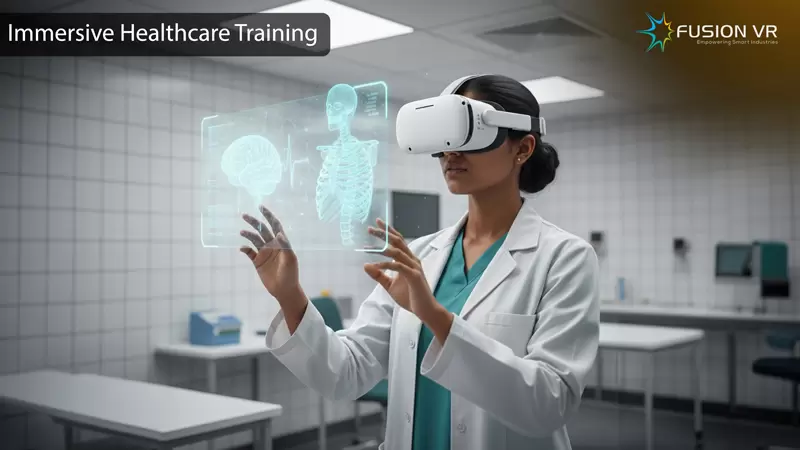
Healthcare training gains an extra dimension through augmented reality integration. AR technology enables users to see virtual content that they can experience in real-world environments. Medical trainees can use AR headsets to view 3D anatomical structures superimposed onto mannequins or real training models. AR technology enables surgeons to use virtual content that shows them how to make incisions and which blood vessels to avoid while they perform surgical procedures. The combined method creates a strong educational resource that unites physical hands-on experience with computer-based visual improvements.
Surgical education has been revolutionised by the use of immersive simulations which now serve as essential training tools. The standard method of teaching surgery requires students to first observe a procedure before they perform it and then teach others how to do it. Trainees can experience virtual reality environments which enable them to practice intricate medical procedures multiple times before they attend their first real-world surgical experience. The system enables users to perform simulated operations on multiple surgical fields, including laparoscopic surgery and neurosurgery and orthopaedic surgery within a secure virtual environment. Errors transform into educational experiences that do not compromise patient safety. Students develop their abilities through practice because they gain both assurance and expertise from their training.
Emergency response simulations maintain their equal effect on emergency situations. Paramedics and emergency room teams must coordinate their activities during high-pressure situations. Immersive simulations can create realistic experiences of mass casualty incidents, disaster response scenarios, pandemic outbreaks, and cardiac emergencies. Teams can use multi-user VR environments to train together, which enhances their ability to work together and share information. The simulations develop both individual skills and team dynamics while teaching leaders how to perform under difficult circumstances.
Designing immersive healthcare simulations needs to establish psychological immersion as an essential requirement. The project aims to achieve not only visual realism but also emotional connection with users. The trainees need to experience all three elements which include emergency situations and their professional duties, and actual medical emergencies. The emotional intensity of the experience arises from the combination of authentic patient results and time-critical challenges and well-developed storytelling elements. The presence of emotional investment in learners leads to improved retention of knowledge and changes in their behaviour patterns.
The successful implementation of a project requires accessibility and usability testing. The user interface must be intuitive, which helps users learn new technology with minimal effort. Motion tracking needs precise accuracy, while users should experience comfort during extended hardware usage. Designers need to develop products that meet hygiene standards, particularly for medical settings that use shared equipment. Users now prefer portable, lightweight VR systems because they offer better flexibility and simple operation.
Data security and ethical considerations cannot be ignored. Healthcare training systems use patient data scenarios together with institutional protocols as their core components. The organization needs to protect data through security measures while keeping all information private. Simulation platforms need to develop methods that prevent them from strengthening existing biases and false stereotypes that appear during communication training exercises.
The immersive healthcare simulations provide medical training programs with their most valuable advantage through their cost-effectiveness. The complete operational expenses require initial financial backing yet result in substantial future savings. Institutions can decrease their need for costly cadavers, actual simulation facilities and repeated material expenses. The training process operates independently from hospital functions, which protects both staff and patients. The capability to educate multiple professionals at once produces greater returns on investment.
Well-designed simulation systems achieve their main objective through ongoing process improvement. Medical knowledge evolves rapidly, and training modules must be updated accordingly. The platforms which operate through cloud connections provide instant content updates which maintain compliance with current clinical guidelines and protocols. Feedback from trainees and instructors will be used to enhance future versions of the program which creates a process of ongoing improvement.
The future of immersive healthcare training will develop through the combination of different technological components. Mixed reality systems that use virtual reality and augmented reality together with AI analytics and biometric tracking, and wearable sensor technology will produce hyper-realistic training environments. A trainee will wear a headset that tracks their heart rate and stress levels while they practice virtual surgery. The system would assess physiological data to deliver information about effective stress management methods. The implementation of these systems will provide training that develops both professional skills and essential career competencies.
The developing trend of remote collaborative simulation has become the new norm. Specialists from different parts of the world can join the same virtual operating room, mentoring trainees in real time. The global knowledge-sharing model enables medical education to reach all students because it provides high-quality training to those outside elite institutions.
Healthcare organisations need to establish their strategic direction before they can create their immersive simulation programs. The foundation of success requires organisations to identify their training needs while they create measurable goals, choose suitable technologies and build teams from various disciplines. Institutions use pilot programs to evaluate their programs’ effectiveness before they start their complete program rollout. The evaluation process uses metrics that include skill improvement rates, reduced error frequency, and trainee satisfaction to determine the program’s effects.
VR in healthcare simulation creates an immersive educational experience that improves standard educational methods. The program provides additional support to students through its combination of classroom instruction and practical training, and mentoring relationships. The program develops medical professionals through its creation of protected environments that simulate real-life scenarios to build their actual-world abilities.
The field requires precise execution to protect lives, while its success criteria depend on how well people prepare for upcoming challenges. The development of these systems requires three essential components which include vision and collaborative efforts and advanced technical skills. The healthcare workforce of which healthcare professionals receive training, will achieve enhanced training results and increased self-assurance to provide quality healthcare services. The healthcare training system will develop from its current state into an essential element that will create new medical practices as technological progress continues to unfold.