The function of museums has remained unchanged throughout history because they serve as platforms for telling stories. Every era has developed its own methods to maintain historical memory through cave paintings stone inscriptions and models and audio guides. The present time marks a crucial moment for museums because artificial intelligence and virtual reality technologies unite to create interactive storytelling experiences for visitors.
The new form of interactive storytelling which uses AI-powered virtual reality technology enables visitors to experience history and culture and science and heritage in an entirely different manner. Visitors to museums now have the opportunity to enter stories that enable them to interact with characters who help them build their own emotional knowledge through direct experience with the story. The shift from technological development to philosophical development constitutes the actual change that exists today. Museums now function as spaces where visitors create narratives instead of spaces that deliver stories to their audience.
From Static Displays to Living Narratives
Traditional museum storytelling proceeds through its linear narrative path. Exhibits display their contents through a predetermined order which includes panels and objects and timelines and explanations that require visitors to follow a specific path. The method successfully provides information, yet struggles to maintain audience interest because younger viewers prefer interactive digital content.
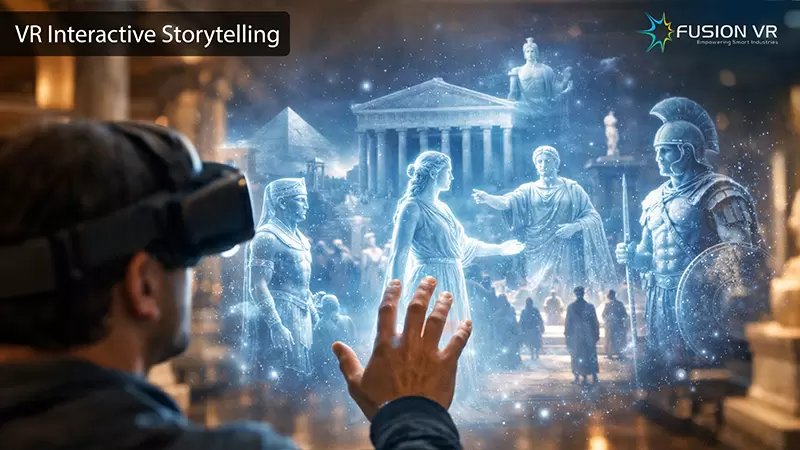
Immersive storytelling emerges through virtual reality which creates new methods of storytelling. The VR museum experience allows stories to develop through three-dimensional space. Visitors can walk through ancient cities, witness historical moments as they happen, or explore environments that no longer exist. Time becomes a path to travel through while space becomes a medium for visual expression.
AI integration with VR platforms brings about new possibilities for storytelling development. Storytelling no longer depends on fixed narratives which remain unchanging throughout the presentation. The narratives develop into dynamic systems which track visitor movements and their inquiries and their emotional responses. The story advances through real-time modifications which enable visitors to control their experience in ways that standard exhibits fail to provide.
What Makes AI-Enhanced VR Storytelling Different?
Virtual reality storytelling becomes different through artificial intelligence because it brings intelligence into the storytelling process. The system operates without a predetermined script since it tracks visitor movements by recording their visual focus and selected items and time spent and speed of their site exploration.
- AI uses this information to create automatic changes that affect:
- All pathways through the storyline and the details of the story
- All character interactions and dialogue components
- All aspects of the scene, including visual elements and space-related information
- All content complexity and language usage in educational materials
The different storytelling experiences between two visitors result from this system. A student exploring a historical VR experience may receive simplified explanations and guided prompts, while a researcher might unlock deeper layers of context, references, and archival detailall within the same digital environment.
Characters That Think, Speak, and Respond
The most effective application of AI in VR museums enables the development of virtual characters who can think and operate independently. The AI-driven avatars function as interactive virtual personas who demonstrate comprehension of their surroundings and ability to hold conversations. The interactive experience allows users to engage with philosophers and craftsmenand scientists and historical figures who possess the following abilities:
- They can respond to questions which do not have definite answers.
- They can change their explanations according to the knowledge level of the users.
- They provide different responses based on the age and knowledge level of the person asking.
- The system tracks all previous interactions that occurred throughout the visitor’s experience.
The characters enable visitors to exchange verbal content with each other instead of listening to formal presentations. Visitors who come to experience history become actual participants in historical events. The method of storytelling through conversation establishes a deeper emotional bond with the audience while making learning material easier to remember.
Non-Linear Storytelling and Visitor Agency
Virtual reality experiences that use artificial intelligence create interactive experiences which let users select their own story paths. Visitors can choose from different storylines which lead to multiple viewpoints of the same narrative world. A cultural heritage experience allows visitors to:
- See an event through the perspectives of various communities
- Investigate how events in different periods interact with one another
- Create choices which determine the outcome of a historical event
The method maintains the authentic nature of historical events and cultural practices. The method recognizes that stories exist as multiple interconnected parts which people continue to debate. AI guarantees that all potential storylines of the interactive experience maintain their educational value while remaining connected between different paths.
Emotional Intelligence in Museum Storytelling
The most important element of storytelling remains unnoticed because it receives insufficient attention. Museums aim to inspire wonder, empathy, reflection, and understanding but traditional exhibits often fail to create strong emotional impacts.
AI-enhanced VR addresses this by integrating emotional intelligence into storytelling. The system uses AI to analyze visitor behavior and interaction patterns for determining their engagement levels, which leads to system adjustments in their experience. The narrative expands when visitors spend time at specific moments. The story will change its tone and pacing and visual effects when audience members stop paying attention.
Museum storytelling uses emotional responsiveness to create both human-centered experiences and complete storytelling experiences. The system enables individual experiences to create personal connections that transform knowledge into lasting memories that develop into significant understanding.
Making Complex Knowledge Accessible
Museums exhibit difficult material which includes ancient philosophical systems and scientific development and social historical accounts and complex cultural storytelling. AI-enabled virtual reality technology effectively demonstrates complex information while maintaining its original content complexity.
Through adaptive storytelling, AI can:
- The system modifies its explanations according to the visitor’s age and their historical expertise.
- The system utilisescomparisons together with visual elements and simulation tools to make difficult concepts understandable to users.
- The system provides visitors with contextual support when they experience difficulties.
- The system delivers advanced knowledge when users demonstrate increased interest in learning.
This method guarantees that everyone can participate in the program. Visitors with no prior knowledge and experts seeking depth can coexist within the same experience, each receiving content tailored to their needs.
Preserving Intangible Heritage through Story
Human heritage includes intangible elements such as oral traditions and rituals and philosophies and lived experiences which people consider to be essential human heritage. The existing methods of preserving these elements through objects fail to achieve full success.
The AI-powered virtual reality system provides an effective method for digitally archiving traditional narratives and cultural heritage through the preservation of authentic traditional tales and their accompanying ceremonial elements. Through interactive storytelling, visitors can experience traditions as living systems that exist in dynamic environments instead of traditional static descriptions. The use of AI technology enables organizations to maintain their original identity while they develop their content for current viewers and upcoming times.
The approach creates a living heritage because communities actively participate in its development, which maintains its ongoing presence in social life.
Data-Driven Story Evolution
The machine-based storytelling system improves its performance because it learns from previous usage patterns. Museums can analyse anonymised interaction data to understand:
- Which stories engage visitors most
- Where attention drops or curiosity spikes
- How different demographics interact with content this feedback allows museums to refine narratives, improve clarity, and expand popular storylines.
Storytelling develops into an ongoing process which maintains its significance and attracts repeat audiences throughout time.
Ethical and Curatorial Responsibility
With great power comes responsibility. AI-enhanced storytelling needs to follow
strongeditorialprinciples that establish its essential guiding framework. The three requirements of historical accuracy and cultural sensitivity, together with ethical representation, must be maintained without exception.
AI should not create historical changes for entertainment purposes instead it should assist historians in developing deep and respectful as well as thoroughly researched historical narratives. The three elements of AI-based content disclosure, educational goal establishment and human control mechanisms serve as essential components for establishing trustworthiness and credibility.
AI functions as a creative partner when people use it according to their needs because it helps them tell stories better without taking anything away from their original work.
The Future of Museum Storytelling
The museums of the future will use artificial intelligence and virtual reality technology to create interactive educational experiences,which will drive their development. Interactive storytelling functions as an educational method that establishes new ways for people to understand and maintain information while they build connections with others. Future museums will be:
- Story worlds rather than exhibition halls
- Dialogues rather thanone-way conversations
- Personalised journeys rather than standardised tours
AI virtual reality systems enable museums to communicate with modern audiences while preserving the historic value of their collections. The experience transforms storytelling into an interactive emotional journey, which creates lasting memories for visitors who come to the gallery.
Conclusion
The museum experience has undergone a major transformation through interactive storytelling that uses AI-powered virtual reality technology. The combination of intelligence and immersive experiences and empathetic understanding enables museums to transform their informative displays into interactive learning experiences.
The new system allows people to experience stories through active participation which leads to deeper understanding and lasting memories. The museum mission to connect different time periods remains constant yet they now use advanced human technology which includes their capacity to adapt and respond and establish connections with visitors.