Arjun (Safety Training Lead): Let me ask you something which requires your honest answer. How many emergency response drills have you attended where everyone knew it was just a drill and behaved accordingly?
Meera (Disaster Response Coordinator): Almost all of them. The problem exists because people react differently when they perceive a situation to be dangerous. The actual emergency situation triggers different responses from people who know there are no existing risks.
Arjun: Exactly. That’s where our whole conversation about VR safety training started. Traditional classroom sessions together with mock drills and tabletop exercises provide educational benefits. The three methods fail to replicate the intense pressure which emergency situations require on-the-spot decision-making.
Meera: I found myself doubtful about the virtual reality technology when I first encountered it. The virtual reality system appeared to him as yet another advanced technology demonstration. My entire viewpoint changed after we used the system for emergency response training and I watched the case studies about it.
Why Emergency Response Training Needs a Rethink
Arjun: Emergency response teams need to consider dangerous situations which exist in industrial plants and chemical storage facilities and airports and tunnels and power stations. The facilities present extensive difficulties because they contain multiple dangerous elements. Emergency simulations require full facility shutdowns which are impossible to achieve for these operations.
Meera: Reproducing a toxic gas leak or a structural collapse needs to be done because it cannot be done in a safe manner.
Arjun: The solution to the problem exists through VR safety training. The system enables users to recreate extreme hazardous situations which include fires, explosions, chemical spills, and mass casualty events. The system enables users to recreate extreme hazardous situations which include fires explosions chemical spills and mass casualty events without endangering any person or disrupting their work activities.
Meera: The trainees need to experience realistic environments because it helps them learn better. The trainees develop automatic responses when they experience smoke and alarms together with panicked voices and failing systems.
Case Study 1: Industrial Fire Response at a Manufacturing Plant
Meera: Let’s talk about that manufacturing plant case study you know, the one with repeated fire-safety violations?
Arjun: Yes. A big industrial facility contains both high-temperature furnaces and materials that can catch fire. The team showed slow response times during fire drills because they conducted safety training sessions. The people showed a lack of decision-making ability.
Meera: The team decided to use VR fire-response training instead of another PowerPoint presentation.
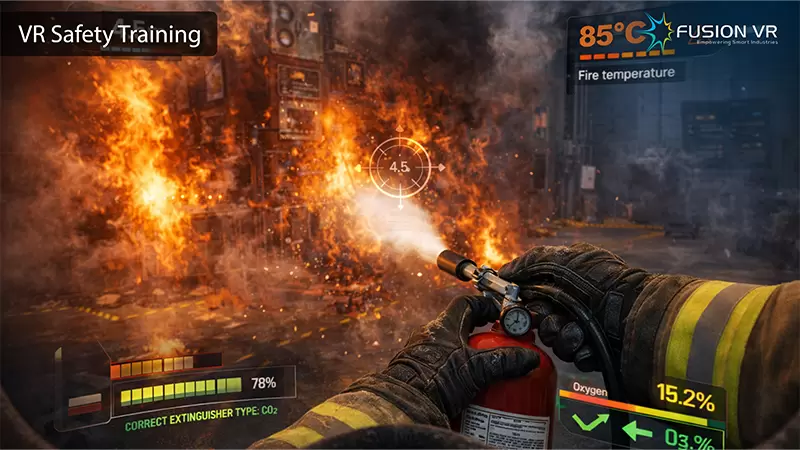
Arjun: Trainees used a virtual reality system which created a complete replica of their training facility including its machines and emergency exits and dangerous areas. The training simulation started when a furnace malfunction occurred which caused a localized fire to spread throughout the area.
Meera: I found the simulation to be both impactful through its adaptive system. The fire became more dangerous when a trainee selected an incorrect extinguisher or took too much time to leave the area.
Arjun: The results of their actions became apparent to everyone within the first moment of their actions. The team achieved a 40% decrease in response times after completing two training cycles. The trainees established better communication skills through their ability to deliver specific orders while they worked to protect important areas and they decided which tasks needed immediate attention.
Meera: What’s different about VR is that it makes the rules second nature.
Case Study 2: Chemical Spill and HazMat Response Training
Meera: Chemical spills create difficult situations because they require special handling procedures. You cannot create a real-life toxic exposure experience through any simulation method which exists today.
Arjun: The introduction of virtual reality technology creates a revolutionary advancement for HazMat response teams. One case study involved a logistics hub handling industrial chemicals. The emergency team possessed theoretical knowledge yet their practical experience remained insufficient.
Meera: The virtual reality scenario demonstrated a hazardous situation that occurred when a container leaked invisible, poisonous gases.
Arjun: The trainees needed to identify the substance used in the simulation to determine the wind direction while they established hot and cold zones and selected appropriate personal protective equipment before they performed containment procedures under time constraints.
Meera: The system error tracking system, which I found most appealing to me. The virtual exposure happened when PPE was worn incorrectly or when people skipped their required protocols.
Arjun: The team evaluated mistakes through performance analytics after they occurred. The team studied all decisions as a group instead of holding specific people responsible for their choices.
Meera: Even though their real-world response audits showed fewer procedural gaps after multiple VR sessions, they didn’t have any proof as to why.
Case Study 3: Urban Search and Rescue after Structural Collapse
Arjun: Urban search and rescue operations represent their most difficult training challenge because each building collapse presents unique challenges.
Meera: The case study demonstrated an intense simulation of a building collapse that occurred after an earthquake. The VR environment simulated unstable wreckage that trapped victims, aftershocks and restricted visibility.
Arjun: The trainees needed to make immediate decisions about their entry points and structure stabilisation methods, and their retreat times.
Meera: The most surprising aspect of virtual reality to me was how it revealed people who could not communicate effectively with each other. Some teams focused too much on speed and ignored safety signals.
Arjun: The simulation operated according to its programmed rules. The system reported secondary collapses which happened because workers did not follow safety protocols.
Meera: The training program completed its goal because teams achieved better performance through improved intelligence. The students acquired skills in self-control and teamwork and understanding their surroundings.
Case Study 4: Emergency Medical Response in Mass Casualty Events
Meera: Emergency medical teams face a different kind of pressure human chaos.
Arjun: Exactly. The VR case study demonstrated a mass casualty incident which took place at a public venue. The scene included multiple injured victims and histrionic bystanders and there existed only limited resources.
Meera: Priority decisions became the core challenge.
Arjun: The VR system required trainees to deliver medical treatment according to patient emergency situations instead of their personal feelings. The medical staff spent excessive time treating one patient which resulted in their other patients experiencing health decline.
Meera: The classroom environment fails to provide effective teaching methods for that particular knowledge.
Arjun: Post-training feedback showed increased confidence among responders. The participants reported feeling better prepared for emotional challenges and technical matters.
What Makes VR Safety Training Effective for Emergency Teams?
Meera: The case studies reveal specific patterns that are present throughout their research.
Arjun: I will make a guess about the three elements that you mentioned before.
Meera: Exactly. VR technology enables trainees to experience emergency situations because it immerses them in actual emergencies. Scenarios can be replayed until responses become second nature through their multiple repetitions. The system requires instant operational results which will help users learn the correct way to behave.
Arjun: And let’s not forget data. VR training produces comprehensive performance data which includes reaction times and decision paths and compliance levels.
Meera: Training then becomes evidence-based as shown, which is not return to assumption-based evidence of the unreliability of its truth.
The Human Side of VR Training
Arjun: People tend to forget about the psychological effects which they should consider.
Meera: The emergency response system requires both physical abilities and mental strength.
Arjun: VR provides trainees with a safe space to face their deepest fears. The way people respond to stress develops into a stable pattern after a certain period.
Meera: I have observed that responders who initially experienced a freeze response during their first VR training sessions developed a state of calmness and decision-making ability by the program’s conclusion.
Arjun: Yes this change only justifies the expenditure.
Integrating VR into Emergency Response Programs
Meera: Virtual reality technology exists to improve existing training methods instead of replacing them.
Arjun: The most effective training programs combine three components which include classroom instruction and practical field exercises and virtual reality training.
Meera: “VR then serves in scenarios where in real life the training falls short those of high risk, high impact.”
Arjun: “More so because it is scalable; it’s suitable for everyone, ranging from the newcomers to the pros to the ones at the initiative of refresher.”
The Future of Emergency Response Training
Meera: Where do you see this heading in the next few years?
Arjun: The future will develop through realistic world simulations which require multiple users to participate in virtual emergency training together with their complete teams.
Meera: The training process develops both personal skills and system capabilities.
Arjun: Exactly. The systems that exist in the world save lives during times of disaster because they operate independently of individual people.
Final Thoughts
Meera: The case studies show one conclusion which states that preparedness requires organizations to develop practical skills which their staff can use during emergency situations.
Arjun: Virtual reality safety training establishes safe pressure conditions which it can repeat and which it can execute with successful results.
Meera: Emergency response teams use these resources to maintain order during emergencies which helps them save lives.
Arjun: Virtual reality has become mandatory for use because it serves as essential technology in all situations. The system requires