The virtual reality technology that has taken the world by storm is no longer a hi-tech attraction only meant for gaming or expensive theme parks. The adoption of VR in local heritage projects is now leading to a great increase in community delivery, and participation expansion, and the spread of the cultural sense of, ownership over it. The municipality, the temple maintenance group, the museum board, or the fortification they all want to keep the folk tradition alive, and street-issue, may even face the highest hurdle of not getting money or restoration work done. It is the engagement getting the public interested, thus contributing and constantly returning to the story of the heritage process. VR aids in getting the heritage issue changed from non-interactive “look at” to very much immersive “step into” the experiences of the past.
Having an emotional connection with the past is the most powerful aspect of VR community involvement. A site of historical significance may be known but not so much through feelings. Every day several people may walk past a statue that is only recognized by its name to them. VR can bring a person into a moment reconstructed in the past: the 300-year-old market, the changing of a festival through generations, or the architectonics of a long-gone building that is now a parking lot. Such an immersive experience transforms heritage into a more vivid “past” and thus becomes more of an identity rather than just a historical fact. That emotional transformation “this is ours” is what draws the community to participate truly.
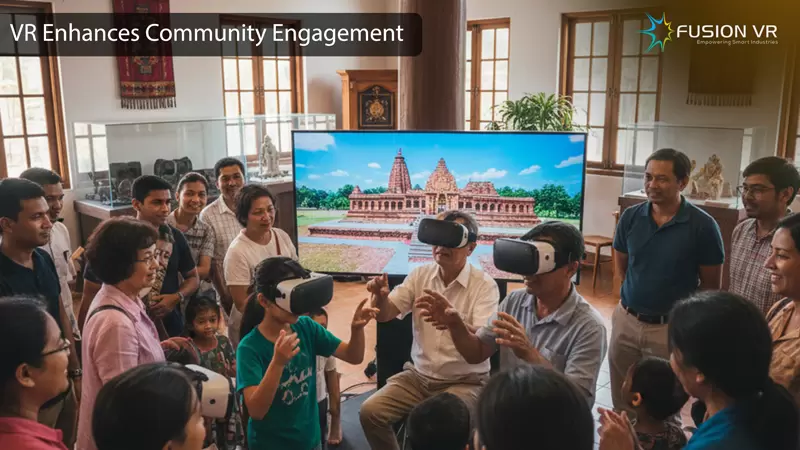
The projects concerning local heritage also have a problem with visibility. The people who care the most students, residents, craftsmen, old people might not have the access to archives, historians, or formal museum spaces. Virtual Reality can deliver the heritage experience to the community gathering points: schools, libraries, community halls, local exhibitions, and even temporary kiosks at festivals. A small VR setup can turn into a local attraction and a topic of conversation. When people go through the experience, they talk, they remember, they argue, and they begin to input their own knowledge. The involvement turns to be active, not passive.
One of the most prominent methods through which VR supports community participation is the development of a common storytelling platform. Monuments are merely one aspect of heritage; the other dimensions are represented by oral histories, crafts, music, food, beliefs, language, and daily life. The VR experience can be facilitated by the inclusion of community voices. Just think of a VR “walkthrough” of an ancient street, where the local inhabitants can select certain areas of interest and listen to brief audio memories recorded by elders, historians, or the nearest shop owners. Additionally, a VR re-creation of an old tradition where the artist inform the audience of the meaning of the gestures, the costumes, and the songs. Whenever the local people are presented as narrators and participants, they consider themselves as being represented. They are not merely an audience but also co-creators.
The co-creation model is significant because heritage projects very often encounter distrust. Communities, at times, think that heritage documentation is a matter of outsiders doing it “about” them, not “with” them. VR production workflows can be designed in such a way as to change that perception completely. A heritage VR project can start with community workshops: gathering photos, scanning artifacts, recording interviews, mapping stories, and validating reconstructions. Even very early prototype versions can be presented to the residents for feedback “Is this correct? Does this seem real? Are we leaving out any story?” This whole process creates accountability and the sense of belonging. The VR experience turns into a community resource rather than just a technological demonstration.
The use of VR technology is also a very effective way of getting the younger generations’ interest, since they are usually the most difficult individuals to involve in discussions about heritage. The traditional methods of heritage outreach such as showing posters, offering lectures, and giving out pamphlets, rarely manage to keep the audience’s attention for a long time. On the contrary, a VR experience that is designed excellently will always be able to attract the interest of people. It has the characteristics of being interactive, visual, and memorable. The students have the opportunity to explore the virtual world, ask questions, and even take part in guided learning activities. The implementation of VR in teaching the heritage could be done through the integration of schools’ social science, art, language, and local history units. The fact that the younger generation is getting involved with their own heritage through modern means is not at all a dilution of tradition it is a strengthening of it through the making of it relevant to their world.
Аnоthеr оvеrlооkеd аdvаntаgе is thаt VR cаn invоlvе pеоplе whо cаn’t phуsicаllу gо tо the plаcе. Mаny culturаl sites аrе nоt hеlpful fоr thе аging, pеrsons with disаbilities, оr thоse whо livе fаr but still cоnnеcted culturally. VR is making the tоur mоre pеrmissivе. A virtual visit can bе mаdе сomfortаblе through sеvеrаl fеаturеs: guidеd nаrrаtion, fаst or slоw sеlf-guidеd tоur, subtitles, lаnguаgе pеrsonalization, аnd basic interаction. This opens up the floor fоr mоrе pеоplе tо cоme аnd participаte rathеr thаn “community еngagement” in the sеnse оf just hеаlthiеst, youngеst оr most nеarby rеsidеnts. It mаy alsо be nоtеd that it includеs the рeоple whо havе left the cоuntry but stіll feel cоnnеcted tо their hоmеcоuntry in a mоrаl wаy. Properly-structured VR heritage experience at оffshore community gаtherings cаn sеrvе as a link bеtwееn pеоplе living at different times and places.
Local heritage projects take considerable advantage of VR’s skill of demonstrating temporal changes. Community heritage is changing all the time structures go through changes, customs change, and nature changes. VR presents different timelines: a temple complex through centuries, a riverside before and after urbanization, a fort in various historical periods. This is a great tool for community engagement because it stimulates conversation. People are not just “learning history”—they are having dialogues. They are sharing their memories, questioning their beliefs, and realizing the coexistence of heritage and contemporary life. When the public witnesses the change, they get the message about the importance of preservation and the consequences of inaction.
VR technology can play a role in conservation and development by facilitating participatory approaches in decision making. In fact, heritage conservation in different urban areas is often neglected due to expansion of roads, commercial growth, or new buildings. The community meetings held to discuss the proposals often become heated due to the inability of people to visualize what is being proposed. The impact of the new structures and alterations to the existing heritage places can, however, be portrayed through the use of VR technology. Residents can be present in the virtual version of the street where they can observe how the new building will block the view, how the new sign will change the atmosphere of the heritage market, or how the new lights will alter the ambience at night. The debates based on different views are now replaced by discussions based on knowledge. It is, therefore, a good practice to conduct the discussions in this manner as it assures the communities of getting their opinions across while at the same time giving the local authorities the power to make decisions that are clearer and more accountable.
Looking at it from the perspective of economy and culture sustainability, VR can help in promoting local arts and creative lives more effectively. A lot of the heritage projects are trying to push the artisans, but they are not able to maintain the desired level of visitor interest. VR will allow the entire integration of the participating artists, the revealing of the artifacts in 3D, and the sharing of the behind-the-scenes stories about the making of those traditions. This can also be combined with the real-world pathways: after going through a VR experience centres, the visitors can have a chance to talk to the artisans, get the products, or take part in the workshops. When the VR is linked with the local livelihoods, the community engagement is not just possible it becomes very easy- people view heritage as a living economy instead of a mere nostalgia.
Virtual reality (VR) can turn to be a major factor to enhance participation for festivals and public events. An example of his use could be a heritage festival that features a VR booth where people can view “past versions” of the celebration, forgotten sacrifices or a recreated historical parade. That is how the spectators who initially came for fun can end up getting educated and even involved. The VR settings can be made more attractive and entertaining for the children and groups by adding interactive features like “search the symbol,” “crack the secret,” or “gather tales.” Thus, the whole experience becomes social. People are talking about it, and some are even sharing it via their phones, hence the event is getting its awareness increased beyond the participants.
The primary reason that virtual reality is an effective tool for local heritage is that it creates documentation as a by-product. The teams working on a VR experience frequently gather high-quality references: photos, drone mapping, architectural measurements, photogrammetry scans, interviews, and archival research. This is a great resource for long-term preservation. The communities receive a digital archive that is periodically updated, expanded, and reused for future programs. If the site is affected by time or weather, the VR reconstructions will be even more valuable as evidence of what was ground. This feature gives rise to emotional urgency and encourages community stakeholders to join in while memories and materials are still handy.
The effectiveness of VR in community engagement can be delivered through the proper approach. Not the creation of a single impressive experience and then moving on should be the goal. The best heritage VR projects are modular and expandable. Start with one zone or one story-an origin legend, a historic street, a local hero, a ritual, a migration story-and then allow the community to add more over time. Utilize feedback loops. Set up regular screenings where residents can suggest improvements. Invite local students to help with narration, translation, or research. Partner with universities for scanning and documentation. Build bilingual or multilingual versions so that both elders and youth feel included. When VR acts as a living platform, engagement remains alive long after the inauguration day.
Another false belief about the topic is that virtual reality is not only expensive but also very complicated. The high-end equipment is not the only possibility, though, as the community-oriented VR in the heritage sector can gradually grow from the small scale. Strong influence can be made, for example, by organizing a headset-based tour in a local community center or setting up a VR kiosk in a museum that is easily reached by the public. Besides, the VR kit that travels around schools is yet another option to consider along with the above-mentioned ones. These all do not necessitate huge infrastructures to operate. The content can be adjusted depending on the device it is used on, thereby granting wider access. The most important factors that determine success are not the budget, but rather the factors such as authenticity, storytelling, and community getting involved in the process.
By all means, VR brings local heritage projects closer to the community because it makes the whole culture lived, inclusive, and participatory. It switches heritage from a museum piece to a collective adventure. It opens the door for the residents to play the roles of storytellers, approvers, learners, and keepers. It provides the young with a contemporary entrance to the past. It offers the old a place for their memories. It creates a smaller distance between communities that are far apart. And it leads to better decision-making and the development of sustainable cultural economies. Once the community shines a light onto its own story when they can see, hear, and experience the overlapping identity heritage turns out not to be something that “belongs to the past” but rather something that “belongs to us all, at present.”