[Scene: A casual coffee chat between two colleagues, Maya and Raghav. Maya has heard of Fusion VR but doesn’t know the details. Raghav works closely with the company and explains in an engaging, storytelling style.]
Maya: Raghav, the company that I keep hearing a lot about whenever someone talks about digital integration with museums, VR training, and other futuristic technology, is called Fusion VR. Do you know about this company?
Raghav: Ah, that’s quite a fascinating topic! Fusion VR isn’t just another IT or animation company. They are an immersive technology company in India based out in Chennai, and are experts in Virtual Reality (VR), Augmented Reality (AR), Mixed Reality (MR), 7DX immersive simulations, and digital twin solutions. Simplifying it further, they assist companies, museums, and other institutions to share stories and train their personnel using technology and in a captivating manner.
Maya: That sounds like a wide spectrum of focus areas. So, do they concentrate more on entertainment, or is it education, or…?
Raghav: That’s the beauty of their focus. They work at the intersection of industries. For now, I would say their priority focus is museums, cultural experiences, and corporate/industrial training. These areas require engagement, precision, and advanced technology. Fusion VR is known for storytelling and immersive engineering.
Maya: Alright, can we break that down? Tell me about the museum part first.
Museums and Cultural Heritage
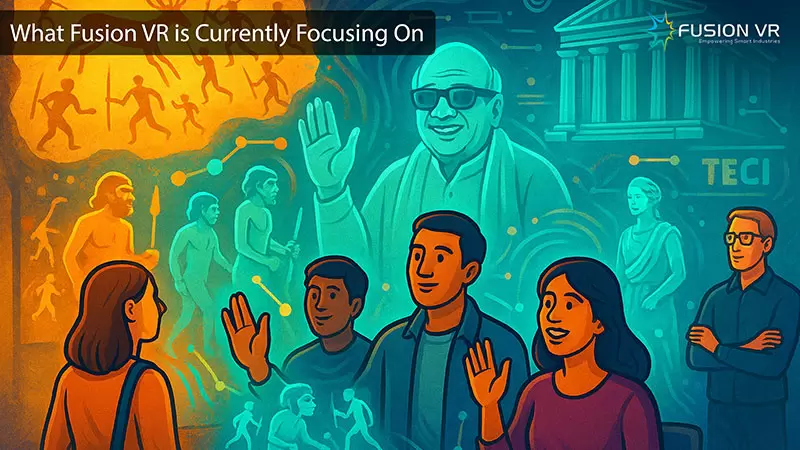
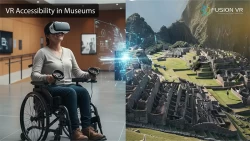
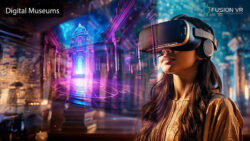
Raghav: Museums appear to be going through a change. Instead of gazing at physical relics, the young seek to immerse themselves in history. The young want the history to be felt, and Fusion VR have been committed to enhancing the immersiveness of museums.
An example of their work is the Kalaignar Express 7DX Simulation. It is a full, train-like structure where visitors partake and enjoy an animated 3D journey through the life of Kalaignar Karunanidhi. Think about entering a train and taking a seat while kies motions mimic real-life movements. As you watch his life story on a 12K resolution stereoscopic display, you are also treated to surround sound, gentle vibrations, scents, and other sensory enhancements. It’s beyond watching a film; it’s an experience.
Maya: That’s a lot to take in! It reminds me of a roller coaster, but with generations of history.
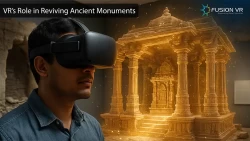
Raghav: And the Ajanta Caves VR Experience, created for the Department of Science & Technology, is a step further. With virtual reality, visitors can explore the caves freely without the risk of harming the actual site. It’s a wonderful way to protect cultural heritage while allowing people to see the intricate craftsmanship up close.
Maya: It’s not just touchscreens now they are actually crafting entire environments for visitors.
Raghav: Exactly. That kind of innovation is the reason they lead in museum tech in India presently.
Corporate & Industrial Training
Maya: Okay, but I want to know more about the corporate training you mentioned earlier.
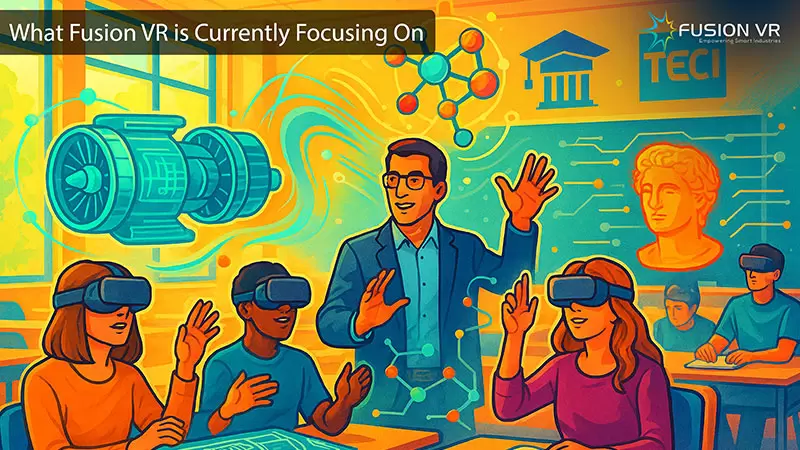
Raghav: Fusion VR is making significant strides in this area as well. Training through VR simulations is becoming widely accepted among companies since it is safer, more cost-effective, and more impactful to train in VR as opposed to the traditional methods.
Imagine employees not having to flip through a guidebook for safety procedures but instead being able to practice a fire drill first-hand through VR. Or employees being trained in a digital twin of the real plant instead of having the actual plant shut down.
Fusion VR creates these bespoke VR training modules for the oil and gas, manufacturing, and engineering sectors. The modules help decrease accidents, improve retention, and build confidence. More importantly, they’ve been offering solutions where trainees can practice as many times as they want without any real-world risks.
Maya: So it’s essentially a flight simulator, but for other industries as well?
Raghav: That’s right! A flight simulator for pilots, a drilling simulator for oil field workers, and a factory simulator for machine operators. Fusion VR focuses on helping companies save money, prevent downtime, and protect their employees, all while enhancing the safety and immersion of the training.
The Type of Company Fusion VR Is
Maya: Understood. Would you classify them as a technology company, a creative agency, or something else entirely?
Raghav: They are a bit of both. From one perspective, they are quite advanced, dealing with Unreal Engine, 3D scanning, motion capture with Captury Live and even multi-projection systems. On the other side, they’re artists and storytellers, shaping stories, visuals, and the ‘feel’ of technology so it touches people.
I would say Fusion VR is what you call an immersive solutions company. Unlike companies that sell just a VR headset or an AR app, Fusion works on comprehensive experiences. They handle everything, from ideation, scripting, and 3D content creation to hardware integration, installation, and support.
Maya: It’s as if a film studio and a tech research facility merged.
Raghav: (Laughs) Very true. It’s the multidisciplinary approach that makes them unique. They’re not an animation studio, but an animation studio. They’re not a tech integrator, but they’re a tech integrator. They fill in the missing piece.
Their Current Focus
Maya: So what are they focusing on at the moment?
Raghav: For the time being, Fusion VR is focusing on:
- Heritage and Interactive Museums: A Fusion VR signature niche. For a while, they’ve had proof of concept VR museums and 3D interactive kiosks. Their AR-based interactive museum guides and dome theater immersive experiences are western India’s best kept secret. Now, major government departments, tourism boards, and cultural institutions want to gamify heritage for the youth, and Fusion VR stands to benefit.
- Corporate & Industrial Training Centers: Numerous corporations have begun using VR-based training to cut costs and improve safety. Fusion VR is additionally engaged in the creation of VR labs, corporate experience centers, and industrial digital twin environments.
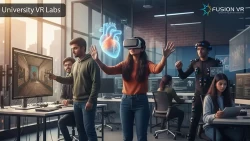
- Academic & Skill Development: Fusion VR is also collaborating with universities through their Industry-Academic Alliance Program, setting up AR/VR labs for the institutions, helping with curriculum design, and even student training. Fusion VR views institutions as partners in the endeavor, as AR/VR competencies are critical and required by the job market.
Maya: In that case, they’re not limiting themselves to chasing new projects. Instead, they’re redefining the way new generations will be educated, trained, and exposed to culture.
Raghav: That’s right, and that’s what makes them unique.
A Few More Projects Worth Mentioning
Maya: I’m wondering along with Kalaignar Express and Ajanta Caves, what other projects catch attention?
Raghav: There’s the “Tales of Ajanta” VR Film, a stereoscopic VR film where multiple users can view and explore the caves in breathtaking detail. Then there is the interactive kiosk for exhibitions that they have done, where the visitors engage with quizzes, explore 3D models, and even navigate through digital galleries.
Maya: It feels like their “visit” is not for a museum, not for a corporate center, and not even for a classroom. It’s something else entirely.
Raghav: I think you captured the essence with these words perfectly.
The Bigger Picture
Maya: If you have to sum up Fusion VR’s mission in one sentence?
Raghav: I’d say its Fusion VR’s desire to make experiences the new mode of learning, storytelling, and engagement. People won’t read, watch, or listen anymore; everything be it history, corporate training, or any form of education will be experienced.
They are one of the leading immersive tech companies in India, but think on a global scale. The industries they focus on museums, corporate training, and academic partnerships attest that they are not targeting just entertainment; they aim for impact culture preservation, life-saving in industries, and student preparation for what’s ahead.
Maya: It’s great to hear that. I want to go see one of their installations now myself.
Raghav: You must! I guarantee you, once you attend one of their VR experiences, you would understand why it is called “immersive.” It is not something that can be explained; it is something that has to be experienced.
Closing Thoughts
Maya: Thank you, Raghav. This session was insightful. Now, I feel prepared to describe Fusion VR to anyone.
Raghav: My pleasure! Just keep in mind: Fusion VR isn’t just a venture it’s a confluence of yesterday and tomorrow, the real world and fantasy, education and experience. At the moment, they’re focusing their know-how on impactful industries.