
Introduction: When Time Fades, VR Revives
If we think about ancient monuments and ruins of once-prosperous cultures, we can visualize such stories of ingenuity, faith, and arts. These had been slowly diluted into fragments by time, weather, wars, and neglect. Enter the world of Virtual Reality (VR), a cutting-edge technology striving not only to conserve heritage but also to revive it. This blog will go into how VR is giving new life to some ancient monuments for viewing, engaging experiences, and emotional interaction, as well as highlight innovations catalyzing this transformation from Fusion VR.
The Power of Virtual Reconstruction
Immersion into Lost Worlds
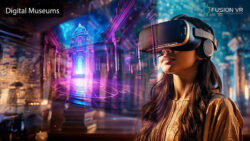
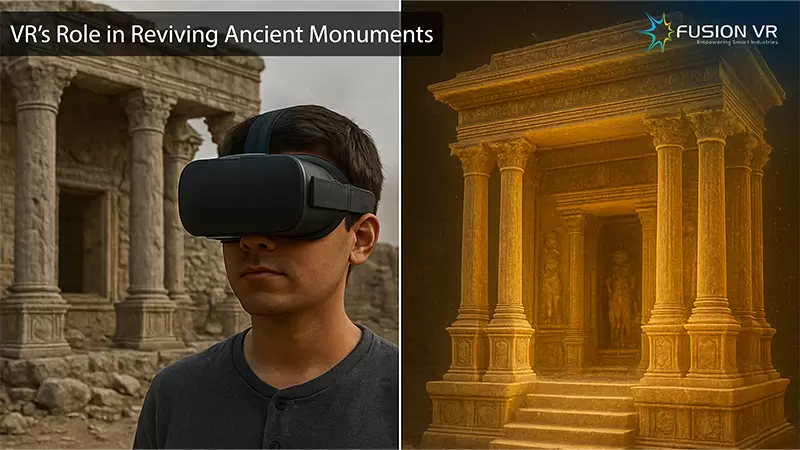
VR takes us beyond photographs and drawings, permitting immersive journeys into reconstructed ancient places. Users may step into the busy temple courtyard, stroll along the crumbling rampart, or witness rituals that no longer exist in complete realism. Thus far, an experience serves to foster emotional bonding and historical understanding, taking static heritage into narratives.
Storytelling from Ruins to Reality
With the traditional approach of historical sites, only silently standing remnants can be viewed by the visitor. Without context reconstruction by VR, temples light up with ceremonies; marketplaces hum with trade; stone walls echo ancient chants. This narrative immersion provides an intense cultural empathy that turns disengaged spectators into active participants.
Democratising Access to Heritage
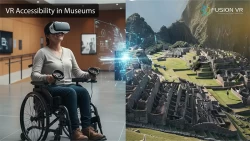
Pouring into one region and shifting into another are delicate artifacts, each potentially limiting access to heritage. Targeted Virtual Reality solutions are scrapping these barriers: now any person-with-any-willful mind, or even mobile devices, will be able to virtually tour the reconstructed ancient wonderlands. This democratization thus encourages global engagement and appreciation in situations wherein one cannot physically travel.
Technologies Making Heritage Reconstruction Possible
Contemporary VR heritage projects leverage advanced technology. Photogrammetry and 3D scanning capture finer details, recording each carving and texture with immense precision. Through state-of-the-art simulation, one attempts to reconstruct an environment while preserving scale and ambient realism. Thus, Fusion VR’s innovations, in stereoscopic 3D, projection mapping, and multisensory design, give these reconstructions a further impetus.
Fusion VR: Indian Innovator in the Heritage-Tech Space
Museum 2.0: Reimagining Exhibits
With Fusion VR at the forefront, a conventional museum becomes Museum 2.0, interactive and immersive experiences, instead of the passive type of gallery it has been known to be. They combine physical artifacts with VR, AR, and multisensory design along with holography and projection mapping to lend to deeper engagement and availability.
Iconic Works: Kalaignar Memorial and Vivekananda Exhibit
- Kalaignar Memorial Digital Museum, which opened in February 2024, pays tribute to the Tamil leader M. Karunanidhi by offering immersive experiences: 3D holography, AR selfie booth, quiz station, an 80-seat cinema hall, and a 7DX Train Simulator featuring 12K stereoscopic visuals to appeal to senses, history, and emotions.
- VR for Swami Vivekananda – With the help of augmented reality experiences and a 4D VR short film called Tears of Vivekananda – Transformation of India, Fusion VR connects the spiritual heritage to modern technology, thereby inspiring new generations.
Museum Experience Centers: Blending Simulation with Gamification
Fusion VR’s Museum Experience Centers fuse industrial-grade 3D simulation with gamified AR content to make learning an adventurous exploration instead of a relatively passive experience. These immersive centers change the paradigm within which visitors interact and are educated.
Future Horizons: Enhanced, Hybrid, and Personalized Experiences
AI and Hybrid Museum Experiences
Fusion VR imagines various hybrid museum formats: a physical setup enhanced by AI-powered VR, MR, and AR. AI guides could apply story lines and narratives in real-time based upon a mixed-reality setup of props through combining physical and virtual story elements. Blockchain could provide secure provenance data, with haptics allowing users to physically touch and feel certain reconstructed artifacts.
Personalization and Multisensory Immersion
Future museum experiences promise to be multisensory combining visuals, sound, touch, motion, and even scent. If AI interfaces are made adaptive to the visitor preferences and languages, memorable heritage journeys will be created for them.
Challenges along the Way
Naturally, VR-based heritage reconstruction comes with its own set of hurdles:
- Costs – Building Virtual Reality experiences is an expensive process, requiring investment in big-time hardware, software, content development, and then its maintenance.
- Authenticity vs. Storytelling – Creativity must not overshadow history.
- Digital Fatigue – The visitor will lose interest if the VR is put forth merely as a gimmick.
Fusion VR contends with these issues through turnkey solutions, through working closely with curators and cultural experts, and through a considerate integration of technology into content and storytelling.
Conclusion: Rebuilding the Past, Inspiring the Future
From ancient murals to virtual palaces, VR has become a crucial bridge between lost heritage and modern audience. Somewhere through innovation and empathy, institutions such as Fusion VR rediscover, speak to, and feel monuments so that the past is dramaturgically felt and not just looked upon.
With the development of VR, AI, and multisensory technology, digital reconstructions will achieve higher levels of accuracy, personality, and emotional appeal. In this transformation, heritage would transcend what it used to imply; it would become an experience to be relived, remembered, and shared across time and space.