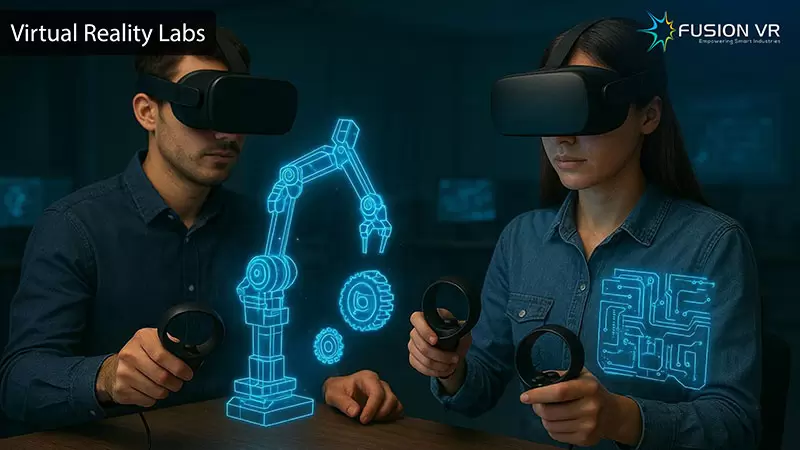
Engineering is all about the future-it is the transformation of imagination into real-world applications. For centuries, engineers have leaned on theory, textbooks, and physical labs to enhance their problem-solving skills. If the world is changing alongside technological advancements, then education needs also to evolve. Presently, the integration of VR labs into engineering curricula is changing the way aspiring engineers learn, thereby bridging the gap between theory and practice like never before.
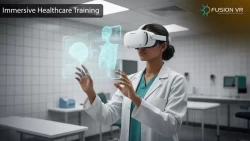
Contrary to common belief, Virtual Reality is not just a plaything; it is, in fact, a great way to learn. VR offers a dynamic and immersive environment where engineering students can experience abstract equations and formulas being transformed into interactive, 3-dimensional experiences. Rather than just working through problems on paper, students can manipulate digital models, run simulations in real-time, and observe the consequences of their decisions all within a safe, inexpensive, and entertaining framework for them.
From Blackboards to Immersive Boards
For many years, engineering has been equated with traditional education, and it has often looked down upon for being too theoretical. Students spend hours upon hours working through complicated equations and sets of problems but then find it hard to correlate these theories with real-life situations. Using physical laboratories goes a long way in bridging this gap, but they also have drawbacks such as equipment costs, safety concerns, space constraints, and the nature of most setups that do not mirror modern industry standards.
In such a situation, VR labs have created possibilities of another nature. Imagine a civil engineering student walking down a simulated construction site and testing bridge designs against simulated earthquakes. Or a mechanical engineering student working on a digital turbine that allows him to dismantle and reassemble every part without the fear of loss or expense. These kinds of experiences retain theoretical knowledge through hands-on practice that is hard to forget.
Bridging the Gap between Theory and Practice
Certainly, the VR lab’s key advantage lies in imparting experiential learning. Concepts of fluid dynamics are very challenging for students to visualize. In VR, the student may actually walk inside a pipeline, see how fluids behave, and change variables such as pressure and temperature to immediately notice changes.
The same is true for electrical engineering students as they can safely test circuits in a fully interactive environment. Instead of waiting for a slot in the lab or worrying about short circuits, students could try connections, measure outputs, and learn what happens when things are done incorrectly. Being able to fail, experiment, and try again in a risk-free environment strengthens one’s understanding and increases confidence.
Safe and Cost-Effective Learning
Cost stands as one major hurdle in the road to practical engineering education. Equipping labs with machinery, securing safety standards, and allowing accessibility to all students often put a big strain on budgets. VR labs solve these problems.
With VR-by-headsets, the software platform can simulate an equipment worth a million dollars or, maybe, a large infrastructure project. Aerospace students can step into a jet engine, whereas chemical engineering students can simulate molecular-level reactions. These experiences would be safer than allowing a teenager to touch a real one, not to mention much cheaper and more scalable than the real ones.
On the other hand, VR labs give access to people. Whether your student enrolls from a big urban university or an engineering college in some sleepy countryside somewhere, VR training will level the playing field so every learner gets the top-end lab experience.
Enhancing Engagement and Motivation
Another important challenge of theoretical education involves disengagement. Some students find it difficult to stay motivated when the concepts seem either empty or on the theoretical level of abstraction. Virtual reality adds excitement as something tangible to the whole learning process.
It is in immersive experiences that curiosity gets instilled. A student of structural engineering who can virtually put a material through the testing process under stress conditions sees the direct results, thereby creating interest in materials under stress. In much the same way, VR-based gamification, with challenges, real-time feedback, and progress tracking, helps stimulate learners to go beyond textbooks, embracing exploration.
This switch from passive to active mode of learning increases retention capacities. Research proves again and again that learners retain information longer and can transfer it more effectively to real-life situations when they are engaged in activities of interaction and experience.
Preparing Engineers for Industry 4.0
Industries today demand more than just learning of academics. With the advent of Industry 4.0, the engineer has to reach digital tools, simulations, and advanced technologies. Thus, VR labs train students for such realities.
For example, digital twins are gaining major acceptance among manufacturing companies for the purposes of monitoring and optimization of machinery and processes, respectively. By operating in VR labs, fellow students get hands-on experience with these digital tools; thus, students are made industry-ready on day one.
With collaboration being the core principle of engineering nowadays, VR labs allow for multiple students to enter the same virtual environment and work on projects together regardless of where they are physically located. This is how teams across the globe collaboratively engineer solutions in real life-a removal of geographical boundaries to foster teamwork.
Case Studies of VR in Engineering Education
1. Civil Engineering-Virtual Constructions Sites
Various universities worldwide have introduced VR modules for students to design, test, and modify construction projects. They have the option of simulating weather effects, load-bearing capacities, and even logistics at the site. This offers them a perspective that goes beyond what a traditional classroom can provide.
2. Mechanical Engineering-Virtual Prototyping
Mechanical engineering students usually find themselves being limited in prototyping due to cost. With a VR lab, they can create, modify, and test designs in real-time, thereby mitigating the need for physical models and stimulating creativity.
3. Electrical and Electronics-Circuit Simulation
Instead of getting into shortages of lab equipment or short circuits, the students can attempt millions of circuit variations in VR. This allows for iterative experimentation that reinforces mastery of concepts such as resistance, flow of current, and voltage distribution.
4. Chemical Engineering-Process Visualization
Chemical reactions are many times hidden from the naked eye. With the setup of VR, a student shall view molecular interactions, investigate safety protocols in a virtual environment, and experiment with hazardous scenarios with no danger.
Building Critical Soft Skills
More than mere technical knowledge, VR labs foster vital soft skills that are necessary for engineers.
- Problem-Solving: Immersive environments foster trial, analysis, and improvement.
- Teamwork: Multi-user VR labs replicate collaborative projects of the real world.
- Communication: Students explain ideas and results to their peers inside the VR environment, practicing how to articulate technical concepts.
- Adaptability: Exposure to quickly evolving virtual scenarios instills flexibility and resilience qualities essential for modern-day industries
Challenges and the Road Ahead
While very promising and feasible, VR labs do come with their own share of issues. Setting up the VR labs entails hardware and software spending. The educators also have to be imparted with the knowledge of properly integrating these tools into their curricula. Another hindrance to adoption is that since we’ve been resisting change, in some instances glitches in the technology arise, and sometimes regions find it hard to access it.
These challenges have to be temporaries. The adoption curve will begin rising sharply when the hardware gets cheaper, and VR platforms become highly user-friendly. The great end benefit of having engineers who are industry-ready and innovative surely outweighs those transitional agonies.
The Future of Engineering Education
VR labs stand poised to becoming standard in engineering education. As more developments occur in technology, more mature applications integrating Artificial Intelligence, Augmented Reality, and Mixed Reality into immersive ecosystems will be available.
Future VR labs might allow students to design and test smart cities, explore nanotechnology at a molecular scale, or co-create global engineering projects with fellow students, in real-time. These advancements would not just change engineering education but would also foster faster innovation in industries.
Conclusion
The engineers of tomorrow will not just inherit theoretical knowledge but also the ability to apply it, experiment with it, and innovate with it. VR labs are an interface between theory and practice that converts theory from an abstract concept into hands-on training. By way of immersion, security, and engagement, VR ensures that the soon-to-be engineers will be well-equipped to begin their careers and inspired to push the limits of what has been thought possible.
At the intersection of education and technology, one thing is crystal clear: The classroom of the future will no longer be the four walls. It will be an immersive, interactive one with VR. Now, from the standpoint of engineering students, it means entering into a world where equations come to life, theories are turned into tools, and learning becomes an unforgettable expedition into building tomorrow.