
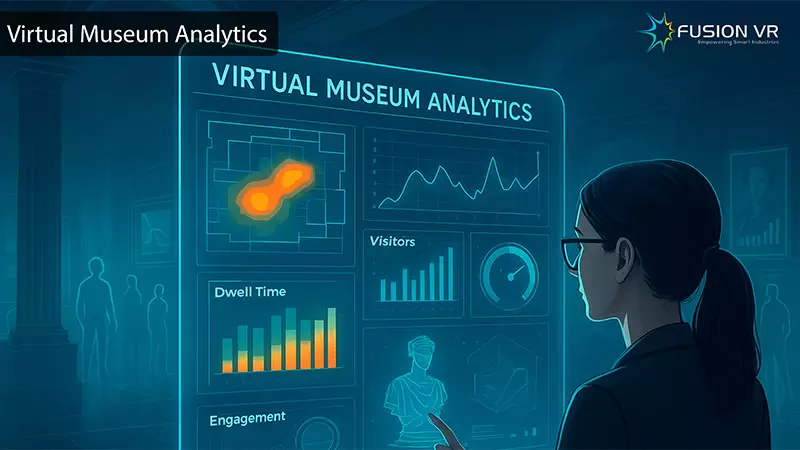
Over the past decade, the focus has shifted entirely. Museums worldwide saw a metamorphosis. They used to be restricted to physical galleries, artifacts behind glass cases, and traditional headcounts as the measure of success. As virtual museums, AR/VR experiences, and interactive exhibitions gain momentum, we’ve seen a complete change in how visitor engagement is defined and measured. In the new age, analytics is the big data tool used to measure how much people interact with content, how much they engage with culture, and how museums can facilitate the formation of meaningful connections beyond the confines of their physical spaces.
The most common and basic metrics that traditional museums always relied on to determine success were ticket sales, the flow of visitors, and dwell time in the gallery. While these numbers provided a general indication of an exhibit’s interest, they often failed to articulate an emotional bond or learning outcomes on the visitor’s side. For example, a visitor may stand in front of a painting for 15 minutes, but what did they take away from that experience? Did they understand the historical context behind the painting? Did the exhibition provoke any curiosity, desire for understanding, or amazement? These questions usually remain unanswered due to the lack of richer information.
With virtual museums or digital exhibitions, one can go much beyond such limitations. Using technologies in museums such as VR, AR, AI, and immersive experience platforms, institutions are able to get very precise data on how visitors search, interact with, respond to cultural content, and experience it. This is a paradigm shift in the measurement of success-extension from a mere numeric evaluation to the consideration of quality and impact of engagement.
One of the most exciting aspects with analytics in the VR museum is the ability to capture a visitor’s behavior at micro-levels. Observations on physical spaces would have to depend on visual cues or sometimes surveys; however, a digital museum can track navigation paths, gaze duration, hand gestures, interactions with 3D models and even emotions if combined with tools doing biometric sentiment analysis. For example: A visitor might be spending a lot of time with this 3D interactive artifact, zooming into details and replaying an audiovisual experience all those gestures narrate a far deeper curiosity than mere entry counts ever could.
Engagement at virtual museums can also be seen from the social interaction of visitors. Nowadays, many AR VR museum platforms support multi-user experiences where participants can join guided tours, socialize, or cooperate in shared tasks such as solving a historical puzzle. From the analytics institution ware would gain insight into the time people spent, how they communicated, collaborated, and explored heritage together. This collective behavior would highlight the building of communities and the social relevance of cultural experiences.
Another area where analytics go beyond tradition is personalization. Content in virtual environments can be adapted to a visitor’s preferences, language, age group, or level of expertise. If a platform has more than one pathway one can take to explore it, analytics can show which paths the majority take, how different demographics respond to the stories, and whether interaction design facilitates memorization. This, in turn, allows curators and designers to forge experiences such that these are inclusive and accessible to a wide range of demography.
When the analytics of virtual museums truly reach fruition, there is a clear relationship established between engagement and impact. With current museum technology, one really could have evaluation tools that can track the visitor retention of knowledge from this experience, the feeling or spark of interest imparted to the visitor, or, even the visitor’s creative output generated by this experience. For instance, after one goes through a VR reconstruction inside some ancient city, s/he might be asked some reflective questions, randomly supply an answer in a poll, or create digital art together on the grounds of interpretation. These can serve as hard data points, which is miles ahead of what traditional footfall reports can demonstrate in terms of cultural and educational value.
The corporate experience centers with similar immersive technology are yet another example showing analytics that go beyond traditional metrics. The intention there is not just to present history or culture but to create corporate narratives, feed innovation, and encourage stakeholder engagement. Applying the same analytic tools as used in the digital museums, the organizations can tell the degree to which the story of the potential partners engages with the partner; the particular aspects of the experience that changes partners on a lasting level; and these experiences translate into tangible business outcomes.
In addition, there is a significant point to consider with regard to the fact that the analytic framework within VR experience centers does not exist only to benefit the institution. Visitors may have enhanced experiences through analytics-based personalization. Capturing a visitor’s footsteps through the digital museum might throw in recommendations for related exhibits, tips, or learning resources or options to unlock new layers of content congruent with the visitor’s individual curiosity. A static museum visit, by virtue of these adaptive capabilities, will soon become an ever-evolving learning experience, as one enhances interaction with gaining richness.
At the very least, the emergence of such analytics also raises legitimate concerns pertaining to ethics, privacy, and inclusion. Data collection on key parameters like deposit visitor behavior must necessarily be conducted with full disclosure and consent. The museums must ensure that analytics are not misused for mere commercial purposes but that their focus remains to achieve the ideals of cultural enrichment. On the other hand, when analytics are properly managed, they stand to enrich museums towards a better understanding of their audiences and aid in democratizing access to cultural knowledge, thus ensuring that learning remains inclusive, dignifying, and inspiring.
The future of virtual museum analytics becomes even more exciting when one brings AI and predictive models into play. AI can now address and predict what visitors may want, help optimize exhibition layouts, and even simulate the effects of a change in design on visitor engagement. Imagine a VR exhibition in a museum that managed to adapt in the moment; midway into the exhibition, data indicated loss of interest by visitors, and the system could respond by injecting more interactive activities or shortening narrative sequences to recapture attention. Adaptive systems like this would not only keep engagement levels high but would also make the cultural affairs fun and memorable.
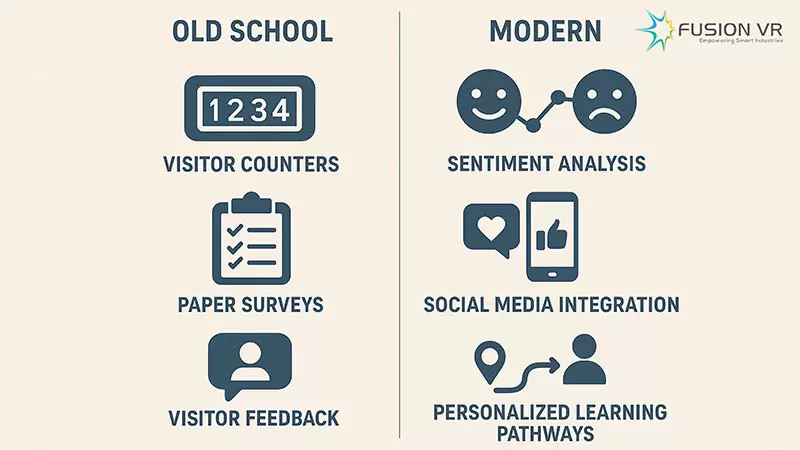
In another way, analyzers maximize reach. Traditional museums are spaces limited to a geographic location, and their metrics concerning visitor patterns intersect with local resident demography. The virtual nature of a museum eliminates such limitations, thus paving the way for a global audience. The analytics then unveil interesting cross-cultural insights in terms of how visitors interpret the same exhibit from varying cultural perspectives, which themes have universal resonance, and which ones need to be further contextualized. This would give museums the positioning of being educators and cultural ambassadors for the world, thereby helping the process of creating shared digital heritage.
Cross-sector collaboration is another excellent incubator of opportunity. Universities, cultural institutions, and corporate experience centers can pool their analytic methodologies to reveal phenomena that could ordinarily escape detection. Suppose the data shows that interacting with 3D museum experiences enhances knowledge retention significantly among students. In that case, educators are in a good position to develop curricula around these tools. Or, say analytics show that virtual museums stimulate repeated engagement among younger audiences: in that case, cultural policymakers can funnel more investment into digital heritage initiatives, guaranteeing that cultural engagement retains its childhood among the future generations.
The advantages of virtual museum analytics extend beyond cultural enrichment to economic implications. Funding bodies, government agencies, and sponsors have begun demanding performance metrics to justify further investments. Visitor counts alone do not suffice in this data-driven world. More detailed analytics into engagement cannot only justify that many people visited but also that there is deep engagement. The ability to demonstrate return on investment in cultural projects by virtual museum analytics would therefore serve another role in sustainability-that of keeping museum immersive technology supported and progressing.
By interrogating engagement in virtual museums, we seek to shift the focus from quantity to quality. Inquiries are posed not only on how many people visited but also what the visitors gained, what feelings they left with, and how much lasting more impact was done through the experience. Agent-based virtual museum analytics represents an immense opportunity for cultural institutions to align themselves with the very intent of museums: to inspire, to instruct, and to join humanity across time and space.
As the AR VR museum platforms have been growing and immersive experiences become the norm rather than the exception, analytics will provide a guiding compass. It will help institutions refine content to build more inclusive experiences while making sure digital heritage is preserved and lived by audiences in real-time across the globe. For visitors, this means stepping into true museum experiences that become more personal, more engaging, and more transformative; for museums, this means the ability to communicate what truly matters-beyond traditional visitor metrics-building those truly meaningful connections.