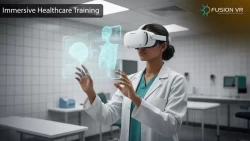
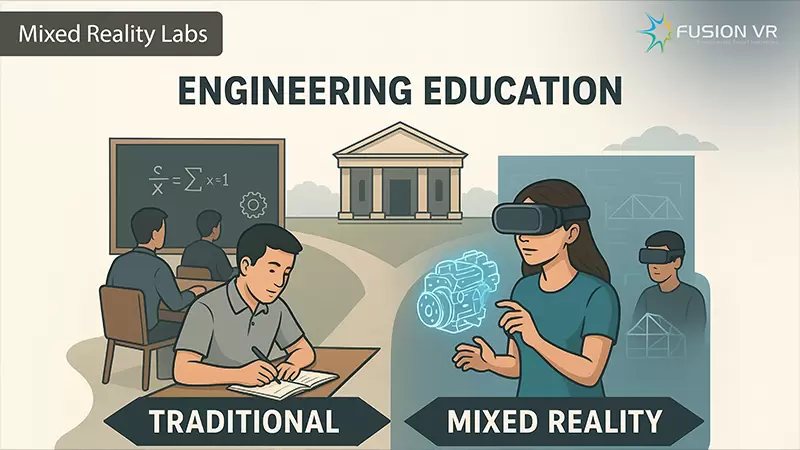
Being at crossroads, engineering education faces situations in which the technological advances in very fast times require from institutions the necessity to educate students for jobs that call for not just theoretical background but practical, interdisciplinary, and technology-based approaches in problem solving. Mixed Reality (MR) technologies booming with elements of both AR and VR have ushered an entirely new spectrum in higher education, offering distance-immersive, highly interactive, context-specific learning experiences far beyond the capabilities of traditional education.
However big or important the deployment of a Mixed Reality Lab within an engineering institution, it is not just about buying the headsets and installing a software package; it needs a well-laid-out roadmap that incorporates all factors ranging from educational objectives to infrastructural planning, technology selection, curriculum integration, and faculty preparedness, to long-term sustainability. The steps from the outset to finish are depicted in this blog about MR in education.
1.Understanding the Role of Mixed Reality or MR in Engineering Education
Before deployment, it is of utmost importance to first define the role of MR within the given academic context. In engineering, for instance, MR can:
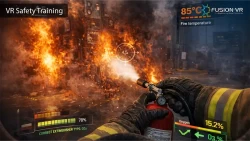
- Simulate dangerous environments for the purpose of experimentation (e.g., chemical plants, power grids, structural tests).
- Provide real-time 3D representations of complex ideas such as fluid dynamics, electromagnetic fields, or mechanical stress patterns.
- Serve as collaborative virtual spaces within which students from different disciplinary and geographic backgrounds can interact with mutual models.
- Help determine design intent and development decisions-one step ahead of physical production-without any wastage of material, thereby promoting sustainable engineering.
In this way, the intended educational alignment will highlight that the MR lab is much more than an expensive novelty; it is, in fact, an essential learning tool for integrated curricular design.
2. Setting Clear Educational Objectives
- A successful MR lab starts with clearly articulated goals. Institutions must ask:
- What specific learning outcomes will MR support?
- Which engineering disciplines will benefit most initially civil, mechanical, electrical, or multi-disciplinary?
- How will MR integrate into existing coursework, labs, and research projects?
For instance, the civil engineering department could use MR for simulating structural integrity, while the mechanical engineering department could use it for thermodynamic analysis and actual manufacturing processes training. The clearer the objectives are, the easier it becomes to justify investments, secure funding, and measure outcomes.
3. Infrastructure Planning and Space Design
Physical planning is crucial. An MR facility would have to be designed with the following in mind:
- Spatial Requirements: Providing enough free space for movement in an immersive VR scenario and aisle space for seating arrangements in AR or desktop-based simulation.
- Safety Measures: Flooring and cable management systems must be sturdy enough to prevent accidents during immersive sessions.
- Connectivity: High-bandwidth wired and wireless networks for large data transfers and so multi-user experiences can be facilitated.
- Environmental Considerations: Light should be controlled such that it does not glare on the AR headset and should improve the accuracy of the sensor tracking of the VR.
With good infrastructure, building-scale expansions can be made as MR utilization grows.
4. Choosing the Right MR Hardware and Software
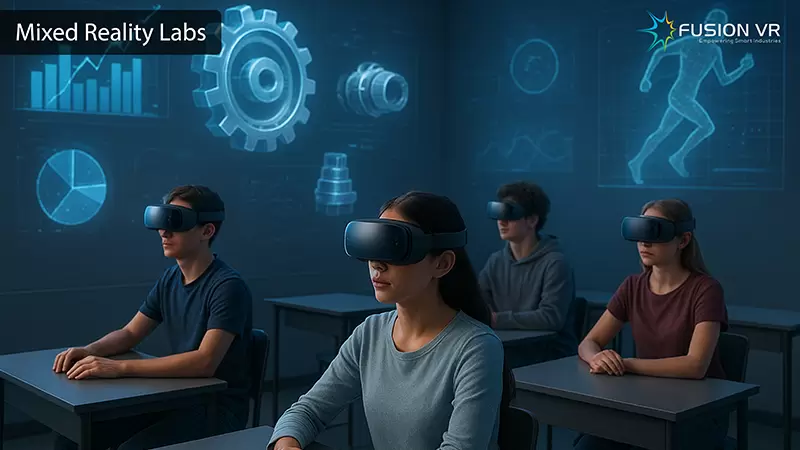
Choosing the right tools for a BE course is one of the most challenging but important steps. Institutions must foster performance, ease of use, and cost.
Hardware Considerations:
- Head Mounted Displays: The options stretch from the high-end ones like the Varjo XR series for hitting the road with photorealism, to the more affordable ones such as the Meta Quest Pro, allowing for deployment flexibility.
- Motion tracking systems: Depending on the concrete applications considered, inside-out tracking (built inside the HMD) can enforce precision, or the engineering simulation needs external support for more accurate tracking.
- Workstations & Servers: MR requires a powerful GPU, having one with large RAM capacity and good processing speed to perform complex simulation tasks.
- Peripherals: Haptic gloves, motion controllers, and spatial scanners can improve realism and interaction.
Software Considerations:
- Industry-standard platforms like Unity or Unreal Engine for content development.
- Simulation software integrations in the engineering domain-an ANSYS, MATLAB, or a Solidworks plugin for MR.
- Cloud-based collaboration tools for remote MR access.
Choosing flexible, scalable solutions ensures longevity and future-proofing.
5. Content Development and Curriculum Integration
An experiment without the appropriate contextual background behind it will quickly lose student engagement. Content development can move down one of three avenues:
- Off-the-Shelf MR Applications: Mainly suitable for introductory experiences and very quick deployment.
- Custom-Built Simulations: Generally keyed towards the particular curriculum of the engineering school, built in collaboration from industry or utilizing in-house capability.
- Hybrid Models: Both purchased applications and custom modules could be used in this case.
For curriculum integration is MR activities need to complement lectures, labs, and projects, not be simply options for students to pick from. As an example, an earthquake-resistant design lecture in structural engineering might be followed by an MR simulation in which students test virtual structures under seismic conditions.
6. Faculty Training and Change Management
The most sophisticated MR lab can underperform if the faculty feels uncertain about utilizing the lab. Institutions should consider conducting:
- Hands-on Workshops: Enabling educators to try MR themselves.
- Instructional Design Support: Enabling faculty to convert their current curricula to MR-delivered curricula.
- Ongoing Peer Learning: Faculty champions mentor their peers; and share best practices.
- Industry Collaboration: Partnering with MR solution providers to maintain skills and refresh technologies.
Change management will be especially crucial as MR solutions may initially be perceived as an impediment or too complicated. Proving that they are effective in stimulating student engagement and making comprehension easier will only speed up adoption.
7. Funding and Stakeholder Engagement
The deployment of a Mixed Reality laboratory would incur a very high initial cost. A few suggestions for funding may include:
- Internal Funding: Could be made available under part of the institution’s budget for technology upgrades.
- External Grants: Educational innovation grants from government or private sources.
- Industry Partners: Engineering firms to whom the research output and talent development may be of value.
- Alumni Donations: Could be engineered by convincing alumni that MR could augment the prestige of the institution.
If stakeholders are engaged from the early stages, they will then muster support for initial setup and long-term maintenance.
8. Pilot Projects and Phased Implementation
Instead of a full MR lab, institutions should attempt to stagger the introduction of MR:
- Select one or two courses for initial integration.
- Record the data on student performance, engagement, and feedback.
- Solve technical or instructional issues in the early stages.
- Apply it to other courses and departments as it matures.
Phased implementation helps contain costs, minimizes risk, and allows faculty and technical staff to build their skills incrementally.
9. Measuring Impact and Continuous Improvement
Evaluation is vital to demonstrate return on investment and for making further improvements. Metrics could consist of:
- Student performance improvements compared to traditional methods.
- An increased retention of complex engineering concepts.
- Collaboration skills and interdisciplinary learning Maturity.
- Levels of satisfaction of students and faculty.
A feedback loop for suggested improvements should exist from educators, students, and industry partners to ensure the MR lab stays relevant and impactful.
10. Ensuring Long-Term Sustainability
A properly launched MR lab is never a fast-and-dirty, one-time deployment. It is instead a continuously evolving facility with strategies for sustainability encompassing:
- Regular Hardware Upgrades: Planning for 3–5 years equipment refresh cycles.
- Content Updates: Keeping simulator-current with industry practice and technology changes.
- Technical Support: Having in-house or contracted expertise for troubleshooting and optimization.
- Research Integration: Using the lab for funded research projects which could generate revenue and new content.
When embedded within the long-term strategic plan of the institution, the lab can thus emerge as a permanent and expanding resource.
The Future of Mixed Reality in Engineering Education
Under the gross trend of making education more experiential, many educators today feel that there is a great space for Mixed Reality to create a new generation of engineers. In addition, with digital twin adoption in industries worldwide and along with this comes immersive prototyping and remote collaboration, workers graduating from MR environments will have a distinct time.
The roadmap spanning needs assessment, infrastructure design, technology selection, curriculum integration, faculty readiness, and long-term planning lends an immensely strategic challenge for any institution wishing to transform engineering education.
In the near future, MR labs will have to be considered equally important by engineering faculties as workshops and CAD labs are today. Institutions acting now will not only uplift their courses but also establish themselves in innovation so as to nurture an entirely new generation of engineers capable of designing, building, and solving in both realms: physical and digital.