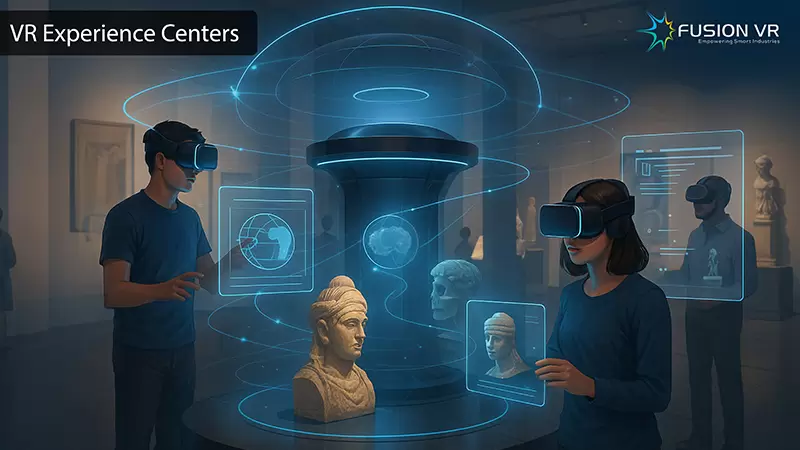
With the modern world increasingly aware of environmental hazards posed by conventional industries, even cultural institutions such as museums are being digitized for the sustainable way. Museums are no longer merely conserving heritage and history; they are also figuring out what that conservation means in terms of distance, virtuality, and responsibility. At the very core of this transition lies Virtual Reality, a truly transformative technology that helps museums reduce their physical footprint and provide a better visitor experience.
Given the rising operational costs, scavenging-for-environment and increased demands and expectations from digitally native visitors, institutions are looking out for an alternative way to preserve their existence. Sustainable museums offer a cocktail of immersive storytelling and green consciousness in which VR is ushering this evolution. Museums are breaking down the barriers to engagement with VR experiences and interactive exhibitions that facilitate vibrant, memorable learning while reducing carbon footprint, energy consumption, and physical infrastructure expansion.
Physical Footprint vs. Digital Presence
Traditional museums require large plots of land, a climate-controlled environment for preserving objects, massive amounts of energy, and a lot of materials for setting up, renovation, and rotating exhibits. Because of these requirements in the physical world, they almost always contribute greatly to carbon emissions, not to mention the time and materials required to transport exhibits, to ship priceless objects, and to set up temporary displays.
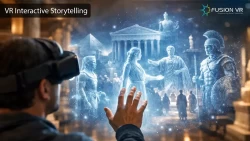
VR comes as a fancy scalable solution. A museum could have virtual galleries and an immersive walk-through without scaling the physical galleries. A virtual museum can host thousands of exhibits without any additional land or energy use. All the visitor needs is a VR headset to be transported to ancient civilizations, underwater to discover shipwrecks, or to witness rare events all from a single digital platform.
Such decrements in material usage will include far fewer materials for physical props, printed signage, lighting, HVAC control, and many more systems, thus drastically cutting down on the carbon footprint of updating and maintaining a physical museum infrastructure. What once could fill warehouses with artifacts and gallons of construction materials can now sit on a server.
Remote Accessibility and Reduced Travel
Every time a visitor drives or flies to a museum, there’s a carbon cost involved. International exhibitions, in particular, often involve shipping fragile artifacts across continents—raising concerns not only about conservation and security but also about carbon footprints and environmental damage.
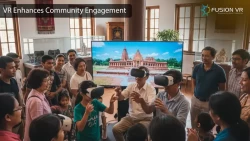
With VR museums, these logistical challenges vanish. Virtual reality eliminates the need for physical travel by offering compelling digital experiences from anywhere. Students in rural India, history lovers in remote Arctic towns, or curious learners in dense urban spaces can access interactive museums from their homes or local experience centers. This global reach significantly reduces greenhouse gas emissions from transportation, contributing to more sustainable visitor engagement.
Incorporating virtual reality into corporate experience centers and educational institutions further amplifies this benefit. Instead of organizing costly and carbon-heavy field trips, institutions can bring the museum experience directly to classrooms and boardrooms through VR.
Digitally Preserving Fragile Artifacts
Certain artifact of history are so fragile that they cannot be transported, touched, or exposed to public view for a long time. Yet, their stories must be told. This is when VR becomes conservationist number one. Via the whole gamut of 3D scanning, photogrammetry, and modeling, museum curators are in a position to present interactively very fine digital replicas of rare artifacts without slightest risk to the original.
This digital copying removes the need for big spaces and complex infrastructure for conservation. Hence, the artifact itself is kept in controlled conditions while its twin is used for display. Visitors can zoom in and out, rotate, explore every seating detail, or virtually touch the object itself-the likes physically would be inconceivable even from behind a piece of display glass.
Using technology in museums is good not only in making resource use efficient but also in opening up access to allow more people to engage with those exhibits that may have ended up in storage, inaccessible from behind the thick walls of archives.
Interactive Museums, Less Material Waste
Traditional exhibits heavily rely upon print material pamphlets, signage, labels, and maps all of which generate huge amounts of paper waste. However, VR museum experiences remove the need for much of this. Integrated narration and immersive interfaces impart everything a visitor requires digitally. In this way, visitors are able to delve into themes, switch languages, catch real-time cues, and communicate with digital characters, all without physical printed matter.
Physical exhibits themselves are often deconstructed and reassembled to present new themes. This sort of setup induced material waste in the form of wood, fabric, lighting systems, adhesives, and paint. In this light, if one switches the venue to a virtual gallery or AR VR museum integrations, content can be refreshed much more often and sustainably without having to throw anything away.
Yet more of such dynamic, software-based updates lessens the expenses typical of conventional renovations, thereby allowing content to be delivered in an agile, cost-efficient, and environmentally conscious manner.
Energy-Efficient Infrastructure
In a traditional museum, climate control is one of the big energy-consuming factors. Sensitive artifacts must be housed under temperature and humidity-controlled conditions; usually, systems with backups for emergencies are installed. Lighting, security, air circulation, and more channels through operational costs and energy consumption.
Reducing that load is a great application of the hybrid model-as in some exhibits are physical exhibits, some are digital exhibits. A VR experience center won’t need the same climate control or architectural design considerations. VR displays dispersed in small pods or rooms will hardly consume an eighth of the energy consumed in a traditional gallery space.
With the more commonly accepted and accessible immersive VR technology, even smaller museums with lesser funds can use it to build sustainable and low-impact exhibits. These smart modular configurations are easier to maintain and manage, further pushing museums towards carbon neutrality.
Long-Term Cost Savings and Scalability
While the initial cost of setting up a VR environment may seem prohibitive, the return-on-investment would be realized through savings in the long run. Construction costs, staffing, travel, insurance of loaned pieces, and even marketing are all areas in which museums can save money with these alternate experiences, because online experiences tend to be shareable, drawing a global audience in the digital world.
VR exhibits are scalable by nature. Beyond the initial development, they can be installed in several venues, from corporate experience centers to learning campuses, without any additional physical infrastructures. Such scalability ensures environmental and economic sustainability.
In particular, the implementation of VR services into museum sites meshes superbly with the present-day movement for smart cities and green public infrastructure. These experiences fit into broader digital museum ecosystems, which can be accessed through municipal VR hubs or library-connected portals, so that the public can benefit without putting additional expenses on scarcity.
Enabling Sustainable Education
Environmental sustainability goals call for interactive education through interactive museums with VR. Visitors are not necessarily just passive observers; they participate and interact to garner a deeper understanding of environmental, historical, or scientific concepts through simulation.
For instance, an AR VR museum exhibit on climate change could simulate scenarios where the glaciers are melting, cities are flooded, and dry landscapes emerge-a scenario too tragic to even think of in the abstract. Such immersive experiences eliminate the need for resource-heavy educational setups and awaken environmental consciousness in the audience, and thus, inspire a chain reaction of awareness and action.
Educational institutions are seeking immersive tools increasingly aligned with green goals. With VR, students get all the riches of museum experiences without consuming materials or resources, reinforcing academic and environmental ideals.
A New Era of Museum Experiences
Otherwise known as sustainable, immersive, and digital-first museums, the trend in such institutions is just that: a trend. The previously archaic methods were helpful. However, higher demands for green operations and meaningful engagement imply that museums must continue evolving. VR is not merely a Virtual singing method for traditional methodologies; it is an entirely new way to tell, preserve, and share tales with ensuing generations.
In using VR, museums are effectively joining the green-minded global movement: where every watt saved, every mile untraveled, and every gram of material conserved expands toward the lesser environmental footprint.
Above all, museums create cultural bridges capable of farther-ranging reach, deeper connection, and longer-lasting memory.
From 3D interactive museums through experience centers for companies, from VR labs for schools through installations in the public domain, the upside-down transformation is palpable and impactful. With less carbon, less waste, greater diffusion of information, conservation of cultural resources, and human services, museum experience is equally green and immersive.
Conclusion
In the green race, VR is appearing as a serpent charming museum. With less building infrastructure, with less waste produced, less energy used, more global access, and so forth, VR is skilfully undermining what it really meant to be a museum in the 21st century. It poses an option through which we face-world-destroying issues by trying to preserve the past. In quick succession, for museums looking to retain their relevance, take on responsibility, and increase reach, VR is more than a mere instrument it really embodies sustainable storytelling.