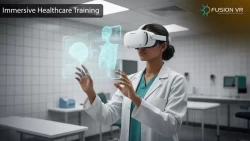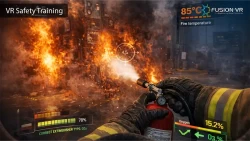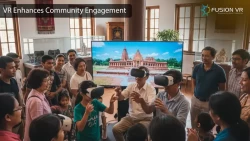

This is how big the educational sphere has become for the use of VR. Across the world, universities sport VR for an immersive learning experience with direct implications on enhancing engagement, retention, and hands-on understanding. But this itself is just a pilot. The hardest part is to convert VR training programs from isolated experiments into full-fledged campus-wide programs; this involves hard strategic decisions, cross-departmental collaboration, good infrastructure, and above all, a sound vision for the future.
The blog will talk about how universities successfully scale from pilot VR training programs to campus-wide implementations while sharing the opportunities, challenges, and best practices.
The Promise of VR in Higher Education
Virtual Reality offers students immersive, interactive, and simulated environments that can revolutionize the way learning and academic concepts are experienced. Be it the execution of complex medical procedures, simulation of engineering systems, visiting a historical spot, or Refining soft skills through scenario-based role play, VR has posed a controlled yet profoundly engaging learning environment. Hence, some advantages are:
- Greater engagement: Students are more likely to retain focus and motivation.
- Higher learning outcome: Immersive training ensures better retention of knowledge.
- Safe environment: Simulations for risky tasks or those that are expensive.
- Scalability of experience: VR content once created can be used across several departments.
Yet most universities usually start with very small-scale pilots, mostly limited to a lab or a department concerned. The ultimate question-Is it scalable?
Stage 1: Designing an Effective VR Pilot Program
Every successful campus-wide initiative starts with a well-planned pilot.
- Set clear objectives
The first step is defining the purpose of the VR training program. Is it to supplement a lab session, to forge virtual field experiences, or to replace exorbitantly priced real-world simulations? The objectives must be clear and measurable.
- Choose appropriate subjects
Start with programs that naturally lend well to immersive learning: medicine, engineering, architecture, archaeology, and psychology are all standard points of departure.
- Select scalable technology
Choose VR platforms and content that may be easily customized and integrated. Either go for open-source tools or well-adopted tools that will not fall into obsolescence in a short time.
- Create partnerships with VR developers
Partner with VR developers who are experienced in academic workflows. Custom solutions that are tailor-built in support of curriculum goals tend to do better in the long run.
- Engage faculty early
Professors and instructors need to be brought in from day one. Their input will help shape the content, delivery strategy, and assessment methods.
Stage 2: Measuring and Evaluating the Pilot
After the initiation of the pilot, the institution needs to collect data to determine if it is effective. The assessment should cover:
- Student engagement and feedback
- Learning outcomes versus those obtained from traditional methods
- Ease of use and accessibility
- Technical stability and support issues
- Deployment cost-effectiveness
Both quantitative and qualitative data are of equal importance. Pre- and post-training assessment results, usage logs, surveys, and/or focus groups will be used to derive constructive information about the program and provide the basis for future decision-making and justifications of funding when moving towards a greater scale of implementation.
Stage 3: Building Institutional Support for Scaling
A strong institutional commitment is required for a transition from a single VR lab to a bulwark of VR strategy operating in the university.
- Leadership buy-in
Present compelling data from the pilot to department heads, deans, and university executives, and align the initiative with broader institutional goals innovation in education, increase in student satisfaction, industry-readiness, and so on.
- Form the VR task force
A cross-functional team consisting of the IT personnel, faculty, curriculum developers, procurement, and student representatives shall be formed. This team develops rollout plans and tackles scaling issues.
- Set up a central VR hub/experience center
This dedicated VR center would be outfitted with devices and manpower trained in VR and support services, thereby ensuring that VR training is more accessible to all departments. It also serves as a platform for sharing knowledge and developing further techniques.
Stage 4: Infrastructure and Technology Considerations
Scaling VR is not just about content, also the hardware, software, and networks play a vital role.
- Standardize VR equipment
Choose headsets and systems that are affordable, durable, and easy to manage. Devices like Meta Quest, HTC Vive, and Pico are commonly used in academia due to their flexibility and support for enterprise deployment.
- Have the high-speed connectivity available
VR applications demand bandwidth and hence universities must guarantee that Wi-Fi and network infrastructure are robust enough, especially in labs and libraries where students may be accessing VR content.
- Develop a content repository
Set up a digital library storing VR modules classified according to subject, level, and usage type. This will allow faculty to quickly locate and select pertinent experiences for integration into their teaching.
- Improve LMS integration
VR training tools must be able to integrate with existing LMS platforms such as Moodle or Blackboard to record student progress, scoring, and participation.
- Train IT support and maintenance staff
Set up an in-house support team so that troubleshooting can occur immediately, installations and patching are done on schedule, and users can get guidance.
Stage 5: Faculty Training and Curriculum Integration
Faculty constitute the backbone of immersive VR integration.
- Conduct professional development workshops
The instructors will need training in the use of VR equipment, adapting their content, and facilitating sessions. Make the training an enjoyable experience by gamifying it.
- Develop curricula acceptable to VR
Work with instructional designers on embedding VR modules into the curriculum; every module should be related to learning outcomes and assessment criteria.
- Establish peer learning and collaboration
Those faculty who have implemented the package successfully may serve as mentors for others. A thriving community of practice should be created in which educators share resources, suggestions, and innovations.
Stage 6: Access and Inclusion of the Student Environment
Students ought to feel empowered and included in the VR learning ecosystem.
- Flexible Access Policies
An ideal setting is to keep the labs open for longer hours so students can use them outside of class. Allow a checkout system for any portable headset wherever feasible.
- Focus on Inclusivity
Ensure that the VR experience is made accessible for disabled students. That means providing subtitles for hearing-impaired students; audio cues for visually impaired students; and adjustable interfaces for anybody who might find that helpful. Consult with experts on accessibility.
- Create Interdisciplinary Experiences
VR is not just for STEM. Use it to teach literature storytelling, history reenactments, or business negotiation simulations. A diverse offering will make it more relevant and will encourage adoption.
Stage 7: Funding and Sustainability
VR interventions can be expensive, and the variations with which to get long-term success are diverse funding and concrete sustainable planning.
- Apply for grants and partnerships
Government grants, ed-tech partnerships, or industry collaborations are all options of consideration. Many of the tech companies do offer funding or the cheapest hardware for educational uses.
- Seek support from alumni and donors
Interviewing with the target of illustrating the novelty and the potential of VR programs to prospective donors will attract alumni donations through some mechanisms such as naming rights for VR laboratories or sponsoring VR modules.
- Regular budgeting
The University shall stop treating VR as an afterthought because it should be embedded into retention and growth activities within the University IT budget as well as in the academic budget.
Stage 8: Monitoring and Continuous Improvement
Scaling VR training never proves a one-time project: Continuous evolution is necessary.
- Feedback cycles
Analytics and student/faculty feedback facilitate further refinements to the experience. You need to determine if any modules are seldom used or voiced as a source of much frustration.
- Update content at least once during the lifecycle of a VR project
VR technologies are ever-changing. This would enable content to stay relevant and fresh.
- Benchmarking and research
Engage in academic research for publishing the outcomes and learning from peer institutions. In return, this enables the body of literature on VR in education to grow, thereby boosting credibility and attracting more collaborators.
Conclusion: Creating a Future-Ready Learning Environment
There are certain moments amidst any scaling process of VR training programs from pilot to full campus-wide implementation wherein challenges have redirected the path. However, appropriately planned with inclusionary policies and with an attitude toward nurturing innovation, universities can transform learning for the better spirit of rendition. A VR provides such immersive power that students become prepared to pass their exams, apply the knowledge learned, think critically, and confidently perform in the outside world.
Therefore, for universities that want to future-proof educational offerings, Virtual Reality is increasingly being transitioned from an experimental concept into a necessary evolution. The need to scale is now.