
Across the world is a silent revolution going on, changing the act of preserving, presenting, and conjuring cultural institutions. At the center of it all lies a synergy of power between Virtual and Augmented Reality (VR and AR). The two technologies, far from mere enhancements to the museum experience, are in fact shaping a whole new identity for museums.
From intricate ancient artifact 3D models to immersive walkthroughs of long lost civilizations, digital museums are using AR and VR to tell stories that would never have been possible otherwise. But what really happens backstage to mount these high-end experiences? Let us explore deeper into the interesting world of how interactive museums build dynamic exhibits through the use of VR and AR technologies.
The Evolution of Museum Storytelling
Traditional museums have usually engaged visitors through real artifacts, static descriptions, and linear methods of storytelling. Powerful in their own right, they bore limitations. Such as: lacking context, being highly interpretative, awesomely linear-based, and minimized interactivity. As the expectations started to shift (now more so with digital-native youngsters), curators were now wanting new ways to make museum experiences relevant, engaging, and interactive.
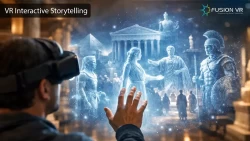
The findings were caused because AR and VR were being brought into the museum scene, thus providing the museum curators with new means of storytelling beyond physical considerations. Step into the virtual Roman Forum, see exploded 3D views of a centuries-old sculpture, or expose a painting’s hidden layers on your tablet. This leap into dynamic, multi-sensory storytelling came from a complex matrix of digital artists, historians, technologists, and curators.
Phase 1: Conceptualization and Narrative Design
At the epicentre of every successful AR VR museum experience lies a captivating narrative. There could be the story of a vanished culture or the ascent of industrial age machinery-the aim is to invoke an intellectual and emotional visitor journey alongside it.
- Curators undertake the task of narrating. This involves:
- Choosing the things or events on display
- Defining the educational purpose behind the exhibit
- Deciding on the degree of interactivity appropriate for the audience
- Determining how AR or VR will make the understanding easier
There is a procedure of checking content with subject matter experts including historians, archaeologists, and scientists for ensuring it is accurate and authentic. Storytelling has to strike a balance among factual depth and showcasing an experience: too technical becomes dull; too much gamification impairs educational value.
Phase 2: Digitization and 3D Scanning
After plot development, digitization follows. Using technologies such as photogrammetry,and other 3D scanners like FARO Scanner, curators and technicians create highly accurate 3D models of the artifacts, works of art, or architectural elements. These models thus constitute the digital base of both AR and VR experiences.
- Photogrammetry obtains high-resolution images from several perspectives and stitches them into 3D textures.
In some VR museum experiences, entire architectural spaces, such as temples, forts, or palaces, are recreated at scale so visitors can explore these places as they once stood hundreds of years ago.
Phase 3: Content Development and Immersive Layering
This is magic. Once the 3D assets are deemed ready, the developers and designers begin layering immersive content with tools like Unity, Unreal Engine, and AR SDKs. Some activities:
- Animations are integrated to show how machines worked or buildings evolved over time.
- Voiceovers, subtitles, or historical dialogues are added for guided storytelling.
- Interaction is created with the use of touchpoints or gaze triggers.
- Contextual information, timelines, or maps are embedded for deeper understanding.
Users point their devices at a real painting in an AR experience to see it come alive with audio-visual overlays. They may put on the headset to walk through a digitally reconstructed battlefield or an ancient city in the VR exhibits.
Special attention is paid to making sure that these layers do not overshadow or distract. UX experts test the interfaces for intuitiveness, accessibility, and learning outcomes. The goal is to augment the visitors’ experience, not replace it.
Phase 4: Curating the Physical-Digital Hybrid Space

And yet, there are exterior factors on which great digital experiences cannot thrive. Corporate experience centers and museum spaces are designed with thoughtfulness and creativity in energizing the seamless marriage between physical and virtual.
Some considerations include:
- Space layout for VR areas that accounts for safety and motion clearance
- Placement of AR markers or QR codes near physical artifacts
- Using large projection screens, holograms, or motion sensors
- Acoustic treatments for multi-sensory storytelling
These developed spaces are not mere tech installations—they tell stories. Lighting and soundscapes, alongside scent diffusers, are used for transporting visitors to different timelines or cultures.
Phase 5: Testing, Calibration, and Iteration
Before publicly launching, every AR VR museum experience undergoes rigorous testing:
- Usability testing with sample audiences of different age groups
- Performance testing on devices to avoid lags or overheating
- Calibrating the AR accuracy under varying lighting conditions
- Making sure VR experiences meet comfort standards and do not cause motion sickness
Depending on the feedback, developers proceed to iterate on the content, remove bugs, add more interactivity, or even refactor some sections. Such processes may sometimes also be undergone after the launch whenever museums continue to gather insights through actual visitor behavior.
The Impact: From Passive Viewing to Active Exploration
Because of all that goes on backstage, the experience is transformative for actual visitors. AR/VR has served museums well by:
- Engaging with visitors so that they stay longer and actually remember the occasion
- Simplifying the abstract or complicated concepts
- Appealing to a younger generation of tech-savvy individuals
- Enabling virtual tours of the exhibits from elsewhere
- Stimulating the interest to conserve culture and heritage
It is almost an oxymoron at this stage that a visitor is described as a passive observer. There is a curated digital journey they participate in. They access the digital past and digital present through AR overlays; they step into a historical simulation of their own by means of VR.
Success Stories and Innovations in India
Digital museum transformations have been in a boom phase across the length and breadth of the country. Fusion VR, a reputed virtual reality and augmented reality company has been instrumental in bringing immersive museum experiences to the various parts of India. This firm has kept Indian institutions in the modus of preserving their legacy in the contemporary sense: from providing VR experience centers inside cultural museums to curating mobile-based AR heritage walk journeys.
The immersive experience at Kalaignar 7DX Simulation Pavilion in Chennai can be cited as an example combining a 12K stereoscopic screen with surround sound and multisensory effects to revolve around a very powerful narration on a leader’s life. This model exemplifies how a VR museum experience can combine storytelling that really touches people with top-of-the-line technology.
The Museum Experience Centers by Fusion VR fuse industrial-grade 3D simulation with gamified AR content to make learning an adventurous exploration.
The Future of Digital Curation
As AI, spatial computing, and haptic technologies keep evolving, the technologies in museums will become more dynamic and personalized with time. Some of the upcoming innovations are as follows:
- AI-driven virtual guides that deepen adaptation of narrative based on visitor questions
- Haptic suit and gloves for touch-based interaction in VR
- Mixed reality exhibits that merge physical props with digital overlays
- Blockchain authentication for provenance and artifact data
Soon visitors would be analyzed on their interest and behavior, and based on this real-time, exhibit layout or content would be changed. Museums would, therefore, stop merely displaying culture and commence co-creating it with the audience in real time.
Final Thoughts
The digital transformation of museums is not just a simple matter of graphics and tech gimmicks. It is about rebirthing the soul of storytelling, preserving cultural authenticity, and providing the ambience for immersive, intuitive, and inclusive learning. With more institutions welcoming institutions interfacing with AR and VR, the possibilities are limitless.
Behind every breathtaking exhibition is a group of visionary creators trying to weave history with technology, art with code, and culture with interactivity. These invisible architects of interactive museums are not merely curators of the past-they are pioneers of our shared digital future.